Carrying Jerusalem Consciousness

I have been taught that there are two kinds of people in the world: those who think there are two kinds of people in the world and those who don’t.

The Jewish text known as Pirke Avot (The Ethics of the Fathers) likes to categorize people in a variety of interesting ways. It speaks of seven characteristics that typify a wise person (5:9), four character traits among people having to do with open- or closed-fistedness and tzedakah (5:12, 5:15), four kinds of temperaments (5:13), and four types of students (5:14, 5:16, 5:17).  Just from these categories, you notice that what is valued is study and charity/righteousness (tzedakah).

What Pirke Avot noticeably does not do is categorize people on the basis of God belief. This is because for Jews behavior, not belief, is what counts.

However, my riff on all of this is that there are two kinds of people in the world: those who believe in signs and those who don’t. You might think that there is a third category, as well: those who sometimes believe in signs, but these folks really belong in the first category; they are non-committed believers.

I fall into the believing category.

As a committed student of Mussar (a Jewish spiritual practice in which one cultivates soul-traits called middot), I have to fall into the believing category. The whole spiritual thrust of the practice is to understand that an obstacle is placed in my path in order to teach me something and help me grow. With practice I learn which soul-trait/middah I need to call upon and cultivate in that situation — whether it be faith, patience, generosity, humility, compassion, etc.

Who else is placing the obstacle and wanting me to grow if not for God?

So, yes, I believe in signs.

Those of you who know me also know that I have a bad back. In 2001, the pain left me suicidal.

When the pain left, however, I learned gratitude, a real overflowing tears-of-thanksgiving, O-my-God, I’m-in-love-with-the-world kind of gratitude, and a gratitude for the community of people who had helped me through — those who did my laundry, brought me food and medication and company, as I was on the top floor of a fifth-floor walk-up.

My immediate take on the situation was that God had purposefully “zapped” me with pain in order to teach me gratitude in a way I had never understood it before. S/He looked down at a very capable but very selfish woman and said, “This woman needs a lesson or two. Let’s start with gratitude.” And ZAP! And from there (though I was already a rabbi in the world) my real, authentic spiritual life began.

My friends and colleagues argue with me about this theology of mine. Some of them even snicker, I imagine. But it is my theology, certainly not one I impose on clients who come for spiritual counseling, but the one I hold for myself. It even has a name: issurim shel ahavah (challenges of God out of love) .

So when I came home to New York from Jerusalem, trying desperately to hold onto my “Jerusalem consciousness,” it took THREE obstacles/signs for me to realize that God was telling me something. My head was still in the clouds, I wasn’t looking for signs yet.

  1. My windshield cracked last Friday.
  2. My back went out on Monday.
  3. The pipes burst in our Massachusetts home (apparently on Friday, but we didn’t find out until Monday — after my back went out).

And the remarkable thing is that I was unusually equanimous about all of them. My Jerusalem spiritual consciousness had permeated my physical reality/the world of assiyah, to such an extent that I wasn’t undone by any of them as I would have been before our Jerusalem trip. I pretty much kept it all in perspective.

My challenge moving forward is this: How will I keep my Jerusalem consciousness alive so that the physical obstacles of life can be handled with equanimity and grace into the future? Will I be able to continue honoring the spiritual strides I’ve made?

So, I believe that that’s what God was telling me: there IS a way to handle day-to-day obstacles with equanimity and grace. S/He was testing me, showing me how far I’d come.

First the cracked windshield, a relatively minor inconvenience. Passed the test. No real biggie, but a great metaphor. (As Leonard Cohen sings, “There is a crack in everything. That’s how the light gets in.”)

Then the pipes, a bigger headache. Of course, we didn’t get the message before Shabbat, so we flew through the weekend without a care (except for Chaim being sick).

Since we didn’t get that message, what next? Hmmm. Another sign: my back. Now that is a scary one. Every episode harbors fears of excruciating, suicidal pain, the potential of back surgery, utter misery and depression.

But even this time, I responded with uncommon calm: called the physical therapist and asked if I could see him without a prescription from my orthopedist. Yes. Took my pain meds. Didn’t panic/project.

Then we received the news about the pipes. Chaim at first refused to believe the news since the source (our crazy neighbor) was suspect. But then we had confirmation, and Chaim went up to the house (a five-hour bus ride while sick — his car was sitting in MA since leaving for Israel, and I had to work and needed my car) to deal with it — insurance adjustor, plumber, cleaner. He, too, not typically an administrative maven, handled it all with aplomb, relieving me of any additional stress.

Some people get to this level of equanimity with meditation, some with prayer, some with Mussar. I counsel people on how to use these spiritual interventions all the time. (It doesn’t mean I myself have perfected them!) This time, I got there primarily with the help of Jerusalem consciousness, which is probably a combination of all of the above, and then a little extra mystical something.

I will add “think Yerushalayim l’maalah, the Jerusalem of the spiritual upper spheres” to my list of spiritual interventions.

May I be privileged to call upon this Jerusalem consciousness and benefit from it as future obstacles/nuisances/curveballs inevitably come my way.

Today is Rosh Hodesh (the new moon) of Adar. Tradition teaches that “When Adar enters, joy increases!” May it be!

Chodesh tov — wishing you a good month.

February 11, 2013/1 Adar 5773

Aliyah and the Rude Yeridah Awakening

When one receives the honor of blessing the Torah before and after one of the readings from it, that honor is called an aliyah, “going up.” The “going up” refers to Zion — Ki mi-Tzion teitzei Torah u-d’var Adonai mi-Yerushalayim — “Out of Zion came Torah and the word of Adonai from Jerusalem”. So merely being close to Torah is akin to ascending to the holy city of Jerusalem, and therefore being close to God.

Likewise, the word aliyah is used to describe the actual process of going to Israel or moving to Israel, as in “making aliyah.”

Aliyah has its shadow self. Leaving Israel, or moving away from Israel, is called yeridah. It has a pejorative connotation in modern parlance. Yordim are Israelis who have settled in the Diaspora. Considering the fact that the Diaspora is considered Exile/Galut by traditionalists, it makes sense that anywhere other than Israel would be considered a spiritual descent.

My yeridah this past week was a rude one. My heart was still in aliyah, my body in yeridah.  Amichai’s poem (included in full in my last post entitled “My heart is in the East”) really speaks to me — I’m like a migratory bird without my bearings on summer and winter.

And so it was that Chaim and I were to spend our first Shabbat back in the Diaspora after four remarkable Shabbatot in Jerusalem. Not only is he still on Israel time, up all night and barely sleeping days either, but he has gotten sick as a result. Nonetheless, it was clear that we were going to go to synagogue last night (why break a perfect four-week record now?). And while it wasn’t clear at first, it soon became clear — we were going to be attending an Orthodox synagogue.

What you need to know about most synagogues in Jerusalem, including non-Orthodox ones (and I assume this is the case elsewhere in Israel, as well) and about Orthodox synagogues in the Diaspora is that you go off to synagogue on Friday evening as soon as the Shabbat candles are lit. In winter that means 4:30 or 5:00 PM, in summer much later. Liberal Jewish congregations in the U.S. don’t generally take sundown into account to set the time of Shabbat evening services — a Friday night service might be 7:30 or 8:00 PM year-round.

What this meant for us was that the only way to retain our sense of aliyah-consciousness, of keeping Shabbat in the way we’d grown accustomed in Jerusalem, was to go off to synagogue as soon as we lit our Shabbat candles at 4:55 PM. And that would mean attending an Orthodox synagogue.

We have several to choose from in our neighborhood, all walking distance, but the obvious choice was the Hebrew Institute of Riverdale, made known by its controversial rabbi, Avi Weiss — either reviled or beloved, depending on whom you speak to. He is the founder of a liberal Orthodox yeshiva, Chovavei Torah, that has come under scrutiny from the right-wing of the Orthodox world, who won’t allow Chovavei Torah ordinees to join their rabbinic union (or to place for jobs in their congregations). Avi Weiss is also considered suspect due to the fact that he ordained Sara Hurwitz (who happens to live in our building) as a rabbah, making her full-time clergy at the congregation.

But as much as I hoped that HIR (affectionately called “The Bayit/Home”) would make me feel like I was at Shira Chadasha, the wonderful Orthodox singing congregation we attended in Jerusalem, it didn’t. Yeridah had hit my soul, not just my body.

And then, to top it off, Chaim and I had our first (albeit petty) fight in over a month. We had really, really descended from on high, on all levels.

This morning, we decided to try a different Orthodox synagogue a four-mile walk away in Yonkers, served by my new friend, Rabbi Manny Vinas from Cuba. I met Manny just on Thursday when he came to my agency to speak about Jews of color as part of our belated Martin Luther King Day commemoration, and I was giving the closing remarks and prayer. We hit it off, I knew Chaim would also really like him (in part because Manny is so very critical of Chabad in the same ways that Chaim is). Manny told me that once he needed a minyan/a tenth man for the quorum, and a messianist Chabadnik walked in (one who believes that the deceased Rabbi Menachem Mendel Schneerson/the Lubavitcher Rebbe is the messiah) — noticeable because of a distinctive head covering as well as a yellow crown pin they wear representing the Messiah. Manny refused to count him in the minyan — remarkable!

It was a bitter cold morning this morning, in the 20’s, and we bundled up, ready to go, when I realized that Chaim really wasn’t well enough to go out in the cold, let alone to walk four miles to shul in each direction. So I went by car by myself. I got a little of Jerusalem back there, but not enough to sustain me for the long haul, I’m afraid. Manny did make me promise to give the d’var Torah next time I come, and he gave me a big public welcome, which was quite lovely. He is one of the inclusive and pluralistic rabbis of the Orthodox world, as is Avi Weiss.

For anyone who may be wondering if I have either dispensed with my feminist principles by attending a non-egalitarian synagogue or given up on my Reform identity, not to worry. I’m just in an exploring place vis-a-vis synagogues, playing ethnographer and dilettante and spiritual seeker, all in one. I am sorry Chaim and I didn’t explore some of the small little synagogues in Jerusalem — Turkish, Iraqi, Persian, Syrian — where I know the music would have been new and different, and all would have been Orthodox. I am more open to exploring the “all that is” in the Jewish community.

Since we don’t have a home congregation yet in Riverdale, we don’t feel bound anywhere for the time-being, except by distance (since Chaim will not drive on Shabbat, we can only go places that are walking distance, if we go together). So explore, we can, and explore, we shall…

Tomorrow is my 53rd birthday, actually only 30 minutes away… There is nothing mystical about the number 53, no way for me to redeem aliyah-consciousness through gematria as far as I can tell (unless any of you can offer me a possibility).

So here is Ari Elon’s interesting take on aliyah and yeridah. My prayer for my birthday is that I create God for myself and take off with her for my rooftop in Pampamina-land.

“Everyday I make myself come down from my rooftop, which is Pumbedita, to the land of Israel. This is the sum total of my present Zionism, told on one foot. My frustrating first exile made me dream of going up to the land of Israel (aliyah); the exciting power of my second exile makes me come down to the land of Israel (yeridah). No one can stand such enormous power as Pumbedita’s for any length of time. We need our national home as a place to come down to — and to come down in — so that we can once again take off skyward with renewed strength. My first exile was the direct result of the death of my childhood God who had created me in His likeness and image. My second exile is a living testimony to the birth of the God that I am creating in my likeness and image. Every day I create God for myself in my image and take off with Her for my rooftop in Pumbedita.” (Ari Elon, From Jerusalem to the Edge of Heaven: Meditations on the Soul of Israel, p. 19)

23 Shevat/February 2, 2013
My Heart is in the East

My heart is in the east and I in the west of the west: so how
Can I savor sweetness, taste any food, or even call it mine?
How can I make good my vows, my pledge, with Zion now
Held by the crusades of Edom, and me in Arabian chains?
The burden would be light to leave behind all ease of Spain
To see that mighty light, the simple dust of our Ruined Shrine. 

(Judah ha-Levi, 12th C.)

***

My Body is in the East, My Heart in the Extreme West

The land knows where the clouds come

from and whence the hot wind

Where hatred and whence love.

But its inhabitants are confused, their

heart is in the East

And their body in the far West

Like migratory birds who lost their summer and winter,

Lost in the beginning and the end, and

they migrate

To the end of pain all their days.

(Yehuda Amichai, 20th C.)

sabra
Native-born Israelis are called Sabras, for this cactus that is prickly on the outside and soft on the inside

***

I know that our friends Nancy and Mark have been reading this blog. We spent New Year’s Eve with them a year ago, and when they told us that they were thinking of making aliyah/moving to Israel, I (basically) said, “WHAT?! Are you CRAZY?”

Let me eat my words now. It is not crazy at all.

For a moment, leave aside the socio-economic and political realities and difficulties of Israel. Imagine instead what it means for a practicing Jew, living as a minority wherever you live in the Diaspora, of coming to a place that reeks of things Jewish, that revolves around the Jewish calendar, whose very street names remind us daily of our centuries-old history. Even a secular Jew lives a Jewish life in Israel. Shabbat is not just another day — the whole week revolves around it.

Or think of those Jews who came to Israel not for spiritual/religious reasons, but for sanctuary. I think of Malka, my kibbutz roommate. She was then a 16-year old girl from Ethiopia who had trekked through the Sudan to make it to Israel, leaving behind her family for a better life — for life itself. She cried herself to sleep every night, and I didn’t know how to help her. I just knew that while I was on kibbutz to learn Hebrew and return to college in the U.S., she was on kibbutz to learn Hebrew and make a new life in Israel as best she could.

When I lived on that kibbutz in 1981, I was pretty sure that I would make aliyah one day. What a high it was to run through the forest there, past the kibbutz cemetery, to reach the top of the mountain and view the entire Jezreel Valley stretched before me. Reading the Bible, knowing the ancient history that took place in that place, in those long-ago days, feeling part of a long chain of longing to be in that place, that historic land.

When I returned to the States after that stay, I stopped running. After graduating from college and moving to Santa Cruz, CA, I tried again, but the gorgeous beach along the Monterey Bay was no match for the mountains above the Jezreel Valley. It wasn’t the same high, connecting the physical with the geographical with the spiritual.

And then in 1982, the news of Sabra and Shatilla hit me with all its horror, and my illusions about Israel were punctured. I was in true crisis then, joined a writing/theatre group comprised of other disillusioned lovers of Israel, and wrote out my love, my pain, my longing. Our readers’ theatre group was a lifeline and also a hornet’s nest of dissension. There were members to the left of me who questioned the very existence of Israel as a Jewish state. What I wanted to do was to hold the principled middle, to work from within, as a loving critic. All of those debates made their way into our writing and our performances.

But in 1985 on a return trip to Israel with an interfaith peace group that presented mostly the ugly of Israel, I disengaged completely. (Here I was, someone connected to Israel whose disappointment was so great that I had disengaged. What about those who never engage in the first place?) It was so traumatic that I had a hard time returning to Israel for my year in Israel for rabbinical school in 1988 and tried to place out of my first year there. But go, I did, and despite my mother’s death during that year, I re-engaged, and fell in love again with the land and people of Israel.

Perhaps it is not a coincidence that I fell in love with and married a man with his own complicated history with Israel. His hinges most deeply on religion and family issues, with politics in the background. While I had been back to Israel three times since my rabbinical school year (not including this visit), Chaim had not been back at all in that same time period. Even in his last visit in the 80’s, he had not visited his mother’s grave as it held such painful memories.

So this trip was redemptive for him, for me, and for us as a couple. I wanted to see Kfar Chabad, where he grew up, with which he has a love-hate relationship. Accomplished. And to stand by him as he visited his parents’ and grandson’s graves. Accomplished. And to know that he made contact with his sister. Accomplished.

None of this is to imply that aliyah is in the cards for us. It’s not. But it was important for me to reconnect to that innocent place of first love and infatuation with Israel and to hold that alongside my adult engagement with realpolitik. 

Writing daily has been an incredibly important spiritual experience for me and helpful as a way to chronicle my time in Israel.

Perhaps it has encouraged those of you who’ve never been to Israel to think about going, to  experience Israel firsthand, not only through the news reports. Israel is not the sacred cow of the right which can do no wrong, nor is it the devil incarnate that the far left might paint. It is, as my friend Ronnie wrote in a comment to my blog, “that complicated, impossible, and necessary homeland that is Israel.” Its very imperfection calls to us to respond, to engage, to commit.

On Saturday, February 9, Chaim and I will be reflecting on our trip after services at CBI in North Adams, MA. Please come!

A number of people have encouraged me to continue this blog. If you are one of them, please let me know if you are particularly looking for something that would be Israel-centered or, if something else, what?

Thanks for reading!

17 Shevat/Sunday, January 27, 2013, Riverdale,  NY — AKA “the Far West”

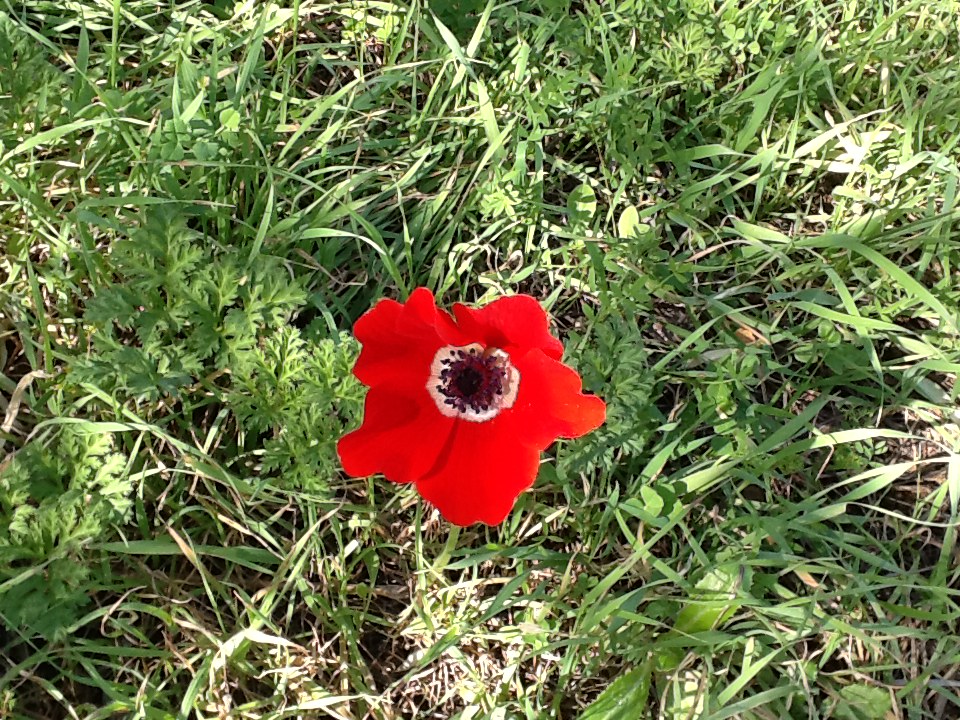
poppy

Shavua tov (4) — leaving Israel

We are leaving in about an hour and a half for the airport. I am very sad, not at all ready to leave.

We had a lovely final Shabbat — Friday night services at Kol haNeshama (where I again ran into visiting rabbis from the US whom I know), dinner (and Tu B’shevat seder) with Rabbi Arik Asherman of Rabbis for Human Rights and his lovely family. Arik’s in-laws and Chaim sang the whole night long, trading songs. This morning we returned to Shira Chadasha (the feminist Orthodox community) for a final hit of their incredible singing. I have their CD so that I can learn some new melodies to remind myself of Jerusalem.

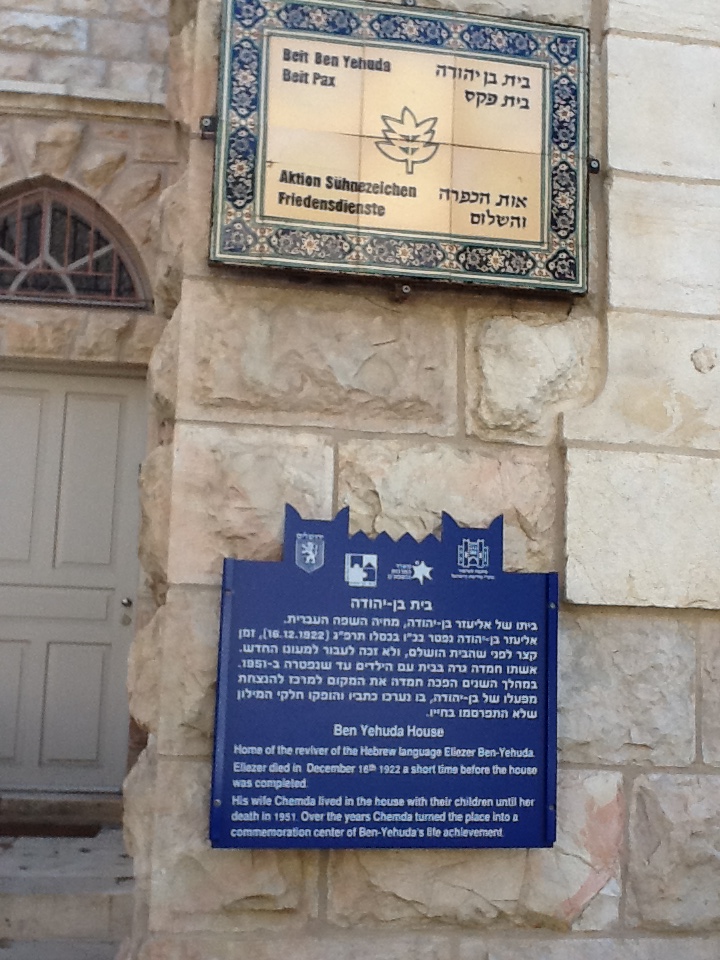
This afternoon, Chaim and I walked to Bili and Mats’ to say our final good-byes. On the way, we stopped at the Eliezer Ben-Yehuda house, just a block or so away from them. Eliezer Ben Yehuda is the man who revived Hebrew. As I understand it, he was quite fanatical about it, not letting his son Ben-Zion speak any other language than the one his father was creating and teaching him. Ben-Zion (Ben-Zion Ben-Yehuda was his name!) was therefore the first native Hebrew speaker.

eliezer ben yehuda

Historical sites around the city have these blue signs

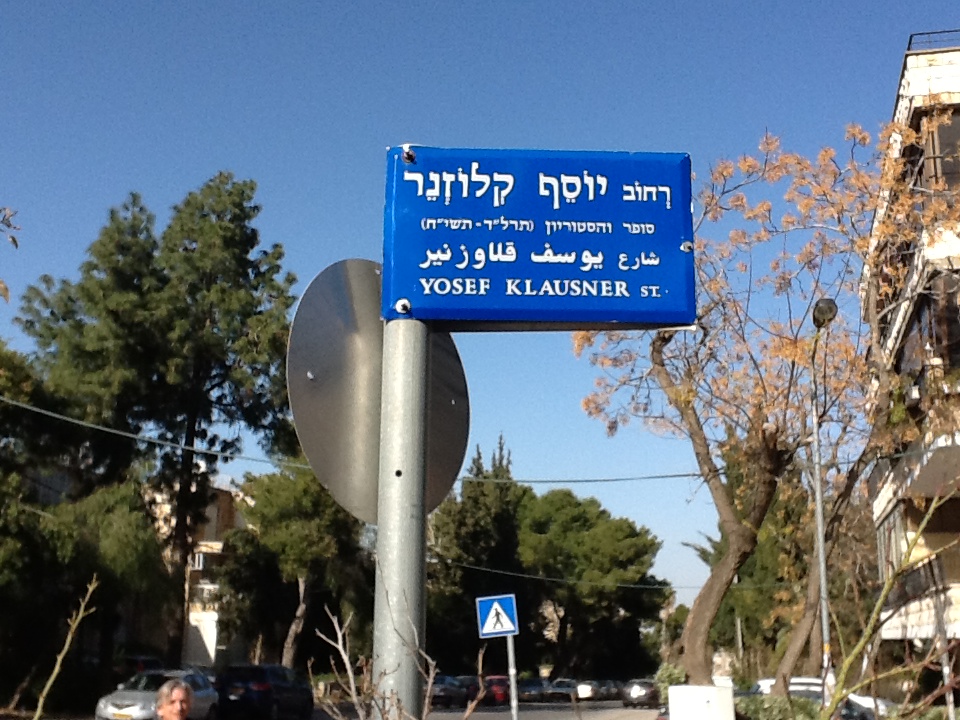
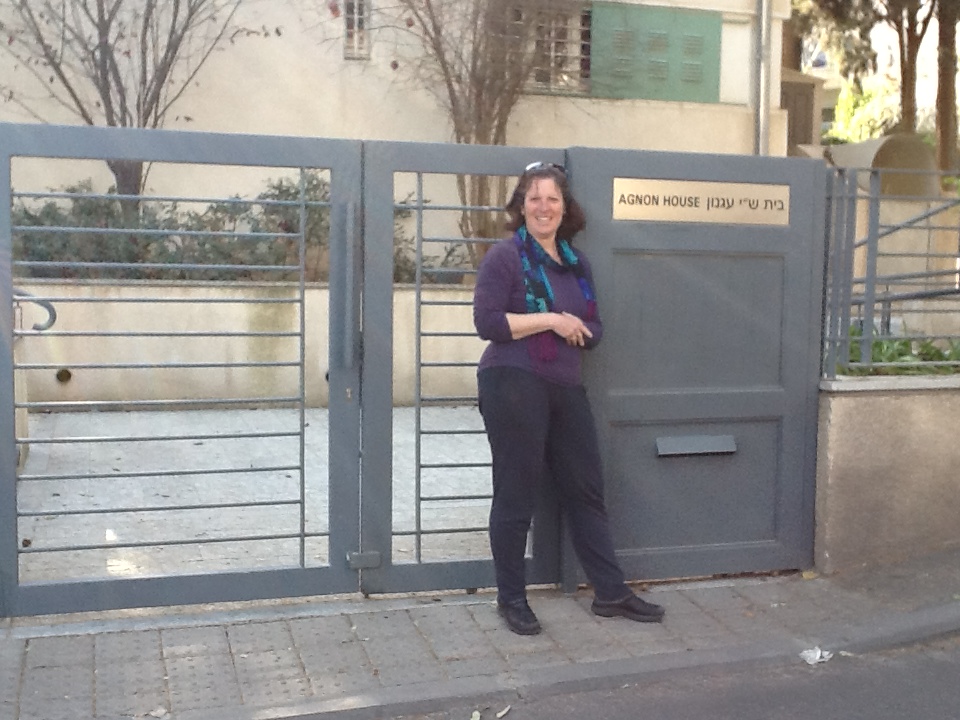
Around the corner from Mats and Bili’s on the other side is Agnon’s house. Shai (Sh. I.) Agnon, winner of the Nobel Prize for Literature, did not get along with his neighbor Yosef Klausner, who happened to be Amos Oz’s uncle. (Amos Oz is another famous Israeli writer.) Though Oz and Agnon did meet once, apparently it could not be a closer relationship because of the enmity between Agnon and Klausner. The bigger irony is that Agnon lived on a street named for Oz’s uncle, Yosef Klausner Street.

Klausner St

agnon houserimonim:agnon

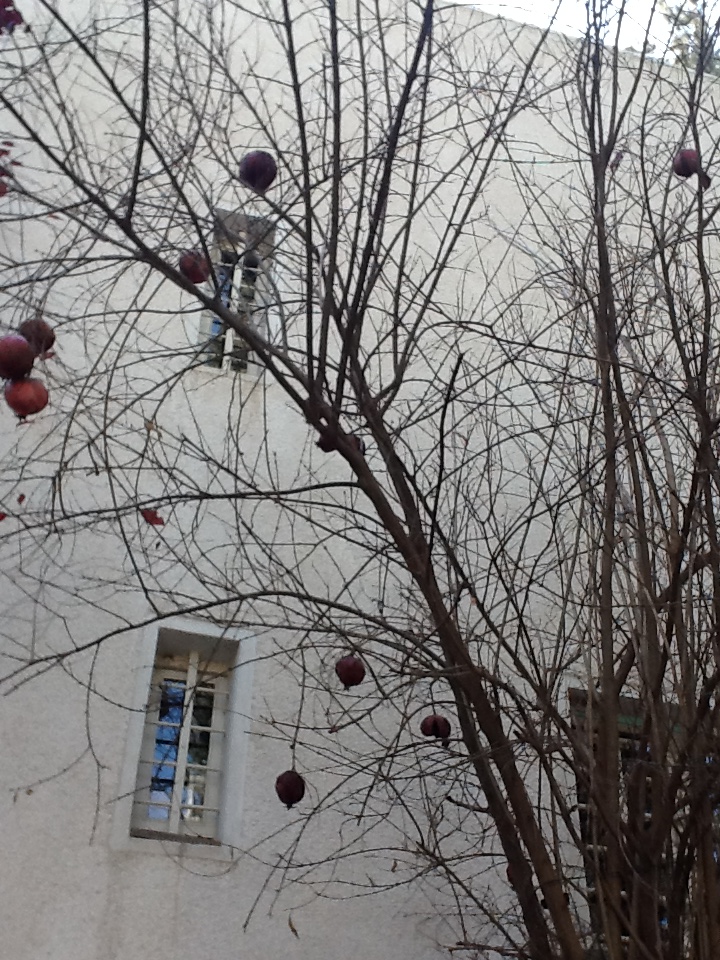
Me in front of Agnon’s house, and pomegranates on Agnon’s front tree!

Note, too, that Agnon’s house is Bauhaus style, one of the rare Jerusalem buildings that is not made from Jerusalem stone.

bili, mats, hunter

Bili, Mats, Hunter

When Chaim and I got home from our walk and visit with Bili, Mats, and Hunter (their dog), I realized that I had left my phone there! Though she’s not a therapist, Bili’s brilliant analysis when I called her from Chaim’s phone was, “You really didn’t want to say goodbye, did you?”

We were fortunate to have Bili with us for Havdalah (aptly meaning “separation”) when she dropped off the phone.

havdalah

Making havdalah

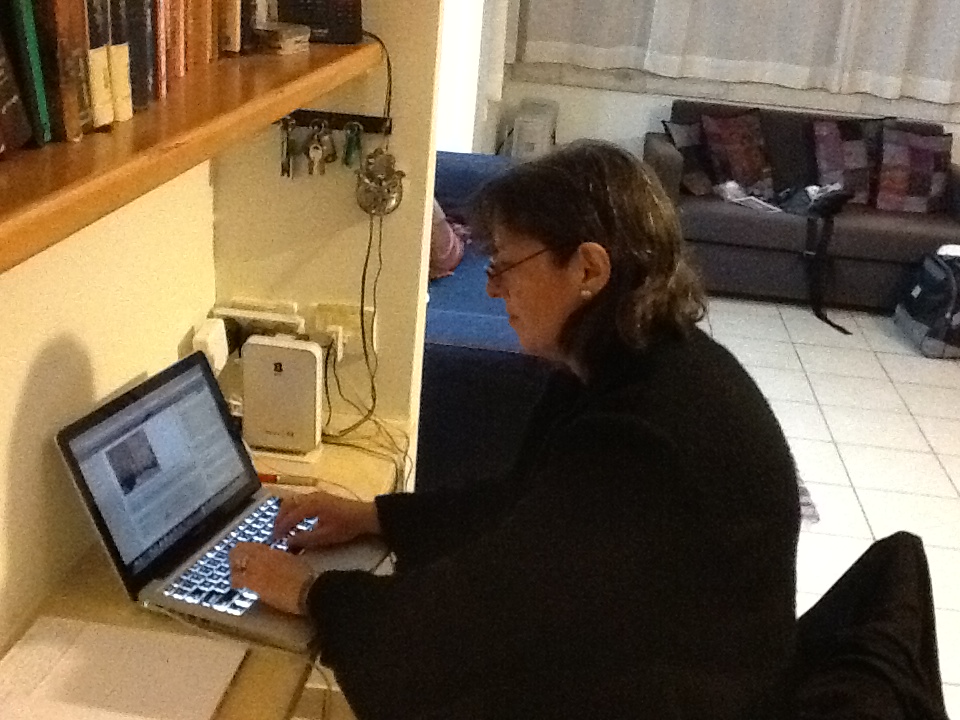
And here I am, blogging away, as a way to stay my anxiety before the flight. I plan to send one more post when I return to the States after processing it all, so stay tuned!

blogging

The blogger at work

16 Shevat/January 26, 2013

Mitzvah messengers and beggar blessings/Shabbat shalom (4)

There is a Jewish custom called shaliach mitzvah/messenger of a mitzvah. When someone tells me that they are going to Israel, I give them a little shaliach mitzvah money. In commissioning this person to be a messenger of a mitzvah/a good deed, since the money is to be used for tzedakah/charity in Israel, I am thereby insuring that they will be safe on their journey. “Insuring” as in buying them insurance, prayerful that anyone on a sacred do-good mission will come to no harm.

So it was that a few people knew to give me shaliach mitzvah money for this journey. I felt protected; I had a holy mission. Those shekels are long-gone, but that hasn’t stopped me from giving to every woman beggar I have encountered, and a few men, as well.

I give to women, in particular, to honor Sora. I jokingly call Sora “my imaginary friend,” but she is really my muse, my Jiminy Cricket, my conscience. I first read about Sora in a yizkor bucher/a remembrance book from Bedzin, Poland. She would carry around a bundle of rags and beg from the community for her “baby.” I have carried that image of Sora around with me for thirty years and written poems and stories about her. And when my heart is closed to beggars, all I have to do is imagine the Sora in them which then opens my heart, my hand, my pocketbook.

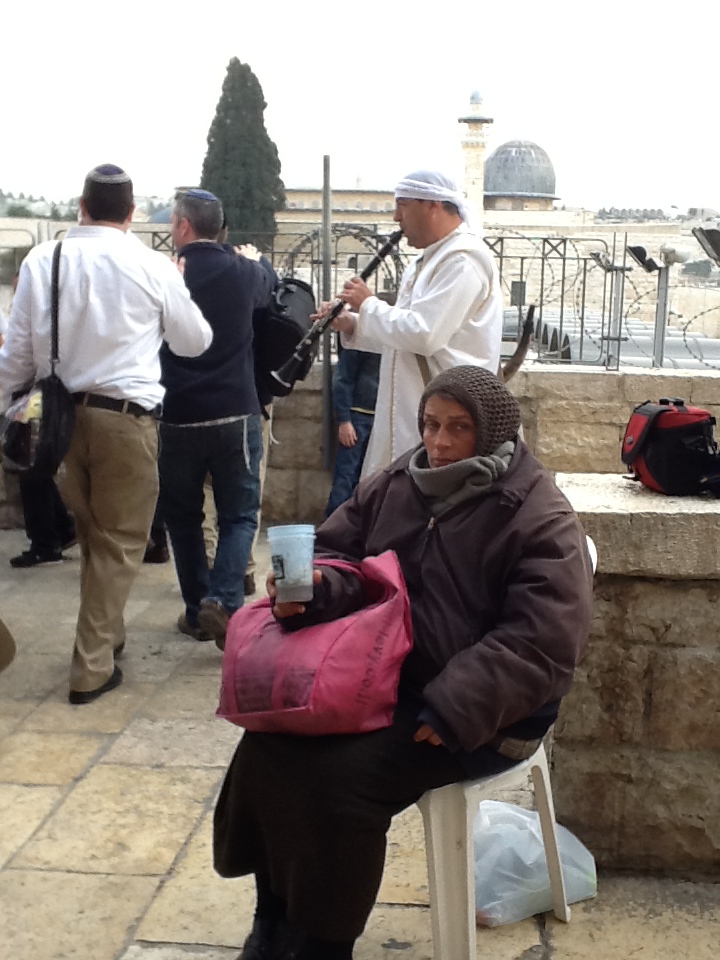
Here is a picture of one of today’s Soras with her outstretched cup. Behind her a bar mitzvah celebration is taking place with some klezmer musicians. The Wall is just down and off to the left.

beggar

Friday is the best day for a beggar to beg in Jerusalem. They are out in full force then, asking for money so they can make Shabbos.  They stand in the pavilion outside of the Wall (though I understand that they were banned from soliciting at the Wall itself about 2-1/2 years ago), or on the stairs leading from the Wall to the Jewish Quarter of the Old City, or they stand outside of the Mahane Yehuda market or along Yaffo Street. In fact, it’s nearly impossible not to encounter a beggar in Jerusalem. They hold their plastic cups and bless you — copiously. Though one shouldn’t do a mitzvah for the sake of a “payback,”  it doesn’t hurt that I receive a string of  blessings in return for my shekels — that I should have a long life, love, good health, a loving family, etc., etc. I know there are scam beggars in Jerusalem, some “fake rabbis” who do blessings for a donation, but even so, what could be bad about a blessing, even from a non-rabbi?

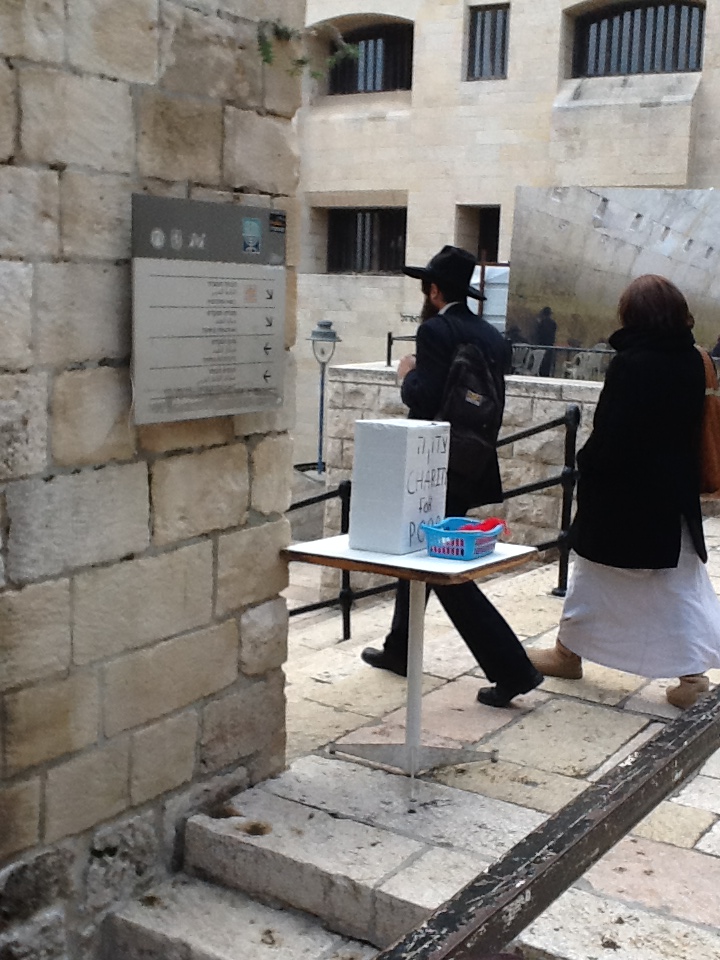
In the Old City, some tzedakah boxes stand independently of a human being. Here is one on a table on one’s path down to the Wall that also has a “payback” for a donation — a box filled with red strings. To wear a red string around one’s wrist as a talisman is supposed to ward off the evil eye. At least that’s what Madonna and the Kabbalah Center seem to think.

charity box

Chaim and I were supposed to go to the West Bank today to help Rabbis for Human Rights plant 200 trees. This is their yearly Tu-B’shevat (Jewish Arbor Day) project —  to help replace trees that Israeli settlers have vandalized or uprooted from Palestinian land. However, after two days of travel, we were just too exhausted to go. And today was my last day to do any last minute gift shopping (now thankfully accomplished) and to explore some more hidden wonders in the streets of Jerusalem. I feel terrible about not joining in this important justice project with my physical labor, but we will make a donation instead. We will also hear about it tonight, since Rabbi Arik Ascherman of RHR invited us to share Shabbat dinner/Tu B’shevat with his family this evening.

Chaim and I walked new ways to and from the Old City. Here are a few shots of our journey.

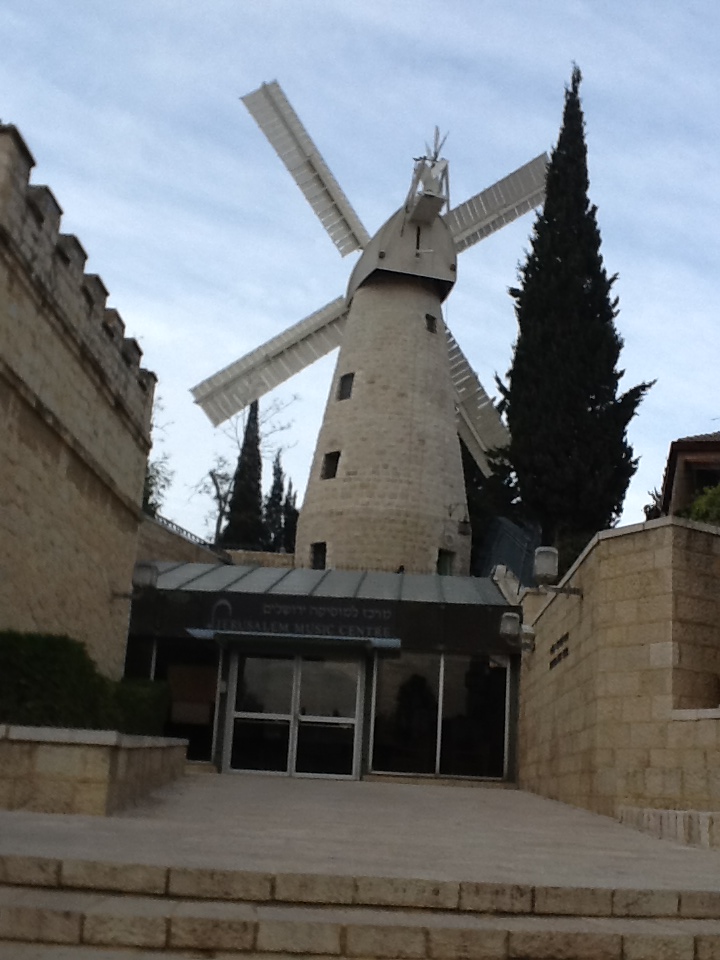
yemin mosheYemin Moshe windmill

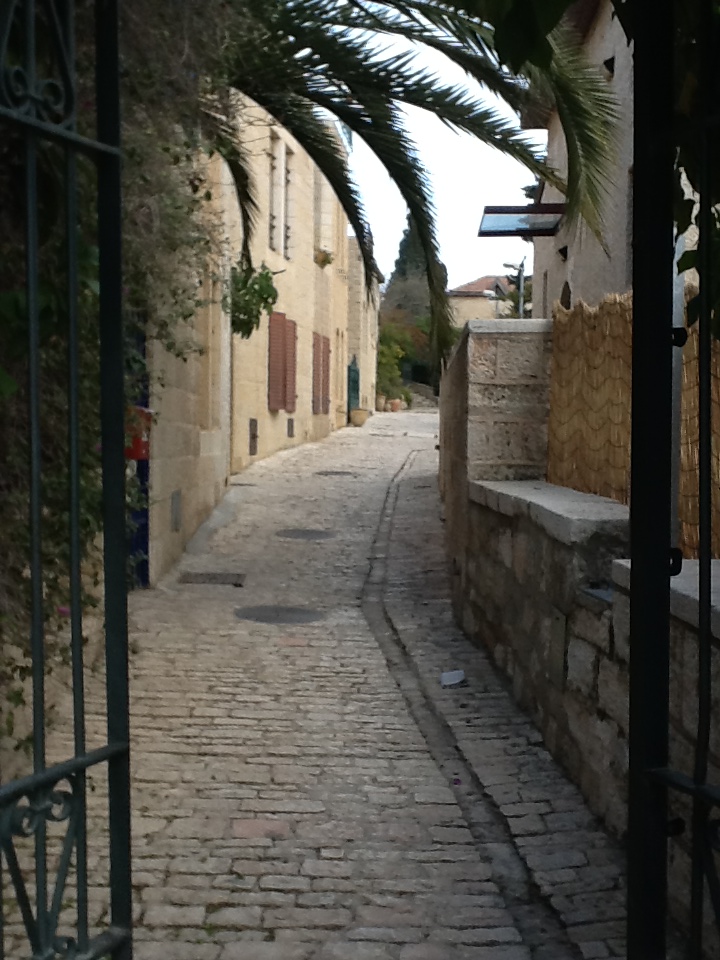
near Yemin MosheQuaint residential street in Yemin Moshe neighborhood

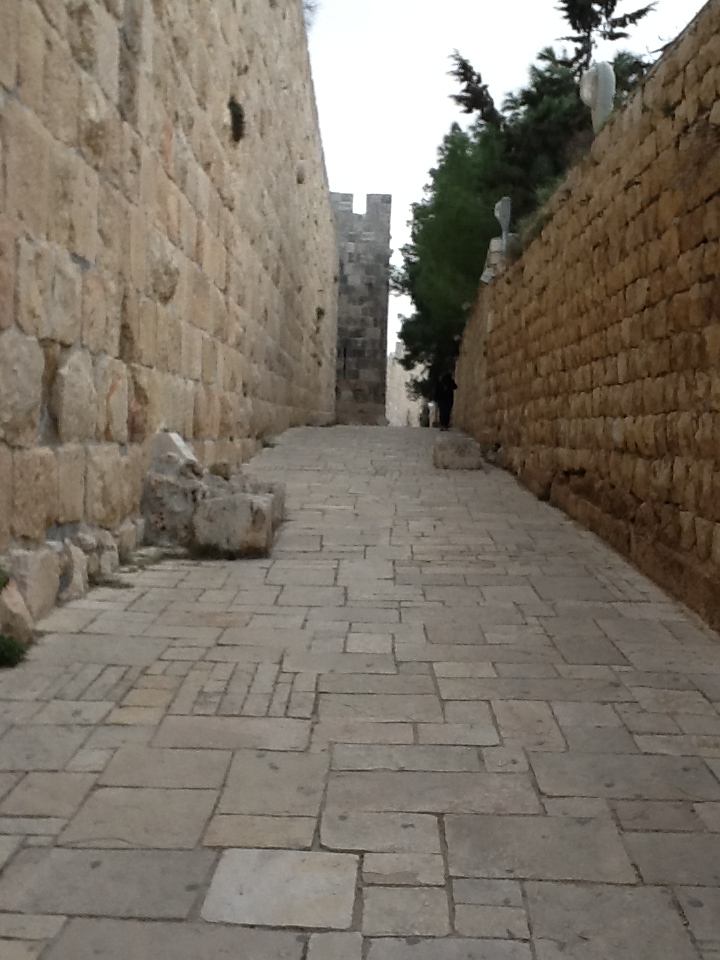
outside the old cityOld City wall on the left, headed toward Dung Gate

chaim outside wallsChaim outside Old City wall, near Dung Gate

bread cartBread cart outside Zion Gate (delicious!)

spicesSpices in the Spice Shuk of the Arab Market. I bought ketzaf from them, these little black seeds that I love and don’t know what they are called in the States.

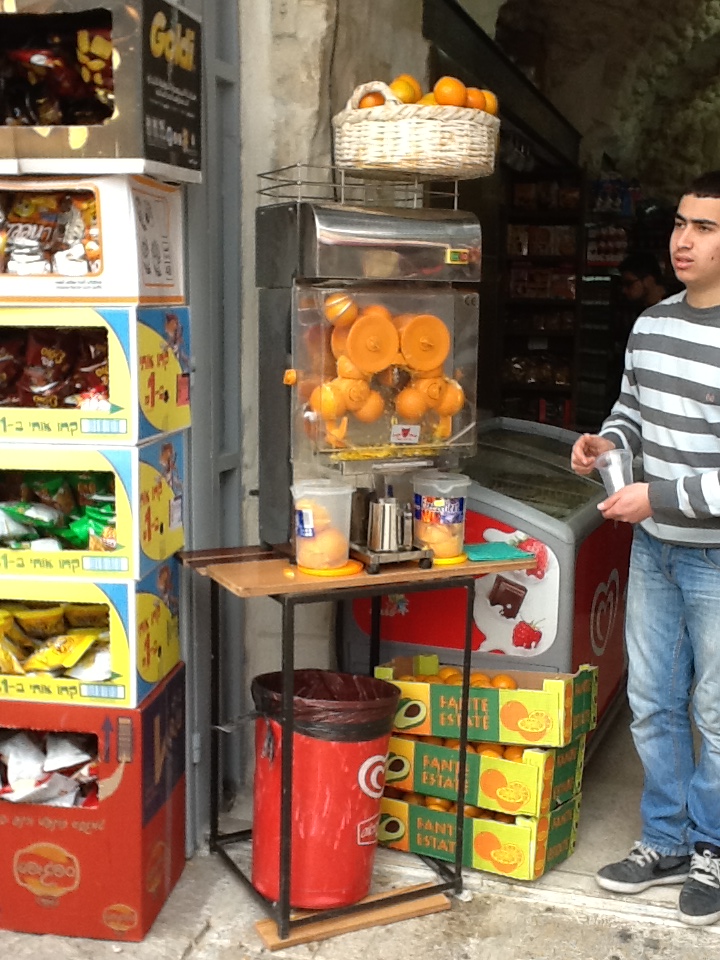
orange juiceYou put whole oranges into this machine, which then cuts them in half and squeezes them. I had a yummy pomegranate/orange juice concoction.

Wishing you a Shabbat shalom!

14 Shevat/January 25, 2013

Tira, Arab Women, and Sayed Kashua

The Central Conference of American Rabbis (CCAR), my rabbinic organization, sponsored a social action trip to Israel this week, and today Chaim and I tagged along. There were a number of colleagues I knew and haven’t seen in years, so even just the socializing part of it was lovely. More importantly, the day was one of the most fascinating and educational of the trip so far (or do I say that every day?)

We began at 8 AM at the Mamilla Hotel, where Professor Reuven Hazan of Hebrew University debriefed the Israeli election for us and helped paint some scenarios that may unfold in the coalition-building process that will take place over the next several weeks. One of the facts he shared that proved important for the rest of our day (which we spent in the Arab town of Tira) was that 50% of Israeli Arabs don’t vote because they feel so disenfranchised. Since Israeli Arabs account for 20% of Israel’s citizens (we are talking about Arabs who live within the Green Line, not those on the West Bank who are not citizens and therefore not eligible to vote), this is a population that could make a real difference in elections, if tapped. Unfortunately, the mainstream parties don’t address Arab issues in their platforms even when they have Arab candidates on their slates (both the Labor and Meretz parties, for instance, will each have an Arab member in the new Knesset). The Arab parties that do exist are never invited into coalitions of either the Doves or the Hawks, they are considered too outside the mainstream (either Communist or Islamist). As a result, many of Israel’s Arab citizens don’t see the use of voting. It hasn’t served them yet.

Within the Green Line of Israel is an area called the M’shulash/Triangle, a concentration of Israeli Arab towns and villages. The Arab Israeli city of Tira that we visited today, with a population of about 25,000, sits in the Triangle. Because today was Mohammed’s birthday and therefore a Muslim holiday, some of the people we were to meet with were not available. But what interesting people we did meet! I particularly want to focus on the three Arab Muslim women we met: Mariam, Ranin, and Dalia, as well as one Jewish woman, Yael, and one Jewish man, Avi.

Seven years ago the Interagency Task Force on Israeli Arab Issues, a coalition of American Jewish groups, was formed. The coalition includes all the heavy hitters of the American Jewish world: UJA Federation of NY, the Joint, the Conference of Presidents, the ADL, all three major religious movements, the New Israel Fund, etc. The thinking was that if American Jewry cares about Israel, we must also care about Israeli Arabs, where there are big gaps and discrepancies in education, housing, and employment opportunities between Israeli Arabs and Jews. Currently, the Israeli government is also investing more in Arab- Israeli communities in order to close these gaps.

Our trip today was meant to introduce us to some of the local agencies on the ground that are part of this gap-closing effort.

lawyer Mariam

Yael Kahan Sharon of Kave Mashve (The Equator), Mariam Kabha (a lawyer for the EEOC), and Avi Fleischer of  JDC Israel

First we spoke about economic development, labor issues, and job training for Israeli’s Arabs. Mariam Kabha is a lawyer for the Israel’s Equal Opportunity Commission, which is housed under the Ministry of Trade and Labor, who fights discrimination in the Arab work force. She showed us an anti-discrimination commercial that appeared on Israel TV recently, under the auspices of Prime Minister Netanyahu’s office. Apparently, the fact that the problem is in the public discourse now is due to the fact that when Israel got into the OECD in 2010, one of the conditions for membership was to get more Arabs and ultra-Orthodox Jews into the labor market and out of poverty.

Mariam also spoke of successful court cases that were brought to court and won on behalf of Arabs who were discriminated against in the workplace. There was one case of 130 Arab men who worked for the IRC (Israel Railway Company) and were let go because of an arbitrary new condition for employment: military service. (Israeli Arabs are not obligated to, but may, serve in the Israel Defense Force; those who do voluntarily serve are often considered traitors in their communities since one’s service would likely include fighting/controlling one’s co-religionists on the West Bank.) Mariam brought the IRC discrimination case to court, and this condition for employment was dropped. But she emphasized that until this commission was established in 2008, cases like this were rarely brought to court because there was no mechanism for bringing or addressing such grievances.

Yael of Kav Mashve/The Equator spoke about her NGO and its mission of getting more Arab university graduates into the private business sector and what some of the obstacles are. She trains Israeli recruiters about cultural differences and how to interview Arab candidates. For instance, a typical interview question might be “Tell me about yourself.” She explained that in the Arab culture, one’s “self” is indistinguishable from one’s family. A Jewish interviewer needs to understand that the answer they will likely get to such a question will be a recitation of family members and what they do.

Since Arabs generally stay put in the town or village where they were born and maintain the extended family relationships there, they are not a people that will move because of a job. This, too, is an obstacle to entering the job market. (Housing is another real issue for the Arab-Israeli community. The communities are becoming more crowded since people stay where they grew up.)

Avi of the JDC spoke about the employment centers that the JDC has opened in Arab communities and how they work with specific communities that are particularly in need of employment opportunities. One successful case of creating employment was that of a Bedouin village, Hura. The women couldn’t leave the village because of family obligations and because of lack of transportation (the lack of transportation in Arab and Bedouin villages and towns is a huge obstacle to employment, we discovered). So the JDC partnered with Bezeq, the Israeli phone company, which was in need of call centers around the country. Bezeq now employs 60 Bedouin women in Hura (in the local mosque!) who take troubleshooting and service calls from customers around the country. (When my friend Bili called for Internet help for me when I first arrived, she spoke with a man named Max, but it could just as easily have been one of these Bedouin women).

Ranin spoke about being at the university to study Hebrew literature (she is particularly in love with the Israeli writer, Agnon! — a very Jewish writer). She thought she’d become a teacher as many Arab women do, when she fell in love with technology and computers. She moved up into a high position at an Israeli bank, but then when she had her first child, she realized she could no longer travel to Tel Aviv for a job. When Appleseeds opened in Tira, she got a job there, a community center that offers free internet access, technical and vocational training. She considers technology “the door to life” and is passionate about giving kids and women the skills they need to enter the job market. 47% of the women they have trained have been employed.

Ranin

Ranin Khateeb Fadila (in white blouse) of Tapuach/Appleseeds

After lunch, our agenda moved from the topic of employment to the topic of education. We met with Dr. Dalia Fadila, an educator who is currently the provost at Al Qassemi College, in addition to being the founder of the Q Schools. I wish you could have been there to be inspired by her, too. She told us her story of feeling victimized as an Arab woman, but how two of her professors at Bar Ilan University helped her on her road to empowerment. She studied the literature of American minority women: Jewish-American, Asian-American, and African-American as a way to turn the lens on herself and understand better her own experience as a minority in Israel.

Dalia gave us the dire statistics of Arab education and spoke of the tension in her community between modernity and tradition, and how women who enter the job market must still maintain their roles as wives and mothers at home (which echoed the personal story that Ranin had told about leaving her important bank job when she had a child). She also spoke of the different self-definitions that Arabs in Israel use and how politicized the issue is: while Jews will speak of Israeli Arabs or Arab Israelis, many Arabs in Israel prefer to be called Palestinians living in Israel or Palestinian Arabs or Palestinians within the Green Line, etc.

The Q Schools that Dalia started are after-school and weekend programs to teach English (her 15 year old son is fluent, if that’s any proof of its success), but she sees the English as a means to the ultimate goals of personal development and empowerment, leadership, and communal responsibility. She has some funding from the government, but more comes from a foundation as well as from the US Embassy.

She has written her own (BRILLIANT!) textbooks that teach values, analytical skills, and creative thought as the primary goals, all through the guise of teaching English, which is merely the secondary goal.

Chaim asked Dalia about the Arab-Israeli writer Sayed Kashua, who happens to be from Tira. (Kashua wrote Dancing Arabs and Second Person Singular — I highly recommend both — which deal a lot with issues of Arab identity, Arab-Jewish relations, and trying to “pass” as a Jew. He also writes a humorous column in Hebrew in HaAretz and is the creator of the hit Israeli TV series Arab Labor.) She said that his parents still live in Tira and that there is a lot of anger in the community at Kashua for airing “dirty laundry.”

Dalia

Dalia Fadila of Q Schools

So we come back to the beginning. When Professor Hazaz spoke about low voting rates in the Arab-Israeli community, we can see how it all connects to the lack of opportunities. Once the Arab-Israeli community enters the job market and the educational system in greater numbers and feels more part of the larger society, I imagine they will vote in greater numbers. We can only hope that the efforts now being made by the government, by NGO’s, and by the American Jewish community to invest in leveling the playing field will ultimately pay off in creating a more just and democratic society for the Arab citizens of Israel.

Election relief and West Bank angst

ballots

Since Israelis vote for party and not for candidates directly, the voting system is remarkably low-tech. Chaim and I collected some of the ballots from the ground this morning — they are just little pieces of paper , as seen above, with the name of the party and  maybe a little blurb about it. The one for Meretz (above, right), for instance, simply reads, “The left of Israel”. Note that we found one for the Shas party that is just in Hebrew, and above it is the ballot that also has Arabic on it.

When you go to the polls, you pick the ballot of the party you wish to vote for, and place it in an envelope. That’s it! At the end of the night, the poll workers count these little pieces of paper by hand.

How much better these elections went than expected! Netanyahu’s Likud-Beiteinu party lost seats and the left picked up seats. Second place winner was left-of-center party Yesh Atid with 19 seats, 8 of them women.

Chaim and I were very excited to see that someone we know, Ruth Calderon, was elected to Knesset on the Yesh Atid ticket. I first met Ruth in the mid-90’s when I came to Israel with a CCAR (Reform Rabbis) trip. She is a brilliant teacher of Talmud who had opened a pluralistic beit midrash (study center) in Tel Aviv called Alma (meaning “world” in Aramaic) where Jewish studies are taught to secular Jews. Since then, Chaim and I have studied with her a number of times in the U.S.

Also now in Knesset on the Yesh Atid slate is a woman named Aliza Lavie whose book A Jewish Woman’s Prayerbook, I own. Yesh Atid also has placed an Ethiopian woman in the Knesset, though I’m not sure if that is a first or not. Meretz, the party we were rooting for, jumped to 7 seats in the coming Knesset.

Netanyahu had big money behind him, just as Romney had. All this is to say that this election, like the one we had in the U.S. in November, could not be bought. That felt refreshing and counterintuitive when I encountered it in November, and I’m not any less uplifted by it occurring here, as well (even thought Netanyahu will still likely be leading the coalition, unless President Shimon Peres surprises everyone by calling on Yair Lapid, leader of Yesh Atid, to form the coalition government instead — a long-shot possibility).

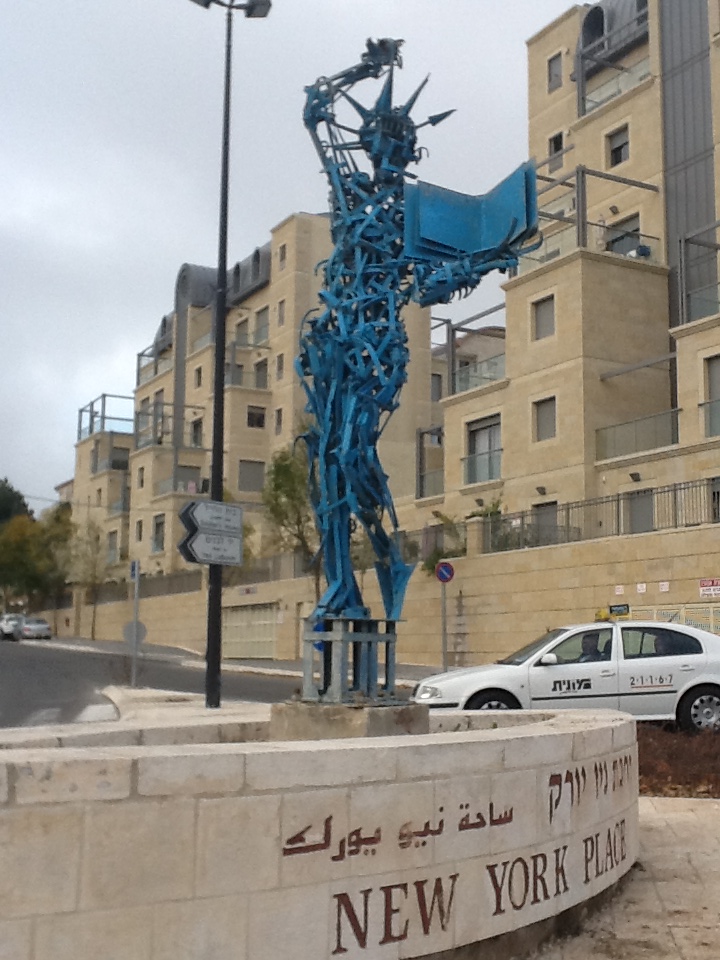
Chaim and I stumbled on this lovely riff on Lady Liberty this morning on our way to get our tour bus to the West Bank. Note that she stands in what is called New York Plaza.

statue of liberty

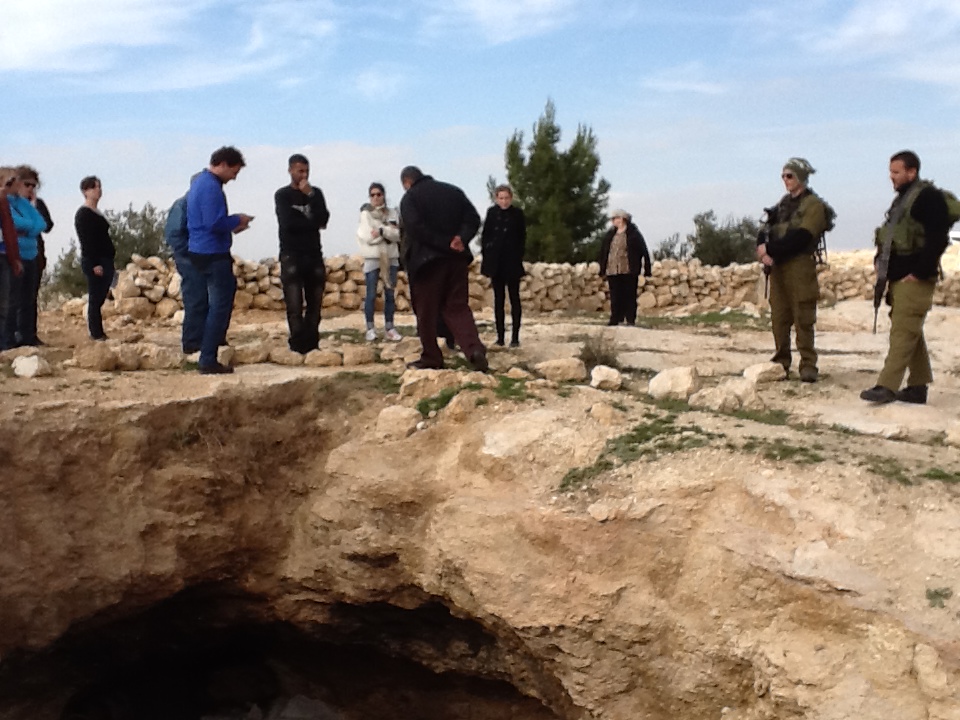
Our tour today to the South Hebron Hills was with a group called Breaking the Silence, “an organization of veteran combatants who have served in the Israeli military since the start of the Second Intifada and have taken it upon themselves to expose the Israeli public to the reality of everyday life in the Occupied Territories. We endeavor to stimulate public debate about the price paid for a reality in which young soldiers face a civilian population on a daily basis, and are engaged in the control of that population’s everyday life.” (http://www.breakingthesilence.org.il/)

It was a truly eye-opening tour which I will be digesting for many days to come. I truthfully am not ready to share much with you about it at this point until I re-read my copious notes and sit with it all a bit more, except for a few West Bank scenes.

west bank

Bucolic West Bank

terraces

Beautiful terraced landscapes

soldiers

In Palestinian Susya, where soldiers decided to stop in and check up on us — they followed us for the rest of the day

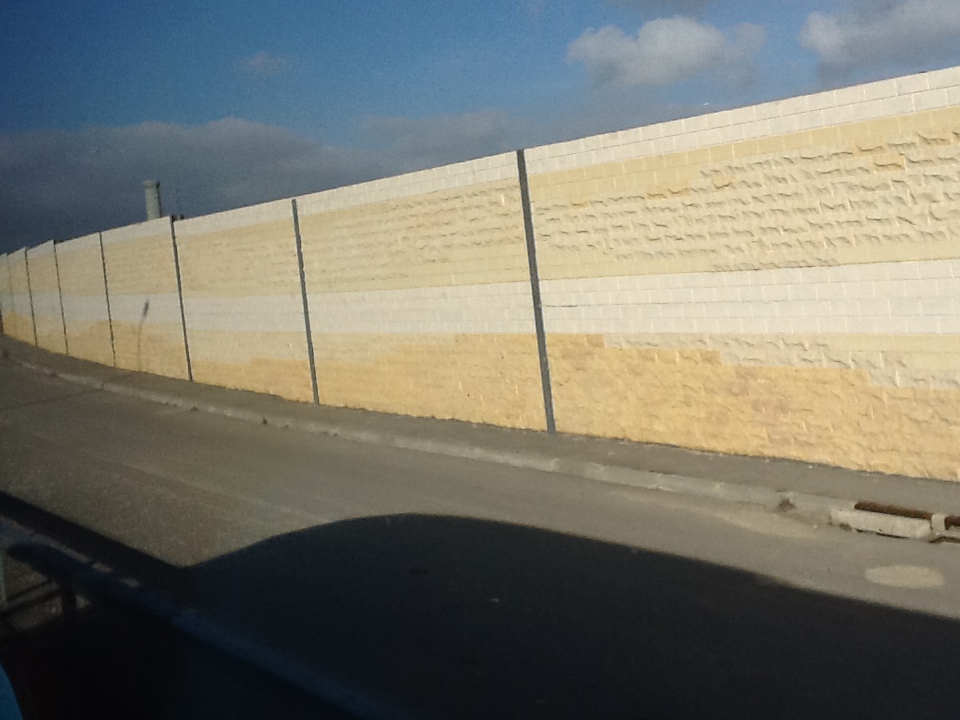
separation wall

A glimpse of the separation barrier

This evening we had dinner with Rivanna and Simon, folks whom we had never met before. It was a date arranged by our mutual friend Steve from London, who sent both me and Simon the following email in early January:

Pam meet Simon, Simon meet Pam
Simon is just about my oldest ever friend, he teaches at the university in Jerusalem and leads an amazing charity CCECH the Centre for Creativity in Education and Cultural Heritage :-
 
“The CCECH designs and implements innovative education projects that help create a climate of cultural pluralism and inter-generational understanding. Its programmes are based on folklore and focus simultaneously on several issues facing Israeli society and the region: co-existence between neighbouring Arab and Jewish, Israeli and Palestinian, communities caught in the conflict; cultural pluralism; and the transmission of home-culture between generations in modern society.The CCECH has designed programmes that bring together Jewish and Arab (Muslim and Christian) school-communities, based on the research and exchange of participants’ folklore. Participating children, family members (parents and grandparents) and teachers become part of a long-term, cross-cultural, multi-generational experience. The CCECH runs two types of programmes: Jewish and Arab school-community pairing programmes and training and enrichment courses for Arab and Jewish educators.”Pam is an old and dear friend, she is a Reform rabbi from New York who has very similar interests to yours Simon. She is staying in Jerusalem for a few weeks with her husband. You two should meet up, no I will rephrase you two must meet up.

Love to you both, I wish I was sitting at a table in a nice cafe in Jerusalem introducing the two of you and listening to the conversation take off.

Take off, it did. And now we have lovely new friends in Jerusalem! Thanks, Steve.

simon:Rivanna

Rivanna (originally from Rhodesia/Zimbabwe) and Simon (originally from Great Britain)


The Lowest Place on Earth

Today is Election Day in Israel. (Chaim wore his “VOTE” t-shirt and was disappointed that no one commented on it.) Since voting is considered such an important civic act here, today is a national holiday. Hospitals and public transportation, for instance, run on reduced schedules. Most public institutions are closed, and only those whose jobs provide essential services are required to work on Election Day. Israeli labor law then requires that they receive either a paid vacation day to make up for it or 200% pay for the day (double their normal day’s salary). Even more interesting to me is that anyone who finds her/himself 20 kilometers away from home on Election Day can receive free public transportation to get home to their polling place by presenting their official identity card. (I learned all of this from today’s Ha-Aretz article entitled “Election Economics: Labor Law on Voting Day”.)

Don’t you think it is time to make Election Day in the U.S. a national holiday like this?

All this is to say that Bili chose not to work today so that some of her staff could make the extra money. Therefore, she was free to take us on an outing to the Dead Sea, the lowest place on earth and one of her favorites. On our way there, we saw lots of desert, some areas of palm trees, and a few Bedouin villages and camels. We passed Qumran, the caves in the desert where the Dead Sea Scrolls were found (and where I almost died of thirst on a hike in 1981), as well as a place called Nabi Musa (“Prophet Moses” in Arabic) which is where Moslems believe that Moses is buried. This is in contrast to Jewish tradition which doesn’t identify a specific place for Moses’ burial place since our text reads and no one knows his burial place to this day  (Deuteronomy 34:6).

Once we arrived at Mineral Beach on the Dead Sea, we were each given a voucher for a free coffee and pastry at the cafe in honor of Election Day! Eizeh kef — a great expression meaning, Wow/What a surprise/What fun! (Since it’s not my holiday, I chose to drink my free coffee in honor of this 40th anniversary of Roe v. Wade.)

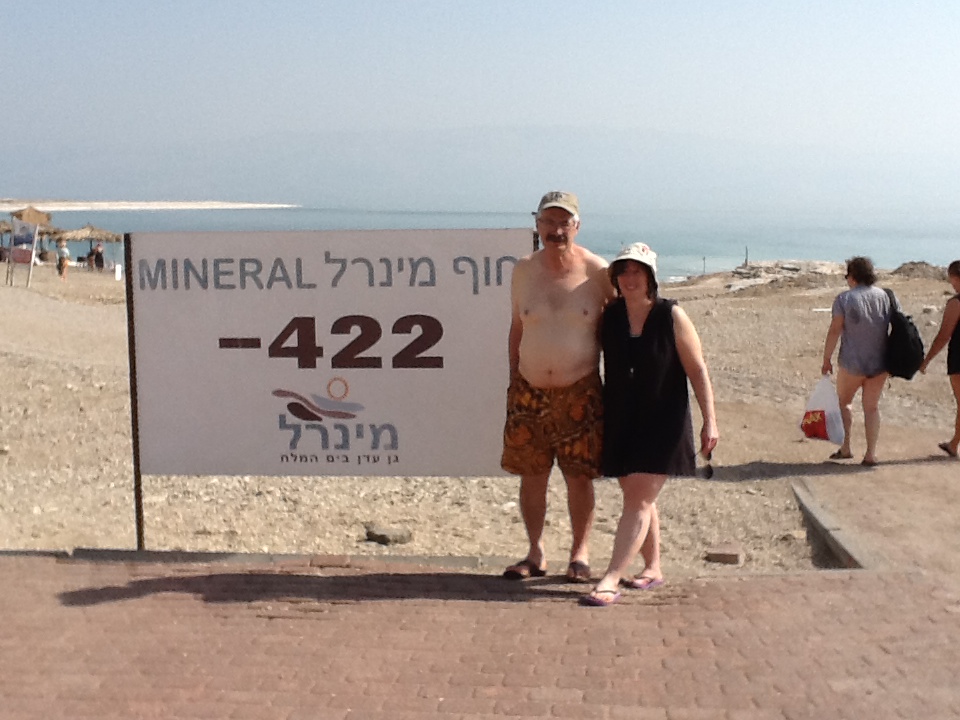
-422

Chaim and I standing at a spot on Mineral Beach that is 422 meters below sea level.

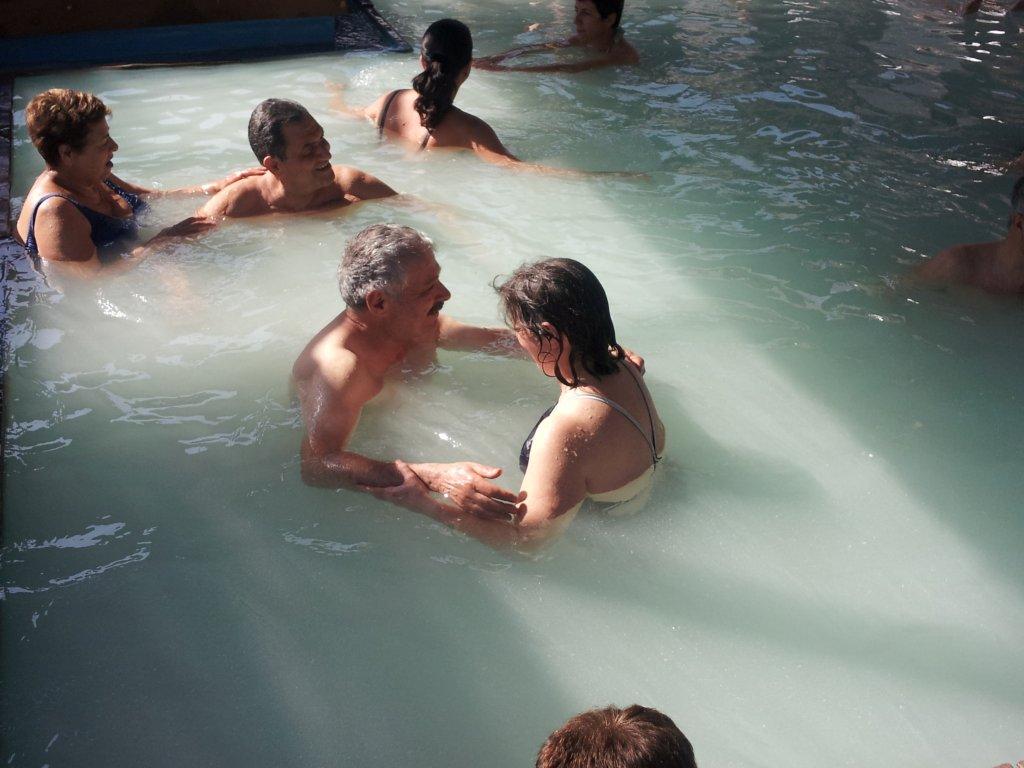
We had such a wonderful and relaxing day there. First we went into the hot sulfur pool before heading down to the beach.

sulfur pool 1

Dancing the hora in the sulfur pool

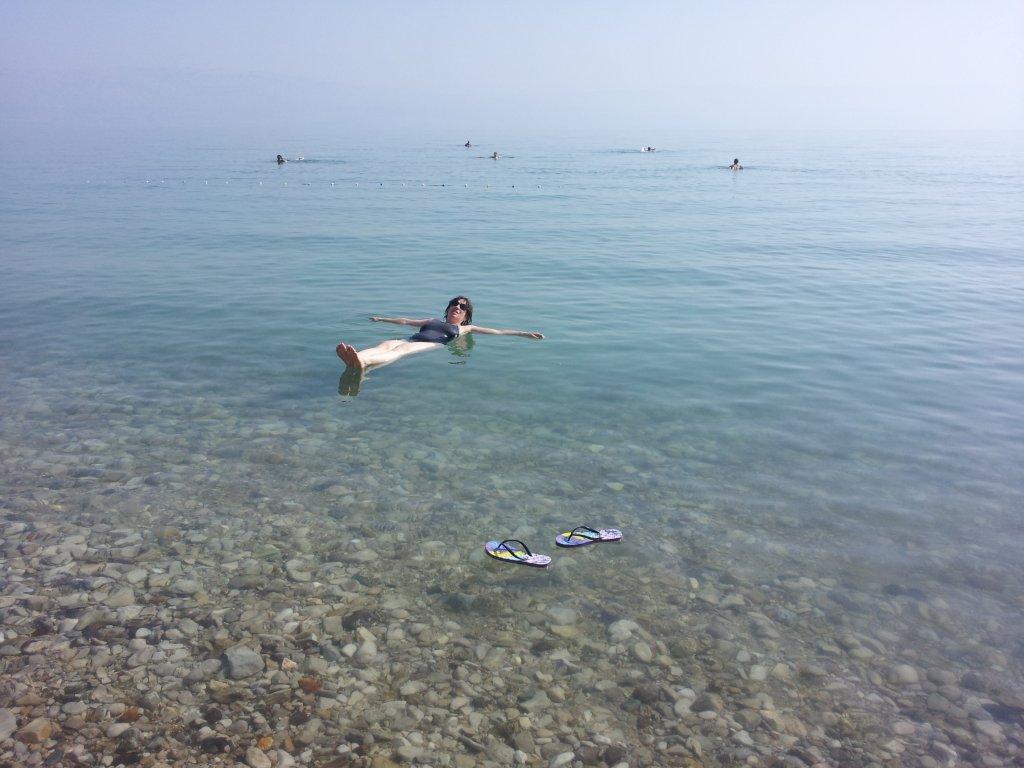
Here I am floating in the Dead Sea, while my flip-flops walk on water!

flipflops

I float, and my flip-flops walk on water in front of me

man floats w paper

Man, buoyed by Dead Sea, relaxes with newspaper

In addition to the hot pool and the Dead Sea, tubs of mineral-filled mud were available for spreading. My skin is SOOOO incredibly smooth right now, I can’t even describe how luscious it feels. The Dead Sea is considered such a healing place that people come from around the world in order to treat their skin for acne, psoriasis, or other skin ailments. In fact, Bili told me that her insurance plan allows her to take two weeks a year AT A HOTEL at the Dead Sea to treat her psoriasis.

Don’t you think it’s time that our insurance plans in the U.S. were as forward-thinking and generous as this?

mud

The new improved me!

The problem with the Dead Sea is that is shrinking. Where I am standing in this picture was covered in water 30 years ago when I first went there. (Actually, even where Chaim and I are standing in the first photo was underwater then, much further from the beach). The Dead Sea is being mined not only by beauty products’ companies like Ahava for the minerals (soaps, bath salts, etc.), but also by pharmaceutical and chemical companies. This is an environmental disaster in the making.

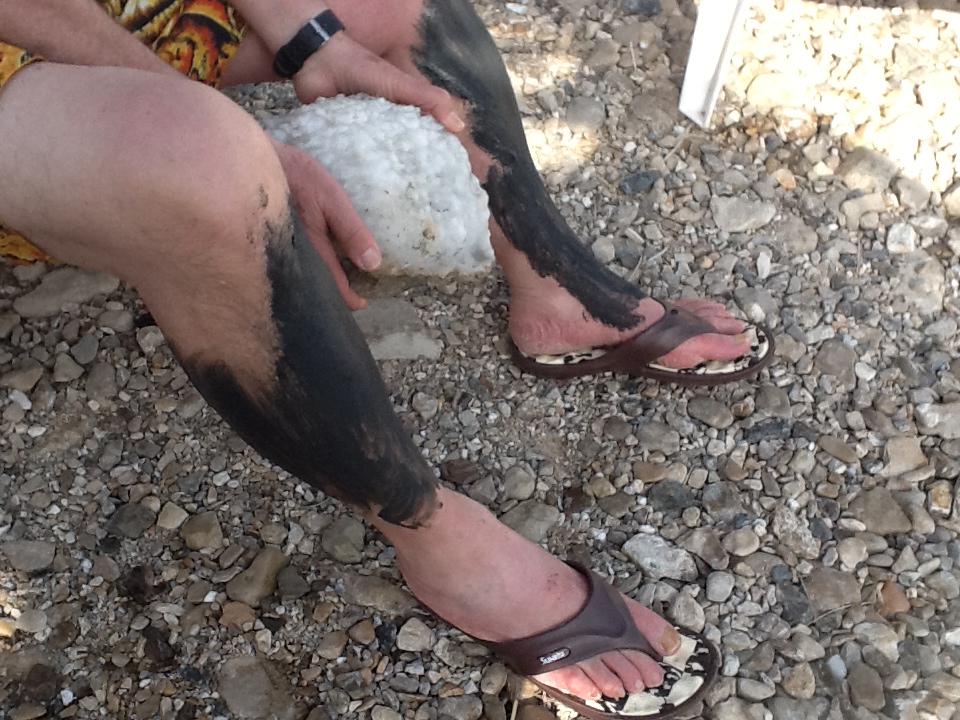
Big chunks of salt can be found by the Dead Sea. Here is a rather large one that Chaim nicknamed Lot’s Wife, in honor of the biblical character who turned into a pillar of salt somewhere not far from where we were today: Lot’s wife looked back, and she thereupon turned into a pillar of salt (Genesis 19:26).

Lot's wife

Chaim (‘s legs and hands) with Lot’s Wife

We returned to Jerusalem at around 5 PM, just in time for me to meet with one of the social workers who had attended my presentation at the Reshet last week. She said she realized that she needed some spiritual care herself and doesn’t know anyone here (except for her professional colleagues who feel too close for comfort) who might be able to offer it to her. I was honored to be able to sit and listen to her sacred story and to help her identify the spiritual issues that she is dealing with in her life.

It is now past 9 PM here and only some of the polls have already closed, as far as I understand. At 10 PM, the news can start reporting on exit poll results, though final results won’t be available until a couple of hours after that. You will certainly have the news before I can post anything tomorrow evening from here.

Today was a respite day for us, as we have three intense days ahead of us before Shabbat (we head to the airport and home just after Shabbat on Saturday evening). Tomorrow we will be taking a tour of the S. Hebron Hills (in the West Bank) with a group called Breaking the Silence. On Thursday we travel with the CCAR (my rabbis’ association) to meet with Arabs within the Green Line, in what is called the Triangle region. And then on Friday we go back to the West Bank with Rabbis for Human Rights to plant trees in honor of the holiday of Tu B’shevat/Jewish Arbor Day.  I am tired just thinking about it, but I suspect that these are going to be among the most meaningful days of our trip.

12 Shevat/January 22, 2013

Memorials, Inauguration, and Only Hebrew

Don’t ever trust Google maps. What they said would be a walk of 1 hour 4 minutes was actually closer to a 2 hour walk, and we’re strong walkers!  They also didn’t inform us that it was all uphill, though I knew that it would be — we were headed up a mountain, after all, Mount Herzl.

Mount Herzl is the site of Israel’s national cemetery. The tomb of Theodor Herzl, founder of modern political Zionism, lies at the top of the hill. Walking the cemetery is more like a stroll through a park  — it is forested with great views and lovely paths.

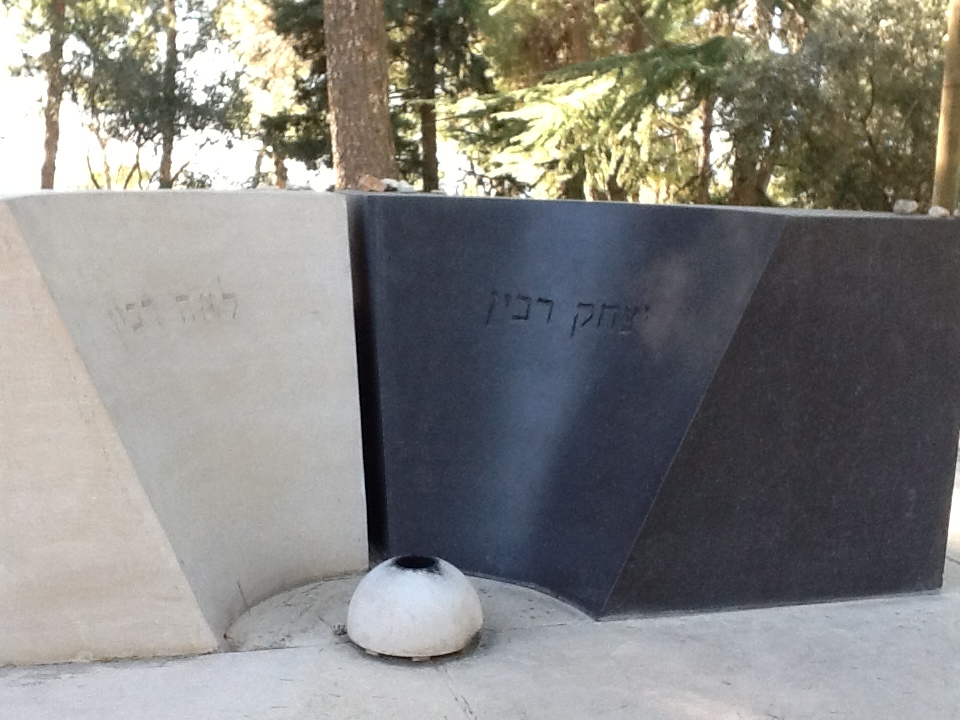
Martin Luther King Day felt like the perfect day to pay homage to Israel’s dead, and particularly to visit the grave of another leader assassinated for his conciliatory and peace-seeking beliefs, that of Yitzchak Rabin. Rabin was the Israeli prime minister who was assassinated in 1995 by a right-wing extremist for signing the Oslo Accords and the man who was President Bill Clinton’s chaver/friend. Shalom, Chaver is how President Clinton ended his eulogy to PM Rabin.

I love the simple and graceful elegance of Rabin’s black stone kissing the white one of his wife Leah, below.

rabin grave

There is a dirt path connecting Yad Vashem (Israel’s official memorial to the Holocaust) to Mount Herzl. The preferred route is to start at Yad Vashem, signifying a dark and victimized past, and from there to make the visit to the national cemetery, representing the reality of the homeland that Herzl had envisioned, the need for a Jewish homeland post-Holocaust, and the political/military coming-of-age of a people in its own land.

However, contrarians that we are, Chaim and I made the journey in the opposite direction. Though it is an amazing museum, we had no plans to visit inside Yad Vashem today in any case, in terms of time, stamina, and emotional will. I did take a few outdoor pictures, however.

Here is the main gate to Yad Vashem, aptly conjuring up Holocaust imagery.

yad vashem gate

From our brief outdoor tour there, Chaim and I took the new light rail (completed in 2010) to Mahane Yehuda to have lunch and do our near-daily fruit and vegetable shop. I took some great shots today when it was quite tame compared to Fridays.

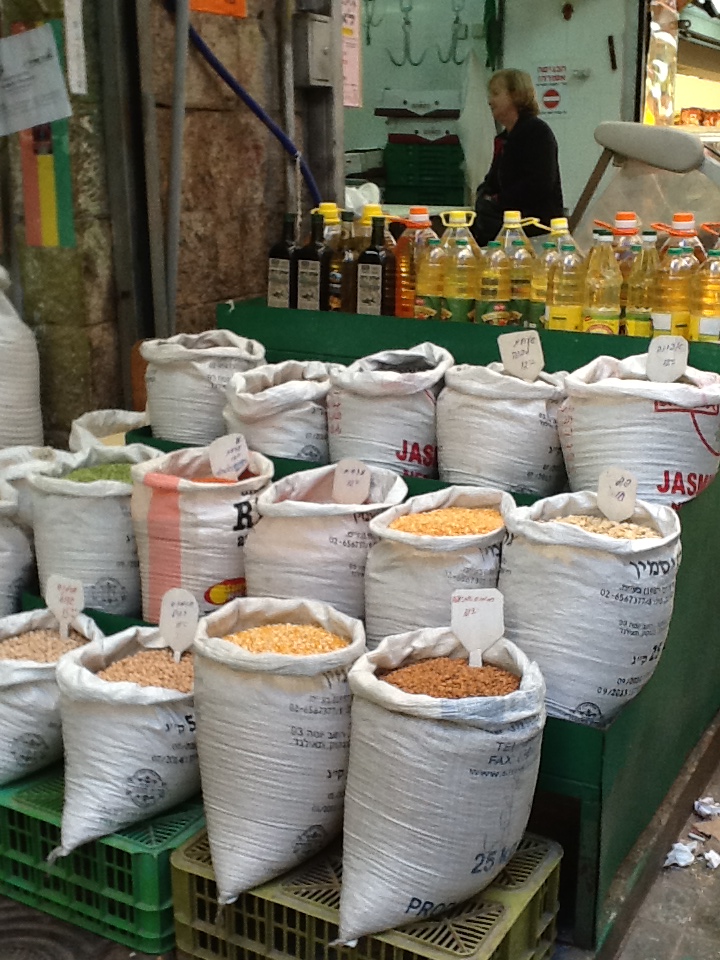
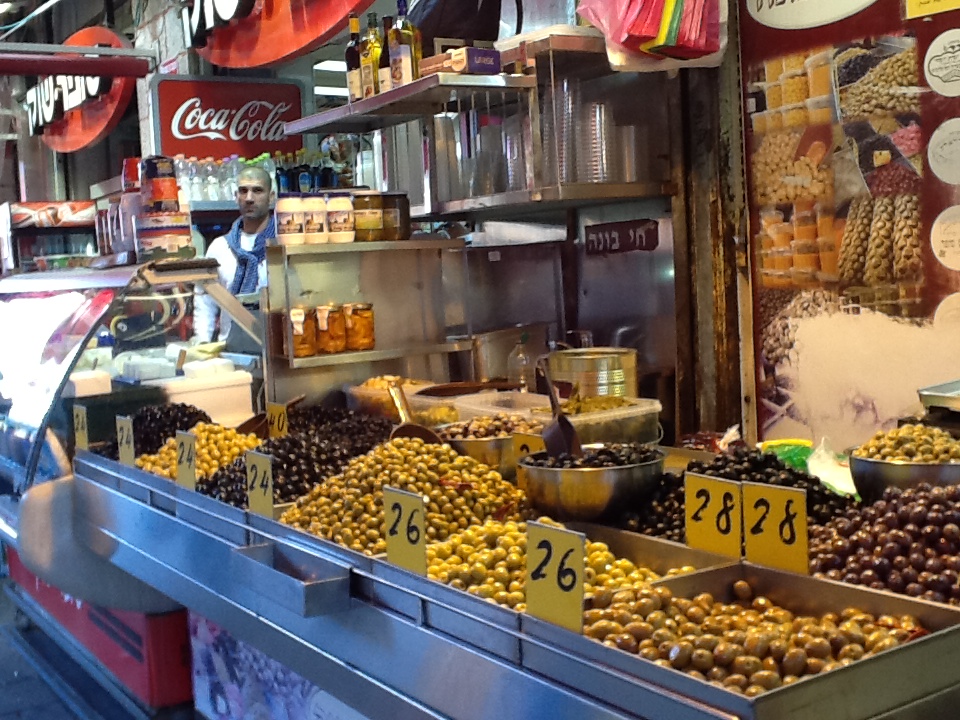
mahane yehudamahane yehuda 2olives

Chaim headed home and I headed to the Israel Broadcasting Authority where Bili works. On my walk there, I bought a beautiful kiddush cup (that I don’t really need, but, hey, the price was right!) at an antique store, as well as a shiviti. (Helen, I finally found one!) A shiviti is a meditative plaque used to focus one’s attention on God, based on Psalms 16:8, Shiviti Adonai l’negdi tamid/I shall keep God before me always.

Bili drove me to Shoeva, the village just outside of Jerusalem where her parents live. She said I was doing a mitzvah since her parents are getting old and miss me so much. She makes it sound like I’m doing something I don’t want to do, which is certainly not the case. Chaim and I have passed by Shoeva each time we’ve come or gone from the city (enroute to Jerusalem from the airport, on the JNF tour, to and from Chaim’s mother’s grave in B’nai Brak, and to and from Tel Aviv.  I get excited every time I see the Shoeva sign, because I have spent so much time there with Bili and her family; it is my home here in Israel. Her parents kvell over me, so how could I not love them back?

Yafa is a Baghdadi Jew. Shmuel is an Ashkenazi Jew who served in the Palmach in the War of Independence. The Palmach was the elite fighting force of the Haganah, the underground army during the period of the British Mandate of Palestine. He speaks some English; Yafa speaks none. I spent most of the day speaking only in Hebrew — asking for directions, interacting with guards, shopkeepers, and passersby. I had a very interesting conversation in Hebrew with an Argentinian woman at Yad Vashem who knew the Argentinian rabbis at B’nai Jeshurun, the synagogue that Chaim and I used to attend in Manhattan. By the way, most Argentinian Jews speak a fluent Hebrew; it’s a given that they will learn it. In any case,  I was relieved that President Obama’s inauguration was on TV, and I could sit back and not think so hard in Hebrew.

Before I left, I did have one request from Shmuel that I knew he would not grant me — please, please, please would he vote tomorrow for Meretz on my behalf?  He and I have battled about Israeli politics since I met him 30+ years ago, and I can’t really expect him to move to the left now. But I had to ask nonetheless, for old time’s sake.

The Shalom Hartman Institute sent out a great article today called “The Struggle for the Israeli Right” by Yossi Klein Halevi.

http://www.hartman.org.il/Blogs_View.asp?Article_Id=1070&Cat_Id=275&Cat_Type=Blogs

Had I read it before seeing Shmuel, I might have amended my request of him. Instead of asking him to move all the way to the left, I might have asked him to move only a little bit to the left from his party of choice, Habayit Hayehudi, headed by Naftali Bennet, to a “pragmatic right” party instead. I may have had more luck.

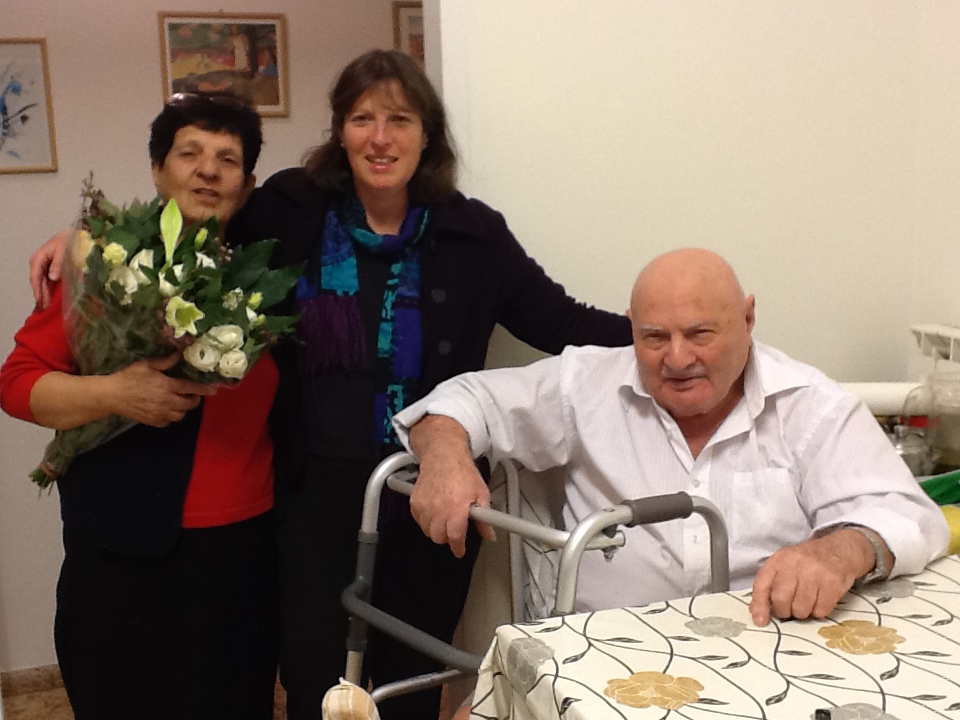
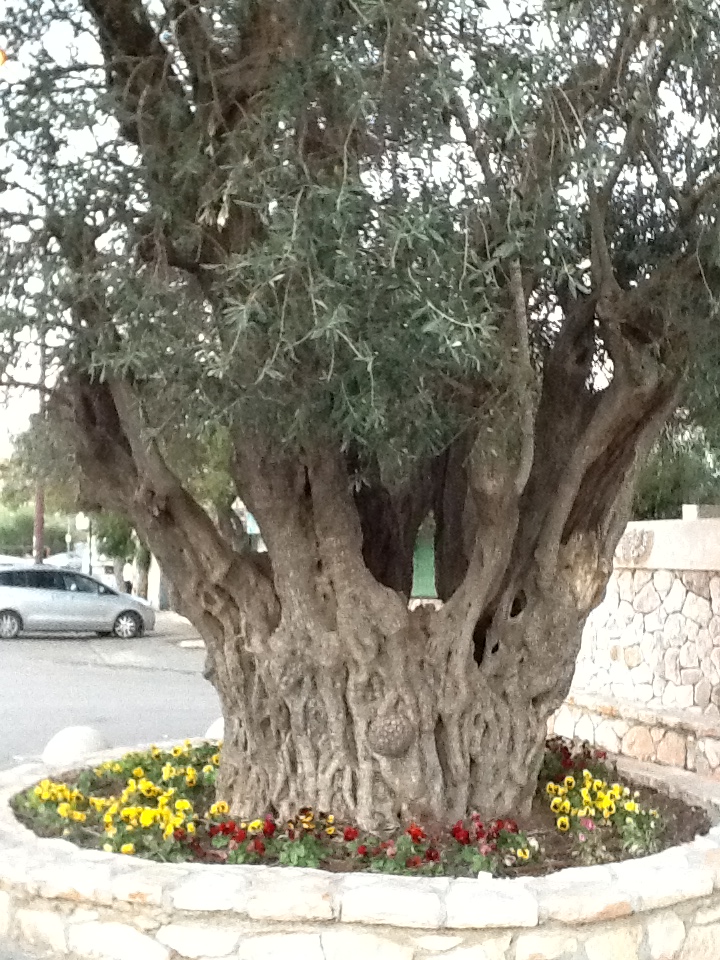
bili's parentsolive tree

Bili’s parents and me                                       Massive olive tree at entrance to Shoeva

So, Mazal Tov, President Obama, and Happy Birthday, Martin Luther King, Jr. And good luck to Israel tomorrow in these elections, another defining moment in Israel’s evolution.

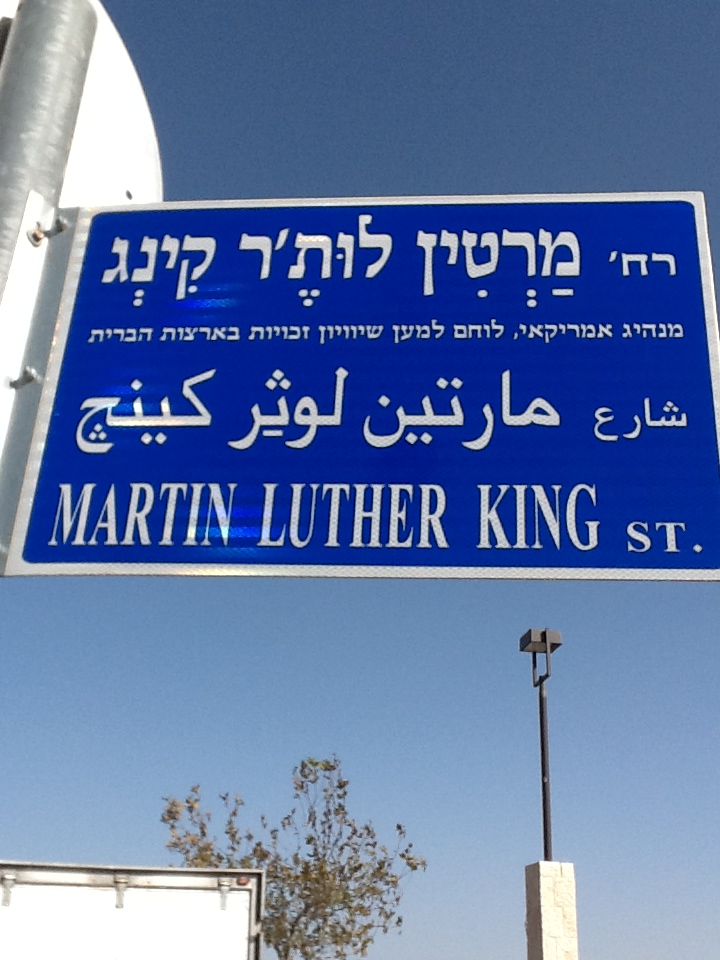
MLK

The biographical statement under the street name in Hebrew reads:

“An American leader who fought for civil rights in the United States”

A Day in the Museum

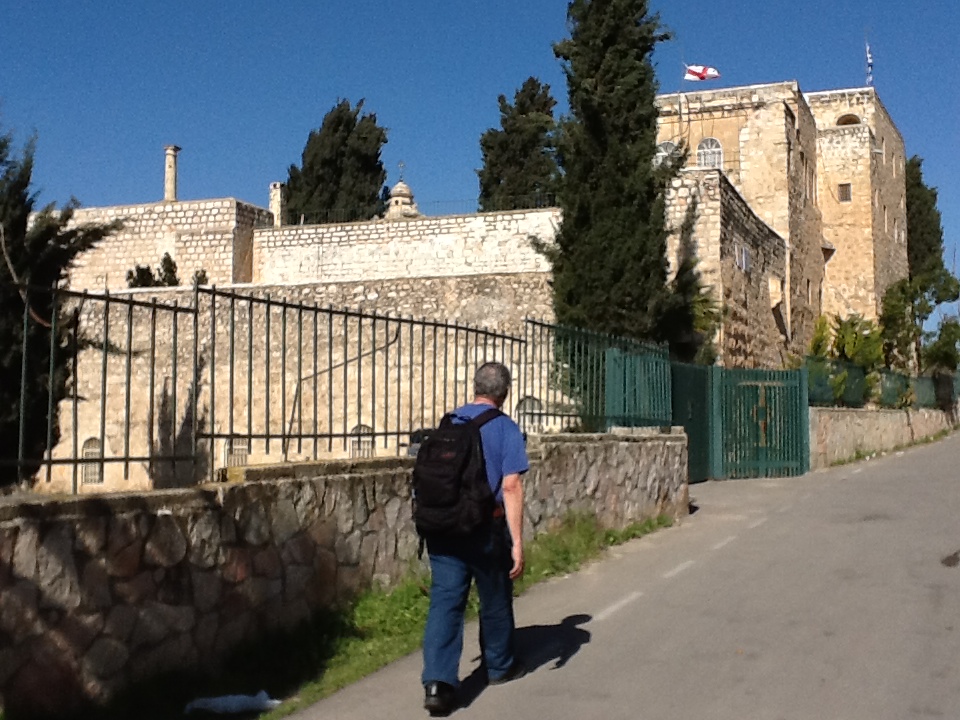
After attending our early morning Comic-tary Torah study in which we discussed such important topics as miracles, faith, memory/forgetting, and whom among the Biblical characters in this week’s Torah portion B’shallach (Moses, Miriam, Pharaoh, God, Amalek, Joshua, Aaron, or Hur) would we vote for if they were to be on Tuesday’s ballot — Chaim and I headed to the impressive Israel Museum for a day of art appreciation. On our way, we passed this amazing 5th century monastery of the Greek Orthodox Patriarchate, the Monastery of the Holy Cross. Fifth century!

church closeup

Monastery of the Holy Cross, 5th century

The Israel Museum is one of the leading art and archeology museums in the world. We were also on a mission to find a small exhibit of work by a landscape artist named Israel Hershberg whom our artist friend Pattie asked us to check out, since they had both exhibited in a show together once.

Knowing we couldn’t see everything in one visit, we skipped the archeological exhibits, the medieval church art, all the European art (the Impressionists,  the Surrealists, the post-Moderns — which meant rushing past Monets, Picassos, Van Goghs, Gaughins, Magrittes and Dalis as if they were flotsam in our path) in order to view the expansive collection of artifacts of Jewish ritual life from around the world, as well as to focus on the Israeli art.

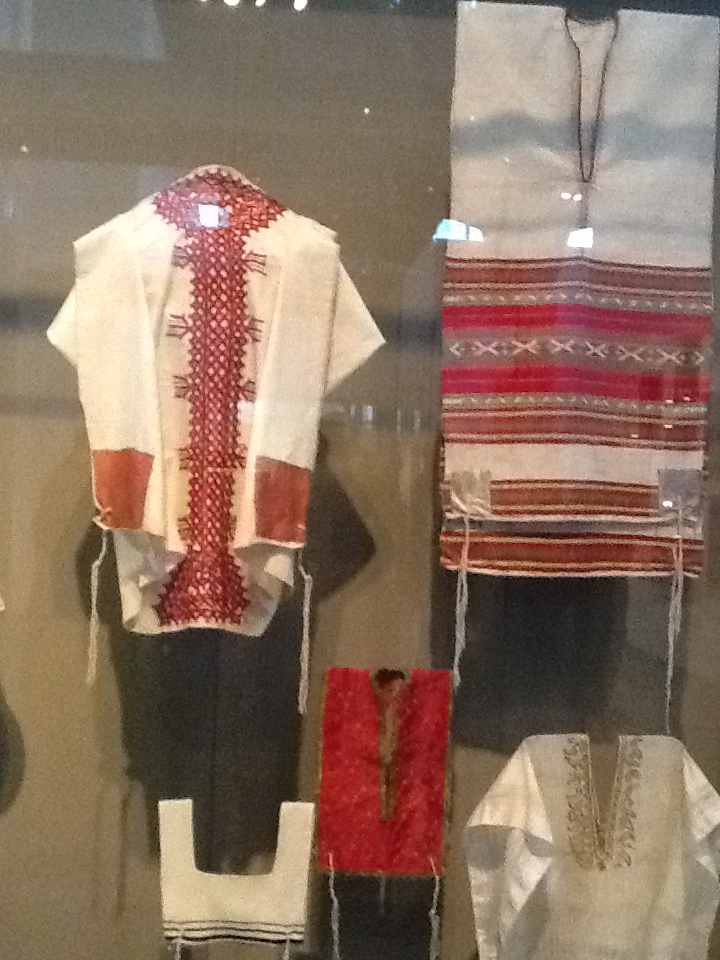
The Jewish Life and Art Wing reminds those of us in North America, that the Jewish world is a lot bigger than the Ashkenazic Jewry that we are typically exposed to and that we think of as mainstream. The Jewish artifacts from Yemen, Morocco, India, Iraq, etc. made me realize the extent of my ignorance of much of Jewish culture. For instance, if you thought (as I did) that blue and black-striped tallesim were “traditional” and that colorful prayer shawls were contemporary inventions, think again. These three red examples are from the 19th and early 20th centuries in Morocco (left), Yemen (right), and Bulgaria (bottom).

tallesim

Examples of prayer shawls

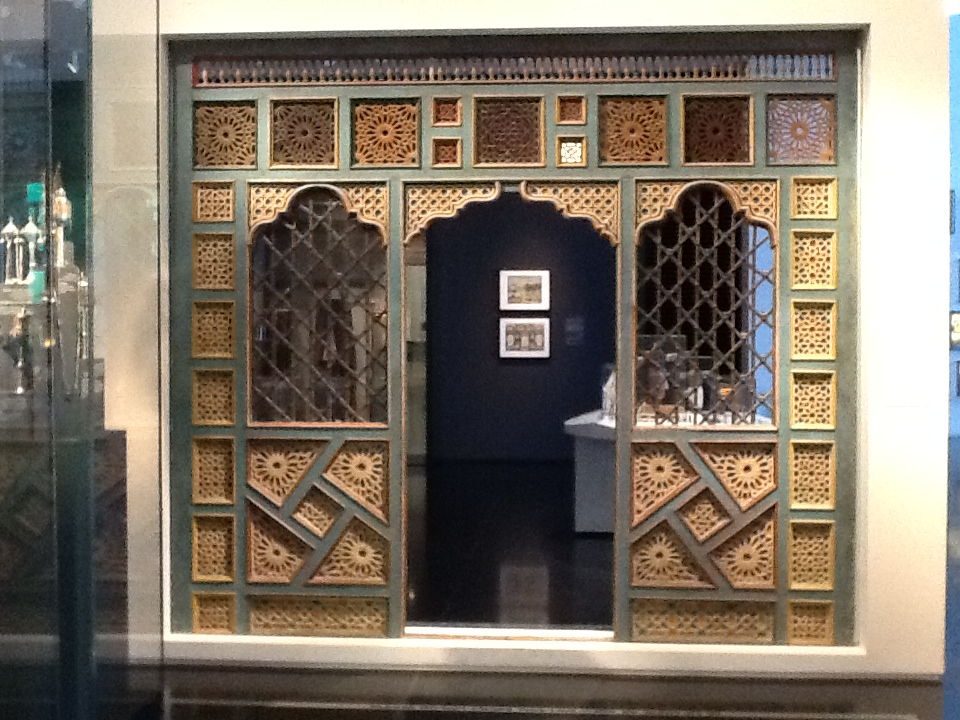
The Israel Museum has saved several sanctuaries from around the world for display — one from Cochin, India, one from Italy, one from Germany, and one from Surinam. Here is just the entryway from a Moroccan synagogue in which you can see the Moorish design.

Moroccan doorway

Moroccan synagogue entrance

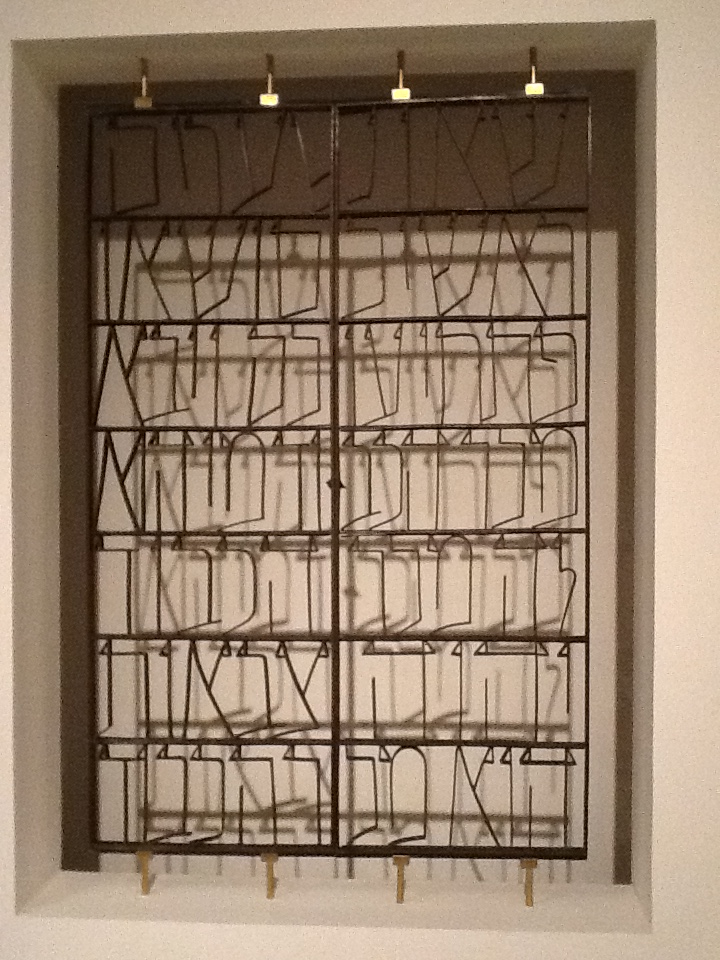
I did a lot of ooh-ing and aah-ing today, but nowhere moreso than of the silverwork of Ludwig Wolpert and David Gumbel, both of whom taught at the New Bezalel School of Arts and Crafts in Jerusalem.  The school was named after the biblical Bezalel who was the craftsman for the Tabernacle. God says of Bezalel (Exodus 31:3-5) that “I have endowed him with a divine spirit of skill, ability, and knowledge in every kind of craft to make designs for work in gold, silver, and copper, to cut stones for setting and to carve wood — to work in every kind of craft.”  Both Wolpert and Gumbel were definitely endowed with divine spirit. Both were also influenced by the Bauhaus style (I posted on Thursday about Bauhaus architecture in Tel Aviv’s White City), and according to the Musuem literature “were among the first to adapt the modern style, characterized by clean, flowing, and functional forms, to the design of Jewish ceremonial objects”.

metalwork

Doors to a Torah Ark (Wolpert) that read “Lift up your heads, o gates! Lift them up, you everlasting doors, so the King of Glory may come in!”” (Psalms 24:9)

One of the most interesting pieces of modern art was this piece called Yom Kippur Flotilla. Why Yom Kippur? If you look closely, you can see that the boats are made out of shofarot/rams’ horns, both whole ones and pieces of them. Shofarot are blown at the end of Yom Kippur (as well as on Rosh Hashanah and throughout the month leading up to Rosh Hashanah).

YK Shofar flotilla

Yom Kippur Flotilla (artist Uri Nur)

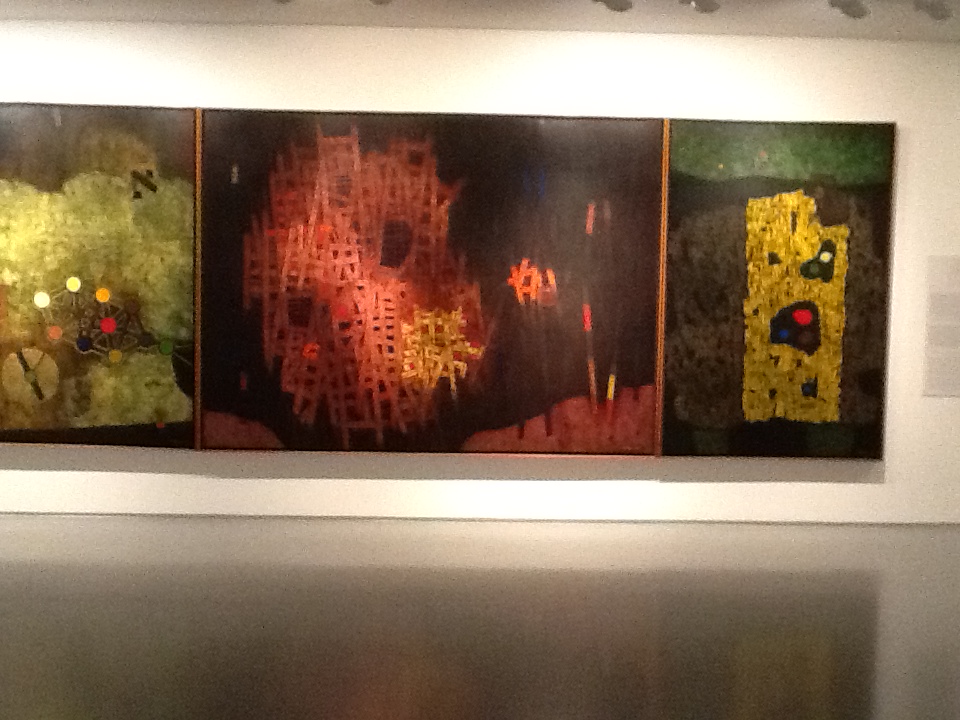
Another interesting piece was this triptych by Mordecai Ardon, who is not himself religious but who uses religious imagery in his paintings. Note the mystical sefirot represented on the left (the Tree of Life symbolizing God’s emanations), the foundation stone of the Temple on the right, and what look to be ladders reaching between heaven and earth in the middle.

Ardon

The Israeli art exhibit, of course, also reflects the changing ethos of Israel — from a collectivist ideology to individualism, from disdain for religion to an embrace of it,  from a focus inward on particularistic Jewish concerns to a focus outwards towards the Other. We watched a short and mesmerizing film about the changing face of art in Israel that helped contextualize the exhibit historically and sociologically.

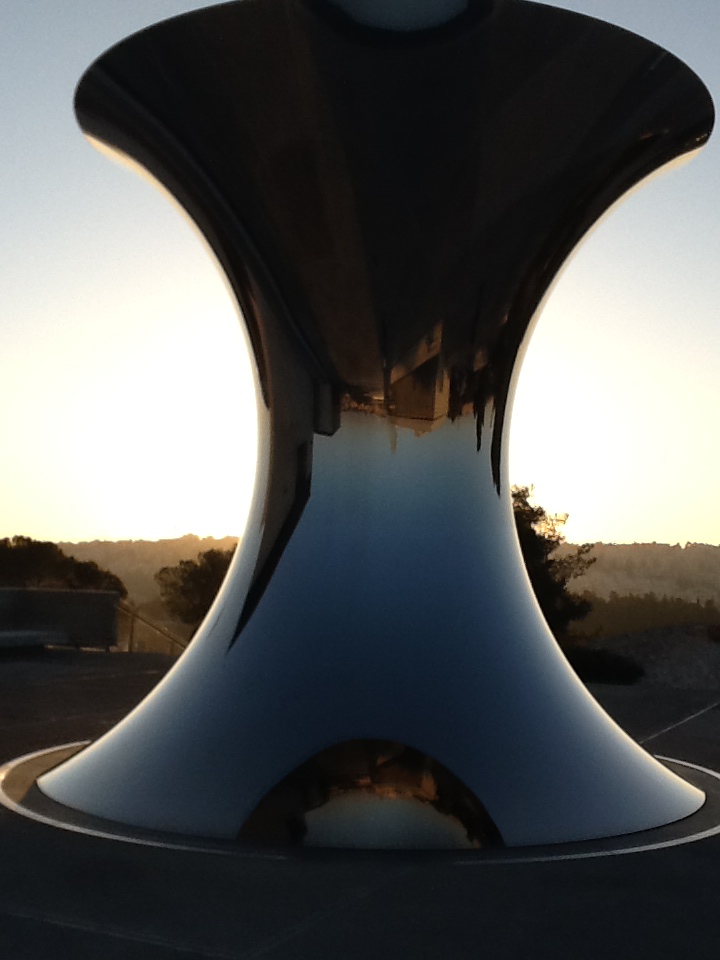
Outside of the museum, in addition to gorgeous views, is a wonderful sculpture garden. When I saw this piece, I immediately thought of The Bean in the Millenial Park in Chicago, another polished stainless steel structure that is meant to be mirror-like. Sure enough, when I came home and Googled, I found that Anish Kampoor was the artist of both. He is an Indian-born British artist who used to live in Israel, born to a Hindu father and a Jewish mother (whose family had immigrated to India from Baghdad — there is a still a Baghdadi Jewish community in India).

Anish Kapoor

This evening I met with an HUC rabbinical student who contacted me after I taught there last week, seeking some advice and counsel. Her concerns, her doubts, her fears brought me back to my own rabbinical school days of uncertainty, questioning and doubting. I hope I allayed her fears — she seems to be exactly where she needs to be, doing exactly what she should be doing.

May that be the same for all of us — that we find ourselves exactly where we need to be, doing exactly what we should be doing. Amen!

10 Shevat/January 20, 2013