Seville and Passover

On Friday we arrived in Cadiz, and took a tour bus to Seville, about 1-1/2 hours away. Three operas are associated with this lovely city: Carmen, Don Giovanni, and the Barber of Seville. Though ours was not a tour specializing in Jewish sights as our Barcelona one had been, the walking tour focused a good deal on la Juderia, the Jewish quarter of Seville, focusing on the relationship between the three cultures of Islam, Judaism, and Christianity. It was pointed out that the Juderia was very close to the palace because the Jews (pre-Inquisition) were protected by the crown due to their relative wealth, education, and know-how. The guide, Lola, is herself the descendant of Conversos, noting that her last name — Romero — means “rosemary,” and that the converted Jews discarded their distinguishable Jewish surnames and often replaced them with words for fruits and herbs like Romero, Nanjara (“orange”), Manzana (“apple”), etc. Anyone with nature words as a last name is likely a descendant of Conversos, she said (I have some research to do to verify that!)

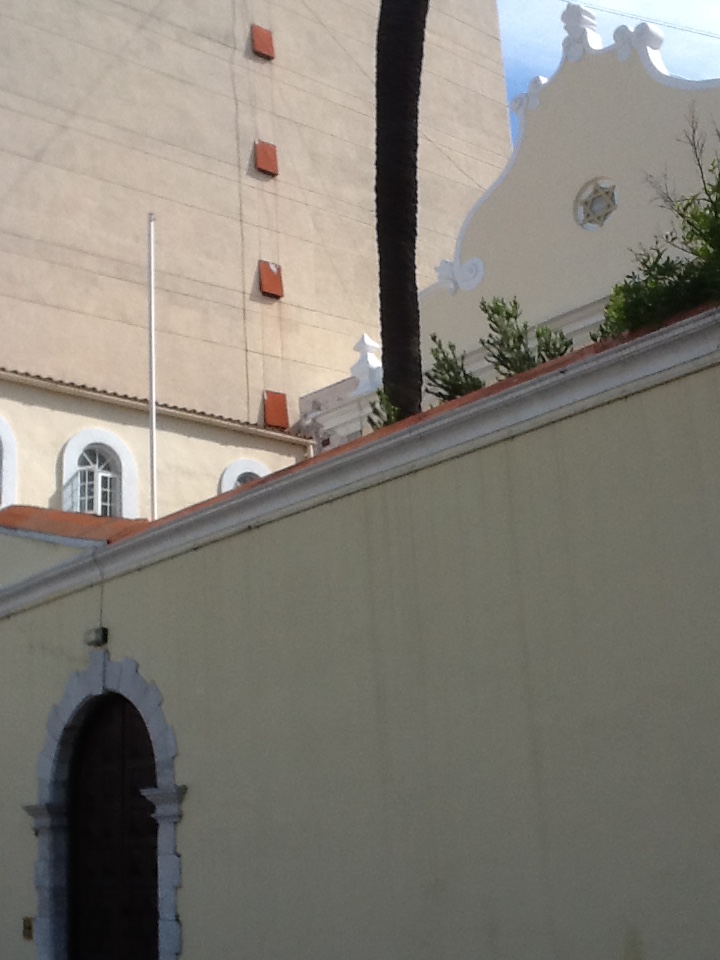
This symbol that says "Sefardi" in Hebrew is an indication of Jewish sights throughout Spain.

This symbol that says “Sefard” in Hebrew is an indication of Jewish sites throughout Spain. The black space also artistically incorporates the Hebrew word “yizkor” (an imperative meaning “Remember!”).

The large Spanish plaza in Seville, built for the World Expo in 1929, has a magnificent tiled display representing each province of Spain and is the most visited landmark in Seville. While there, I was in the midst of choosing from some beautiful hand-painted fans when the young female merchant hurriedly packed up her wares and ran away — along with scores of other merchants. We saw the police enter the square and realized that there must be regular round-ups of these illegal peddlars. Many of the merchants actually left their stuff behind on the ground rather than be caught with it! It was a sad sight. Julie remarked that these might be Romas (the proper name for gypsies).
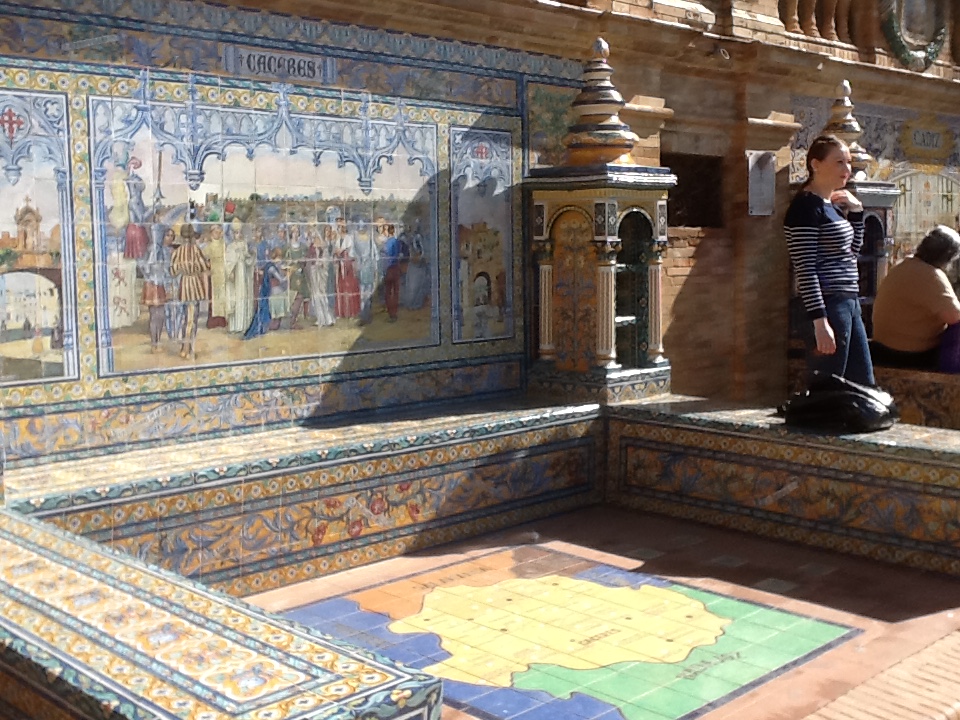
Spanish Plaza in Seville --One of my the provinces represented by a map on the ground and a tiled representation of its history.

Spanish Plaza in Seville — one of the provinces represented by a map on the ground and a tiled representation of its history on the wall behind.

Spanish Plaza

More of the expansive Spanish Plaza

On our tour we also passed the plazas of many other countries that were built for that Expo, as well — the U.S., Argentina, Peru, Guatemala, etc., each unique in its own right. The Plaza of the Americas was actually built by Spain to honor Columbus’s “founding” of the New World. He is quite the hero here in Spain, notably for bringing things like tobacco, coffee, and chocolate back to the Old World.

Of course, we also visited the famed Alcazar, a Moorish palace built for the Spanish King. Again, the three cultures of Islam, Christianity, and Judaism were featured in the design and architecture (all done by the best Muslim architects and artists of the time), with Jewish stars, Hebrew words, verses from the Koran in Arabic, and Christian iconography, all featured. The beautiful gardens themselves cover 18 acres!

I'm a sucker for shots of beautiful doorways. This is an original wood doer at Alcazar.

I’m a sucker for shots of beautiful doorways. This is an original wooden door at Alcazar. Everything was exquisitely and colorfully tiled or carved
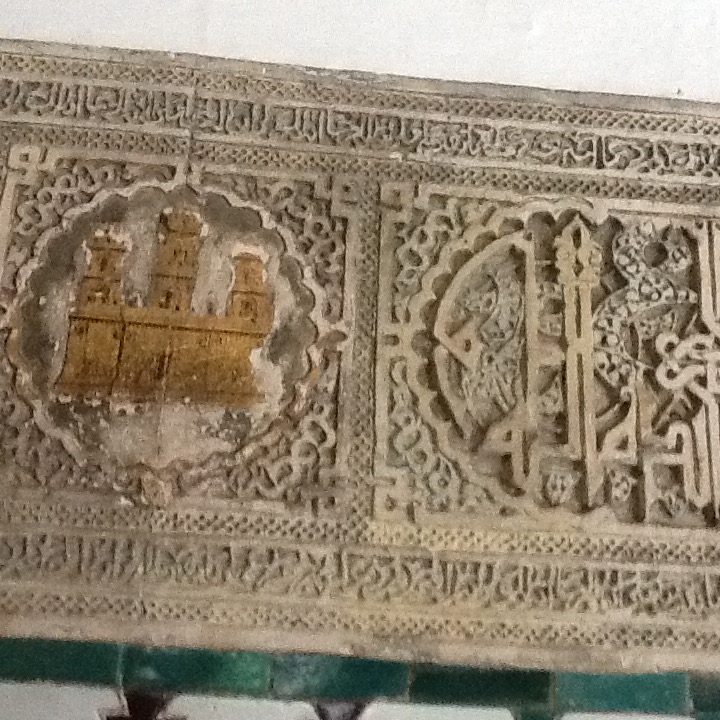
Alcazar decorations showing both Islamic and Christian imagery

Alcazar wall decorations showing both Islamic and Christian medieval imagery

Thanks to the advice of my colleague Rabbi Shira Milgrom, I knew to visit one particular Seville spot off the beaten track during our free time. Julie and I found space #9 in an underground parking garage just outside the Juderia. Apparently the garage was built on top of the community’s Jewish cemetery. Behind that parking space is a glass window display of one of the cemetery’s sarcophagi. May he/she rest in peace. And may the daily parkers in Space #9 (and elsewhere in that garage) know that they park on holy ground.

You can see the reflection of the car in the glass that encloses the sarcophagus

You can see the reflection of the car in the glass that encloses the sarcophagus

When we returned to the ship it was time to ready myself for the Passover seder. This year is THE year of freedom for me — no Passover cleaning or cooking responsibilities. What a welcome reprieve! We had about 75 seder guests. Most of them were Israelis who had packed their own haggadot and matza (including Mordecai who handed over his handmade shmurah matza for the occasion), not expecting a seder onboard. They were all duly impressed (as I was) by the extraordinary efforts of Holland America to provide such an elaborate (and kosher) seder meal for us. They even had a complete Seder plate for each and every table (over 20!) We had a blast, and I received such heart-felt thanks from everyone who came!
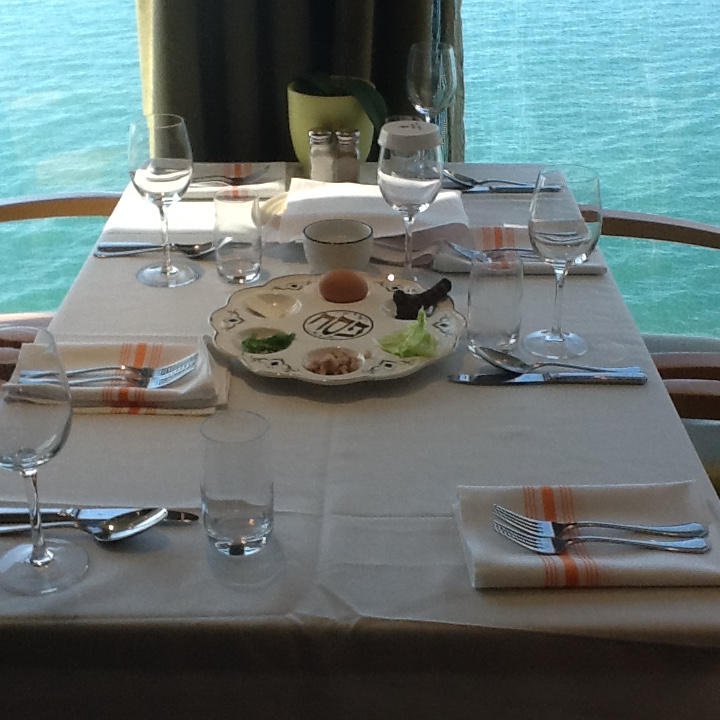
Seder table - note the Mediterranean Sea just outside the window. I was glad to be in a boat and not crossing the Sea by foot, as the Israelites did!

Seder table – note the Mediterranean Sea just outside the window. I was glad to be in a boat and not crossing the Sea by foot, as the Israelites did!

Since Saturday was a day at sea on our return to Barcelona without a port stop, it was truly a day of relaxation. I davenned, walked for an hour around the deck for Holland America’s “On Deck for a Cure” cancer fundraiser, had a massage, swam ( I swam every day this week and was the only one in the pool each time until today), and then in the evening convened an alternative Passover experience (seder “lite”). Julie and I then went to see a late movie (the 4th one I went to this week!)

Julie paid for an exclusive behind-the scenes tour of the inner workings of the cruise ship. All week long, she was asking questions about “how do they this or that?” so she finally had a venue to get all her questions answered! There are 110 chefs onboard, for instance, and our drinking water is desalinated sea water! The captain does far more than navigate — he oversees all departments from guest services to personnel, and she also learned that crew works a certain number of months on before getting a certain number of months off. There is an amazing string quintet onboard who plays on the ship’s Lincoln Center Stage, and Julie (herself a professional musician and founder of an amazing nonprofit called Shelter Music Boston), also was sure to get the scoop on how they got this gig.
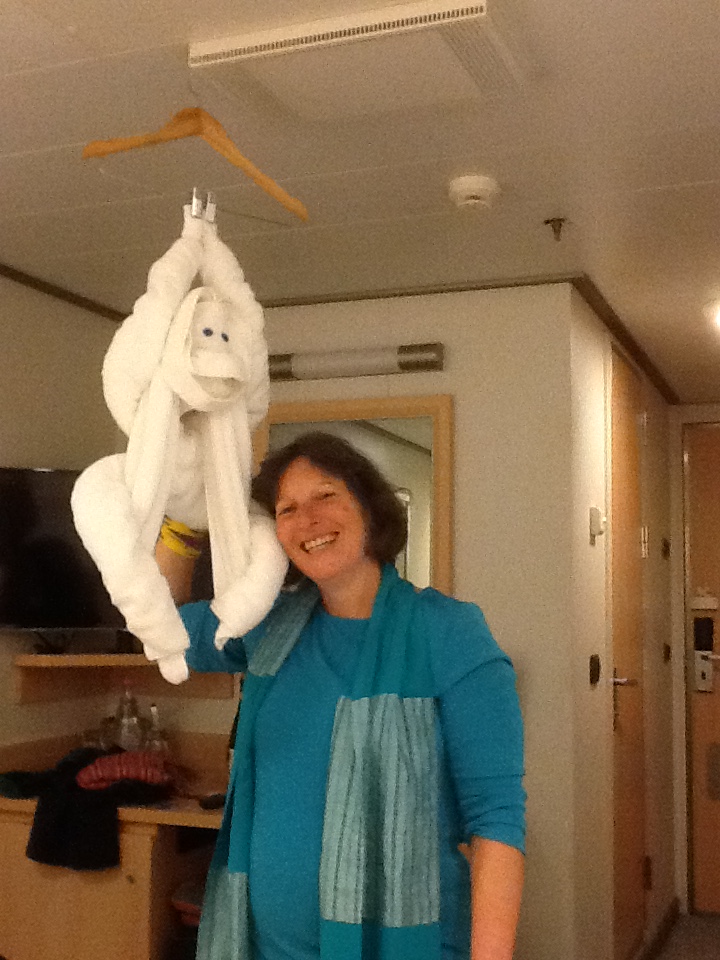
Our cabin steward, Joni, creates a different "towel" animal each night. After Seder, we came back and were surprised by the monkey hanging from our ceiling!

Our cabin steward, Joni, creates a different “towel” animal for our room each night. After Seder, we came back and were surprised by this cutie-pie monkey hanging from our ceiling!

I asked if she needed an officiant, but the bride assured me that the Captain was to perform the ceremony.

I asked if she needed an officiant, but the bride assured me that the Captain was to perform the ceremony. Later Julie told me that the Captain is actually not allowed to do weddings (something she learned on her ship tour). I hope the bride and groom know that!

It is late Saturday night, the second day of Passover, and the first day of the counting of the Omer. It is both the day and the week of chesed, loving-kindness.  As Julie and I head back to the U.S. tomorrow, may we carry these great memories with love in our hearts. I am so grateful for this opportunity to have travelled to Spain, learned so much, been of service to others, and been in the good company of such an old, dear friend.

Shavua tov and Chag Pesach sameiach.
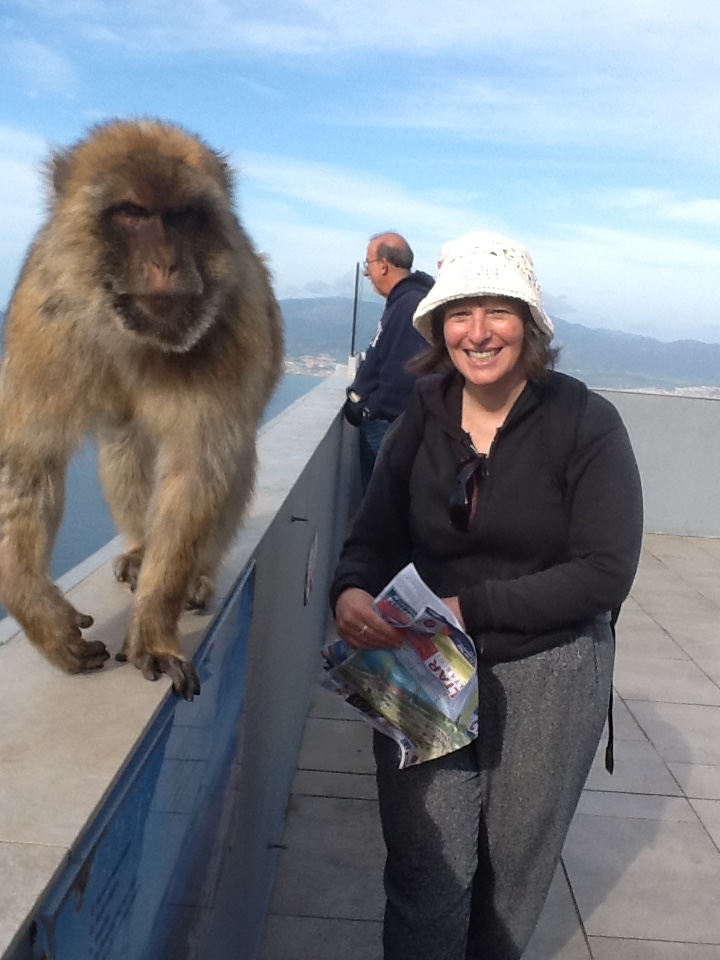
Gibraltar

The Barbary ape and me in Gibraltar

The Barbary ape and me in Gibraltar

Yyone of the 4 synagogues in Gibraltar (all Orthodox and in use). Lots of kosher markets, too. Who would've thunk?

One of the 4 synagogues in Gibraltar (all Orthodox and in use). Lots of kosher markets, too. Who would’ve thunk?

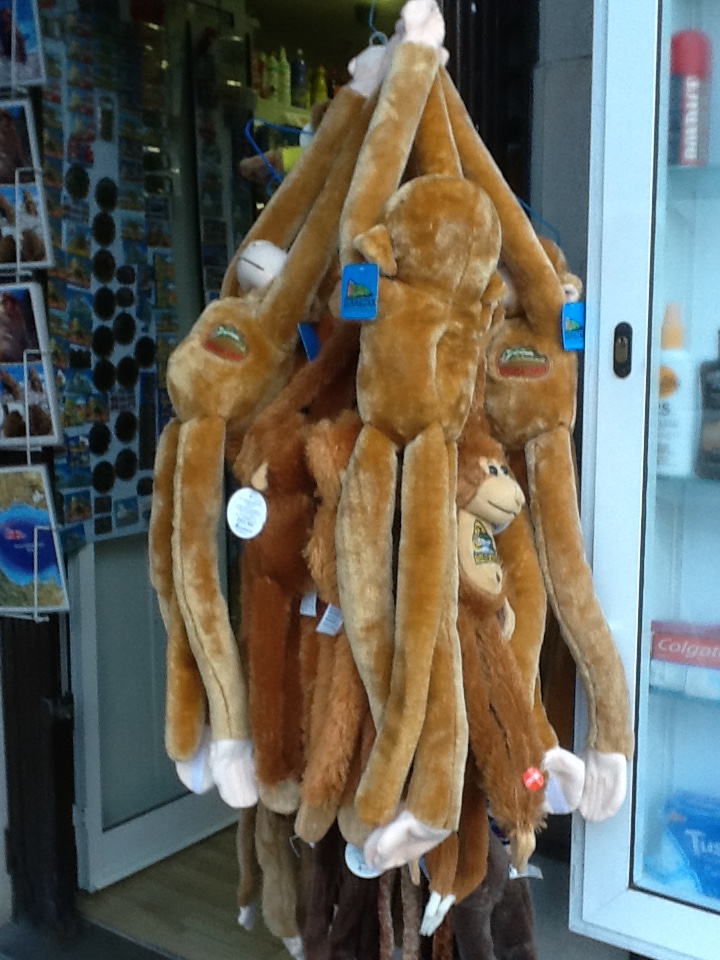
Monkeys sold in the street

Monkeys sold in the street

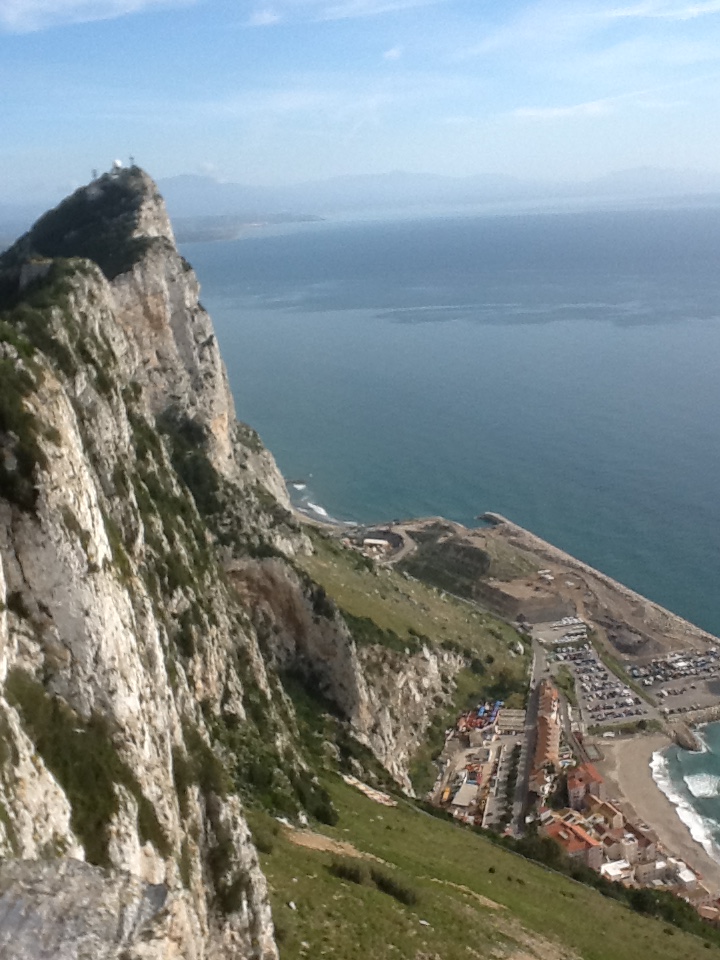
Rock of Gibraltar

Rock of Gibraltar

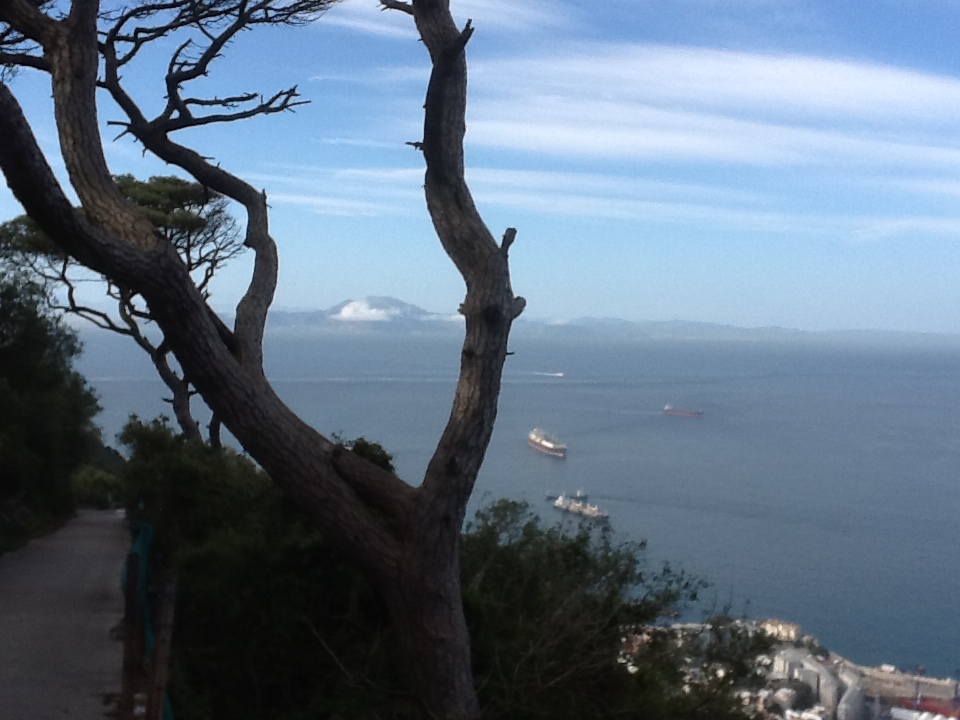
The Rif mountains of Morocco across the Strait of Gibraltar

The Rif mountains of Morocco across the Strait of Gibraltar

Cartagena and Cordoba

Street performer (head inside red shirt), Cartagena

Street performer (head inside red shirt), Cartagena

Ship view from castle, Cartagena. It's humongous!

Ship view from castle, Cartagena. It’s humongous!

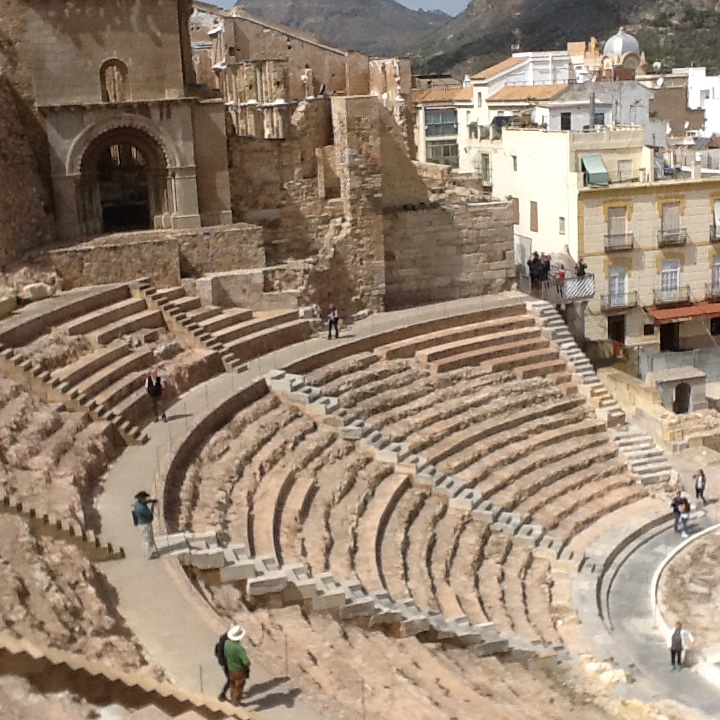
Roman theatre, Cartagena

Roman theatre, Cartagena

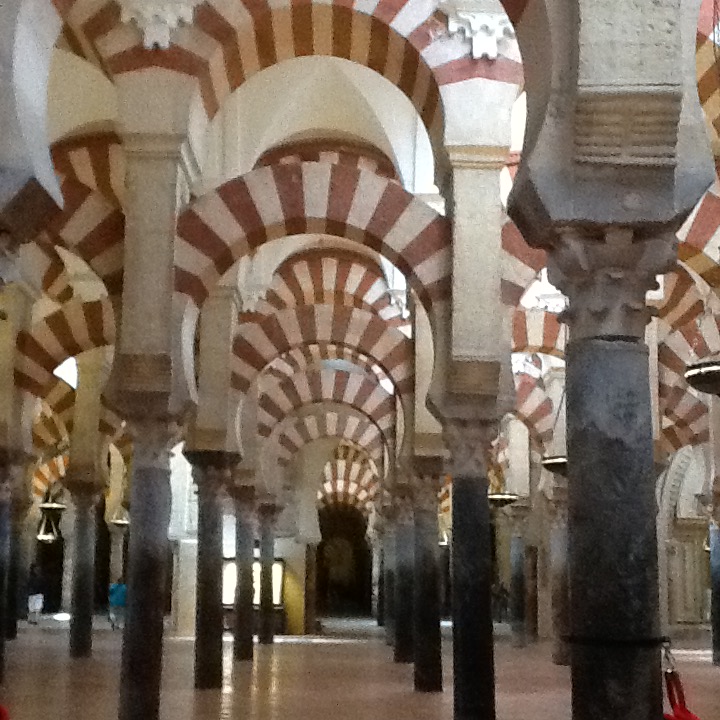
The Mezquita, Cordoba. Amazing!

The Mezquita, Cordoba. Amazing!

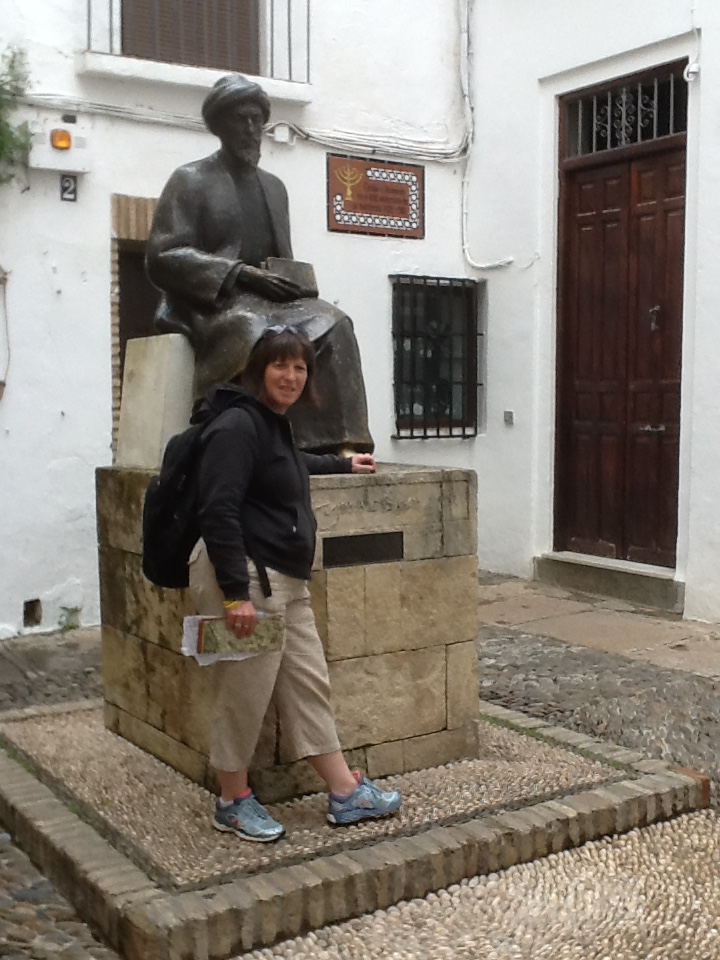
Me and My friend Maimonides in Córdoba

Me and My friend Maimonides in Córdoba

Display on the Inquisition in the Sephardic museum, Cordoba. I wonder if the KKK fashioned their garb on this get-up.

Display on the Inquisition in the Sephardic museum, Cordoba. I wonder if the KKK fashioned their garb on this get-up.

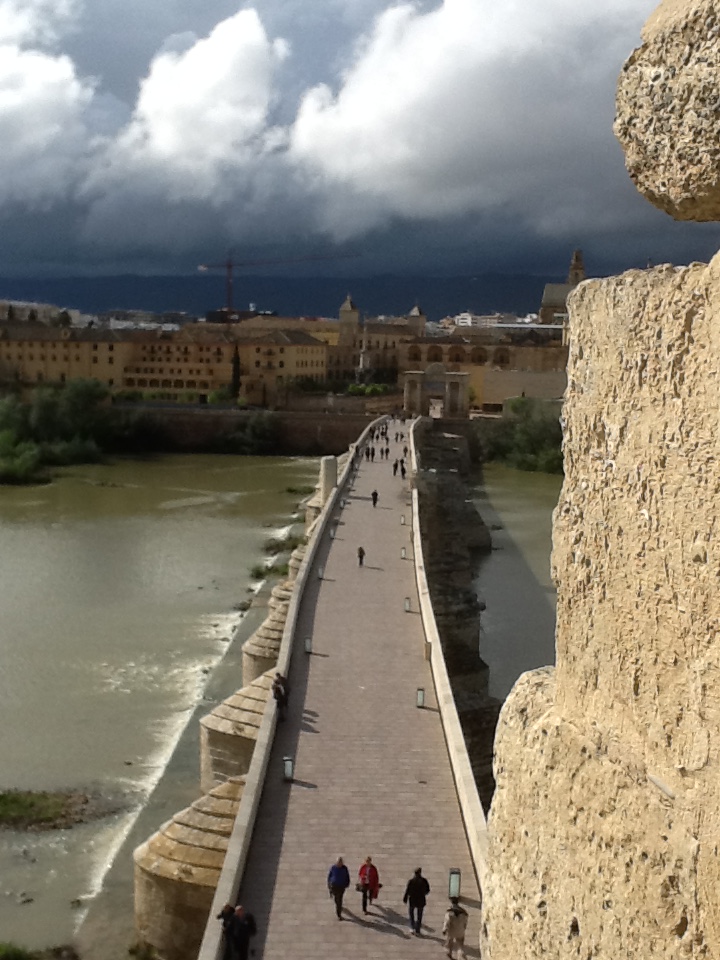
The bridge walk in Córdoba between the town and the tower (view from tower)

The bridge walk in Córdoba between the town and the tower (view from tower)

Cartagena has been an important strategic location throughout history — for the Romans, then under Muslim rule, and more recently during the Spanish Civil War.

This Roman theatre is considered one the finest examples in the world. We also toured its museum of Roman antiquities, a castle, the Shelter Museum of the Spanish Civil War, and walked the lovely walking promenade of shops (including an Apple Store where I got free Wifi and could post yesterday’s blog), and saw street performers like this guy (gal?) above.

It was a day of lost-and-found. We were both just so exhausted from all we’ve been doing, and I’d only gotten 3 hours of sleep the night before. Julie thought she lost her credit card and bank card and went running back to the ship to see if she’d possibly left it in our room-safe. If not, she was going to have to call her husband in the US to cancel the credit card. Shortly thereafter, I found the cards under the seat where we were seated at a cafe and went running after her. Later in the day I went to the front desk of the ship, having misplaced my neck pillow (just purchased in Hawaii) when checking onboard on Sunday. And they had it!

In the meantime, I’ve been trying to work out the details of the Seder with the activities director and dining staff. They actually are preparing everything: gefilte fish, charoset, chicken soup, potato kugel, Empire kosher chicken, matza, macaroons! I’ve always been impressed by Holland America in this regard on all my previous trips — having served twice for Rosh Hashanah and once for Chanukah). They have had all of the necessary ritual objects : prayer books, yarmulkes, kosher wine, electric candlesticks and chanukiah and have prepared traditional foods (challah for Shabbat and a round one with raisins plus apples and honey for Rosh Hashanah, latkes for Chanukah, and that amazing Chinese buffet — plus movie — for the Jewish guests on Christmas Day!) And now a full Seder!

Yesterday our boat docked in Malaga. It was pouring! We took a taxi from the boat to the train station and took a train to Córdoba. Fortunately it wasn’t pouring once we got there (though “the rain in Spain lies mainly on the plain” was thereby disproven). However, later on while eating in a Sephardic restaurant (where I experienced some of the most exquisite flavors of my life, including a gazpacho of orange, ginger, rose tea, and dried flowers), it actually hailed!

We toured La Mezquita, both a mosque and church, — whoa, beautiful! — the Juderia (Jewish quarter) — including an old synagogue (from 1315, recently restored) and a Sephardic Jewish museum, in addition to visiting a museum in a tower that featured the relationship of Jews, Christians, and Muslims. Learned lots, and loved all the Maimonides history. He was born in Córdoba. (When in Morocco 2 years ago, I had seen his home in Fez, where he lived after Spain.)

Today we are in Gibraltar, but I’ll have to post about that tomorrow from Seville. Lots if Internet troubles, I’m afraid. Ciao!


Jewish Barcelona, the Eurodam, and Valencia

Sunday morning, Laura, Julie and I met Dina, our Israeli guide, who took us on a private tour of the Gothic quarter of Barcelona, with a focus on the Jewish history there.

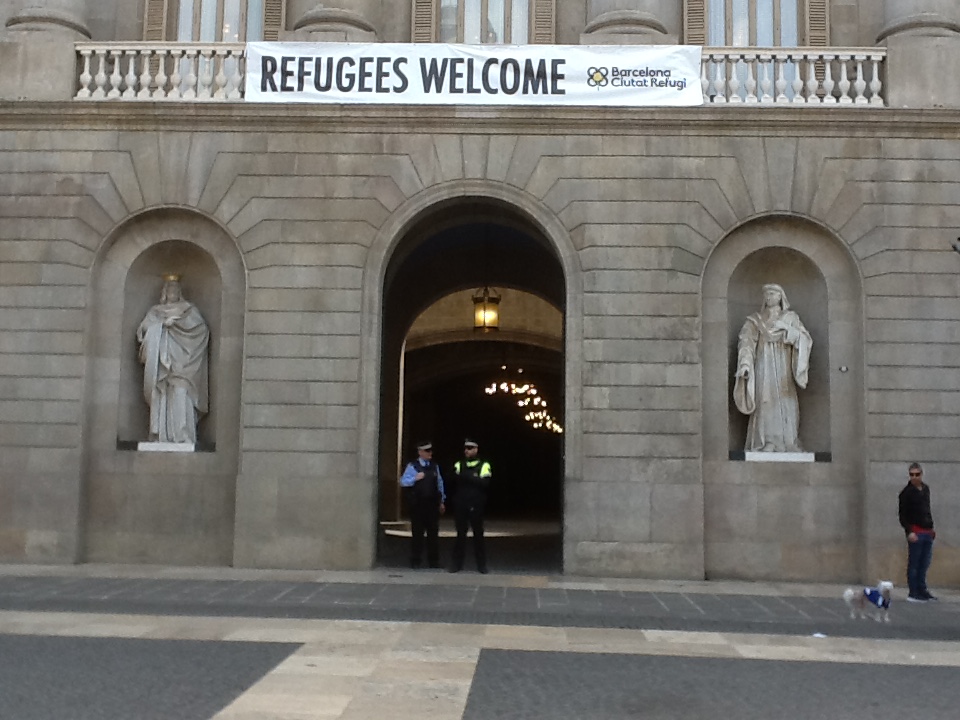
We met Dina in this square where the municipal buildings are. The progressive female mayor has this sign over the entrance of her headquarters.

We met Dina in this square where the municipal buildings are. The progressive female mayor has this sign (“Refugees Welcome”)  over the entrance of her headquarters. Brava!

At one point of the tour, I just broke down in tears, as the overwhelming history  of Anti-Semitism overwhelmed me. Fully 1/4 of this whole area of narrow, winding streets was originally the Jewish quarter (called the Calle, as opposed to La Juderia, as it is called elsewhere in Spain) and there were 5 synagogues there.

Torah scroll from medieval times in the old synagogue we visited, which was excavated and restored by an Argentinian Jew.

16th C. Torah scroll in the old synagogue we visited. The synagogue was excavated and restored by an Argentinian Jew.

However, Jews probably settled in Barcelona as earlier as Roman times in the 9th century! We also saw where the great Disputation of Barcelona between the great medieval Jewish commentator Nachmanides and his  Dominican accusers took place in 1263. It was a debate to prove whether Jesus was the true Messiah or not. Though you can guess who won, Nachmanides did not lose his life. Rather, King James of Aragon was so impressed by Nachmanides that he gave him money (300 gold coins!), said that he had never heard an “unjust cause so nobly defended,” and sent him packing. Nachmanides made his way to Jerusalem and founded a synagogue there. However, on the Shabbat just after the debate, King James visited the great synagogue in Barcelona (the one we visited), something unprecedented. What would have happened had the king actually intervened to say that Nachmanides HAD won the debate, as it seems he may have believed?

Three other famous Jews from Barcelona were Abraham bar Chiya – 11th C. astronomer and astrologer, some of whose scientific Hebrew words are still in use today; the Rashba – whose responsa can be found in the medieval Jewish code the Shulchan Arukh; and Hasdai Crescas, a medieval Jewish philosopher.

Hebrew inscription

Hebrew inscription on a city wall. Apparently the Jewish cemetery was desecrated and these stones were used (“recycled” if you want to be generous). We saw several such stones with Hebrew inscriptions.

Jews were originally expelled from Barcelona in 1391. 70% of the Jews converted to Christianity, 300 were burned to death, and the rest escaped. The Catalon Synagogue in Rome, still in use today, was founded by some of these escaped Jews (Barcelona is in Catalonia, speaks Catalan as its official language, and has tried time and again to get its independence from Spain.) Those Jews who were left in 1492 at the time of the Inquisition were forced converts called Anusim (Marrano is a pejorative term). Dina also gave us some fascinating lore about Christopher Columbus and why there is speculation that he was Jewish (or more likely a forced convert) trying to escape the Inquisition, whose purpose it was to root out the “false” new Christians.

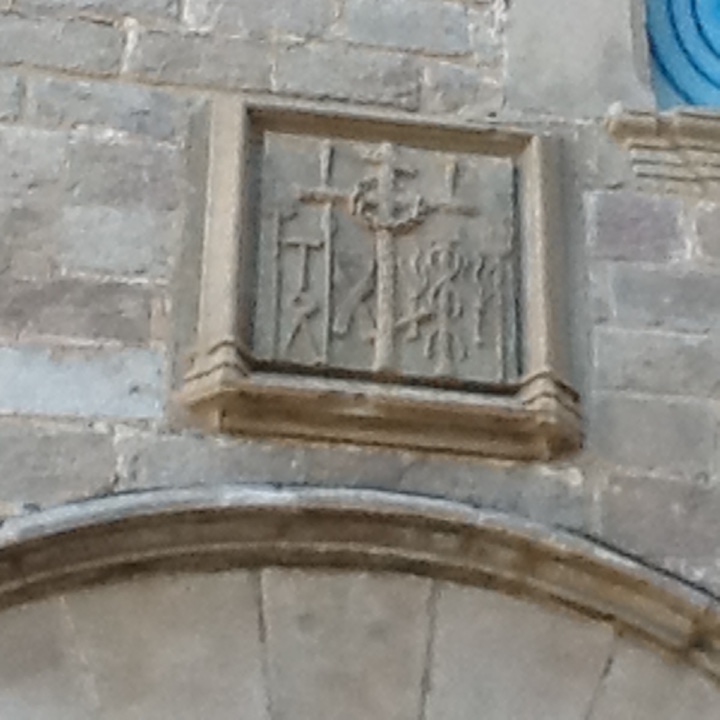
Inquisition Headquarters. For those who could t read, the symbols of torture depicted on the overhead plaque made it clear.

Inquisition Headquarters. For those who couldn’t read, the symbols of torture depicted on the overhead plaque made it clear.

Fourteen different haggadot were produced in Barcelona. 13 of the 14 recently were recently exhibited in Barcelona, and Dina thought the exhibit was now on tour. I hope it comes to New York! For those who read Geraldine Brooks’ novel “People of the Book,” you will get some history of the famous Sarajevo Haggadah.

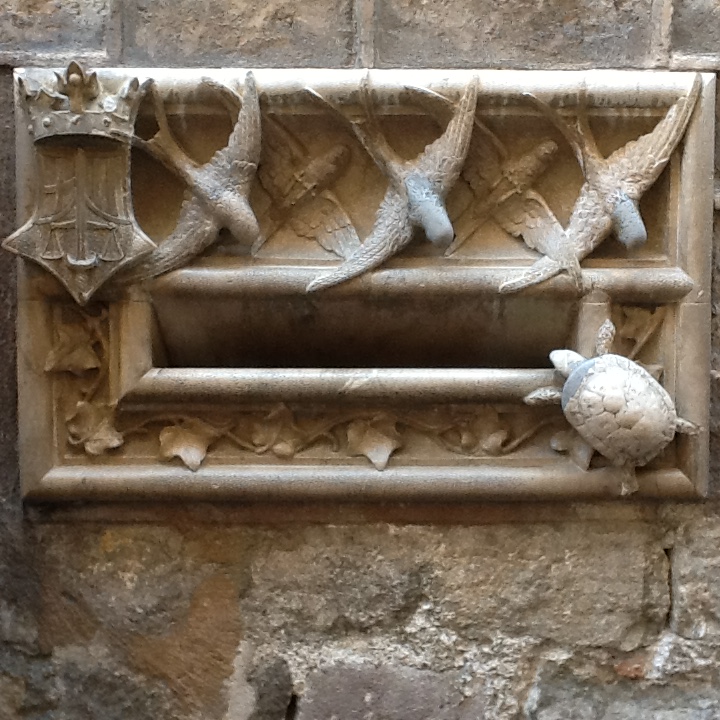
Here is another sign in symbols. If I told you it was the Lawyers' Guild headquarters, do you know what the birds and the turtle represent?

Here is another sign in symbols. If I told you it was on the entrance to the Lawyers’ Guild headquarters, can you guess what the birds and the turtle represent?

Bullet holes from the Spanish Civil War

Bullet holes in Barcelona from the Spanish Civil War

After our wonderful tour, Julie and I picked up our luggage from Laura’s honeymoon palace and headed directly to the port, where we boarded the Eurodam ship of the Holland America line. This is my 4th cruise with them (2 previous trips to Alaska and one to Australia/New Zealand). We are 2 of the over 2900 passengers (a number which includes 850 service crew!)

Yesterday we debarked in Valencia and took it somewhat easy on the touring front (though Julie still has us logged in at over 12 miles, after we danced the night away until the wee hours. I am determined not to be one of the cruise statistics about gaining at least a pound a day on a cruise!

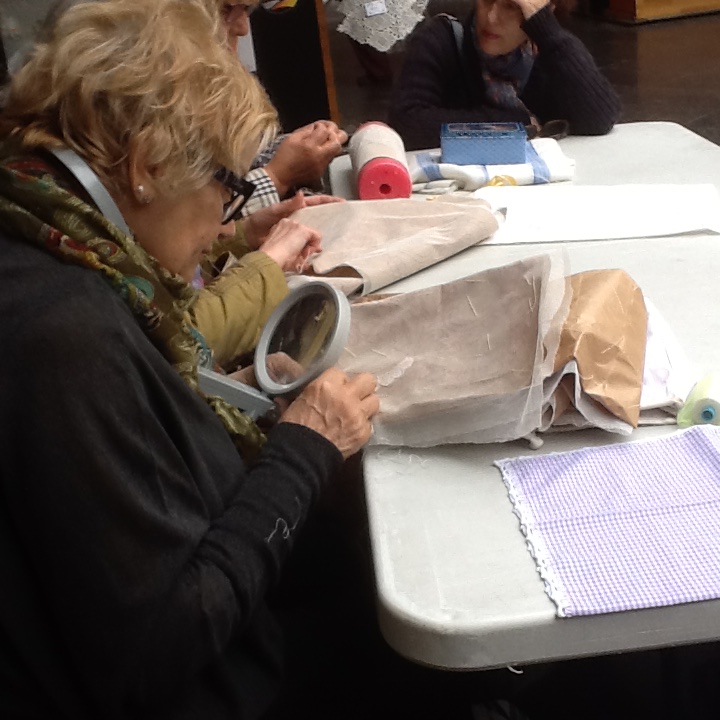
Women's lace and embroidery circles in public space, Valencia

I love my market photos! Central Market, Valencia

I love my market photos! Central Market, Valencia

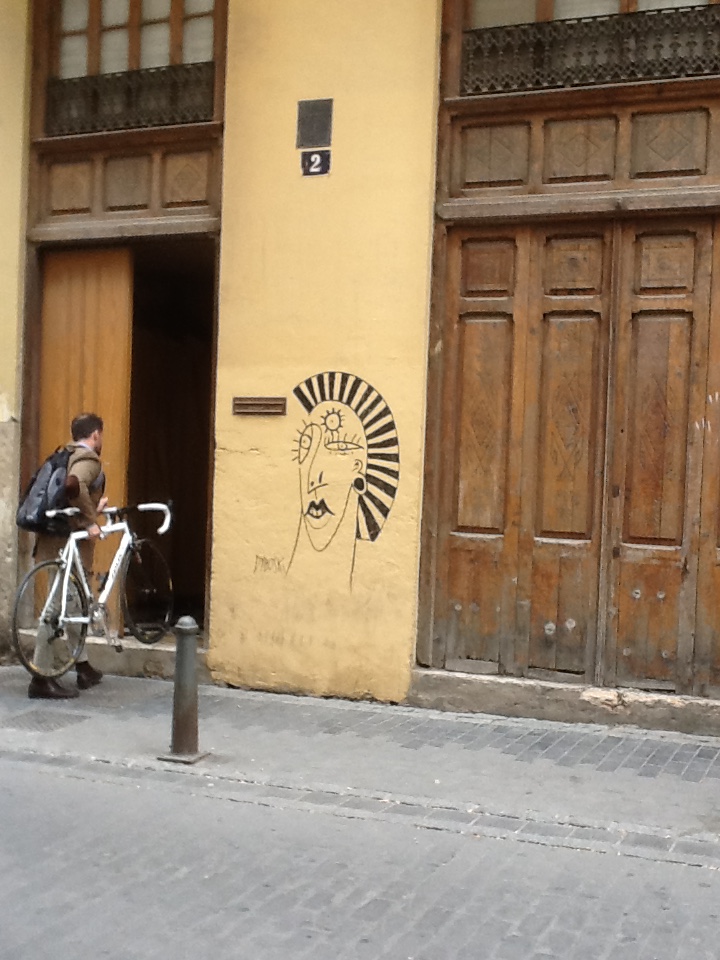
I love the doors and graffiti in Valencia!

Great doors and graffiti in Valencia!

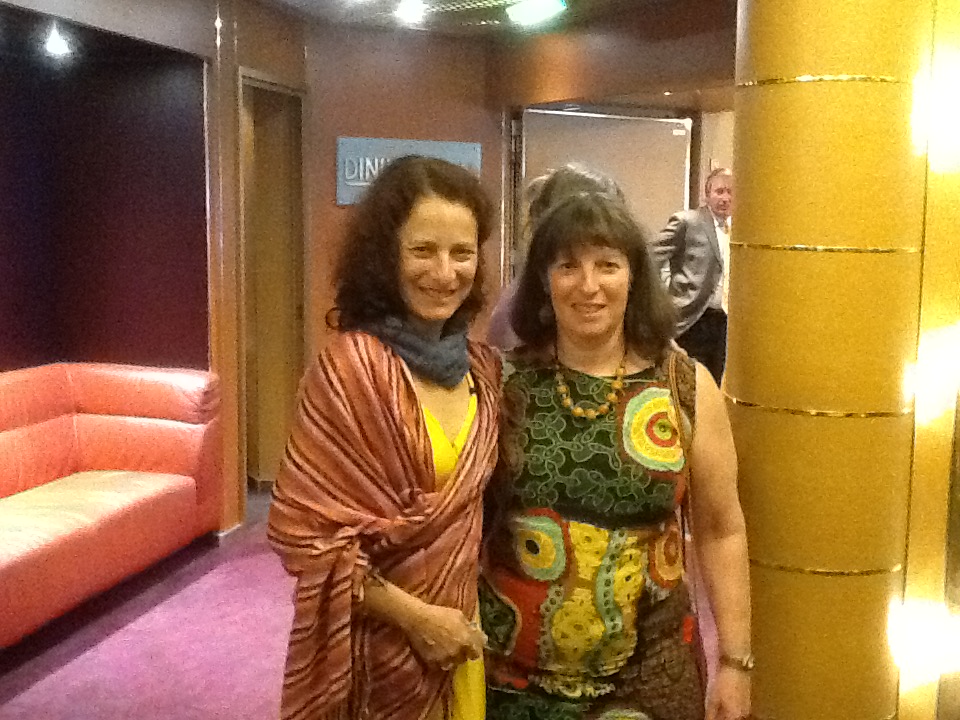
Julie and me in our gala garb for dinner, after which we danced and danced. I bought the dress for 6 euros (8 dollars)

Julie and me in our gala garb for dinner, after which we danced and danced. I bought the dress for 6 euros (8 dollars) in Valencia’s Central Market

Today we are in Cartegena, with amazing Roman ruins and a fascinating Spanish Civil War Museum. I will post pictures tomorrow.

Barcelona!

Yes, I know I just got back from a big trip to Hawaii. And I know that I have traded in 6-hour jetlag from one direction for 6-hour jetlag in the other! But in my defense, I have wanted to get to Barcelona for years. Unfortunately, Chaim is not much of a traveller, and every time I put my name in the hat to serve as rabbi on a cruise that was leaving from or ending up in Barcelona, I was never lucky enough to get that gig. But this time I hit the jackpot! A cruise that begins and ends in Barcelona that the cruise line is paying for in full for myself and a guest (usually guest staff and guest have to pay own airfare and a nominal per-day cruise fee). On this trip, my dear friend Julie (and former college roommate sophomore year) is my plus-one. Julie lives in Boston and is a professional violinist. My responsibilities will be to lead the Passover Seders on-board the ship. And in addition to Barcelona, we get a day in Valencia, Cartagena, Córdoba (Malaga port), Gibraltar, and Seville (Cadiz port). Couldn’t pass it up, would you?

Julie and I came a couple of days early to pack in as much of Barcelona as we could before sailing off tomorrow afternoon. In addition to spending rare and sacred time with Julie, my dear friend Laura (former room-mate from my days in Santa Cruz, CA whose wedding I just co-officiated at in March!) is   here with her new husband Jon, having just honeymooned in France and now in Barcelona so Jon could attend a conference. So in a wonderful confluence of calendars, Laura’s days have been free to bop around with me and Julie.

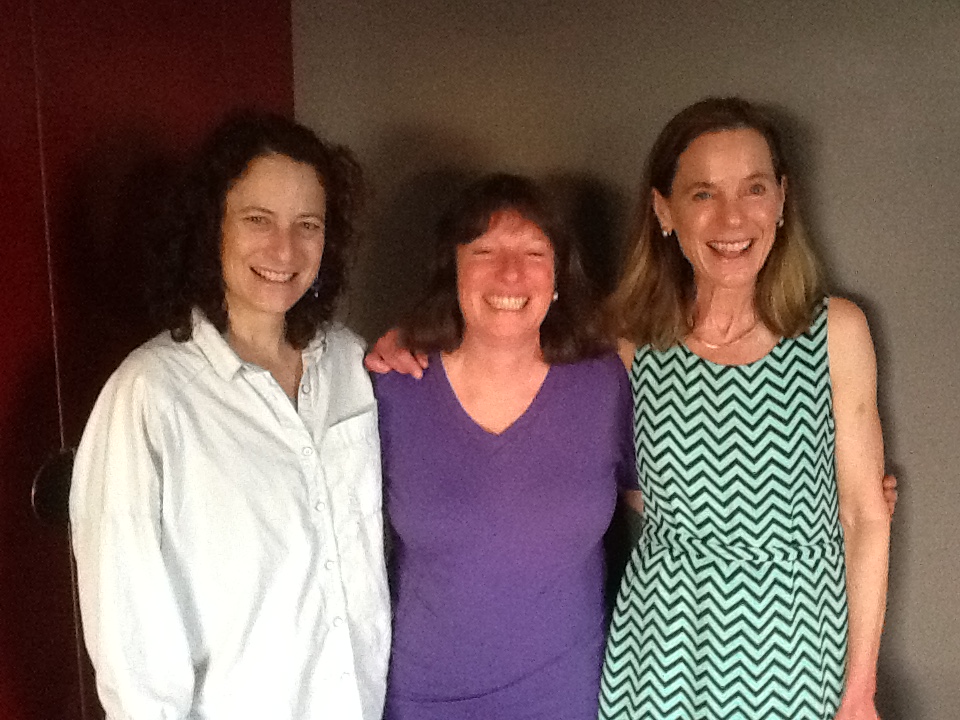
Here I am beaming between two of my dearest friends, Julie and Laura

Here I am beaming between two of my dearest and oldest friends, Julie and Laura, both former room-mates.

For me, coming to Barcelona was all about seeing the incredible architectural gems of Antoni Gaudi that are all over the city. As one of his architecture professors apparently said, “I don’t know if we just graduated a genius or a madman.” His stuff is wildly inventive! You have to see it to believe, so none of my pictures will do it justice.

Basilica of Sagrada Familia from afar. Gaudi spent over 40 years on this project, still unfinished since his death in 1926.

Basilica of Sagrada Familia from afar. Gaudi spent over 40 years on this project, still unfinished since his death in 1926.

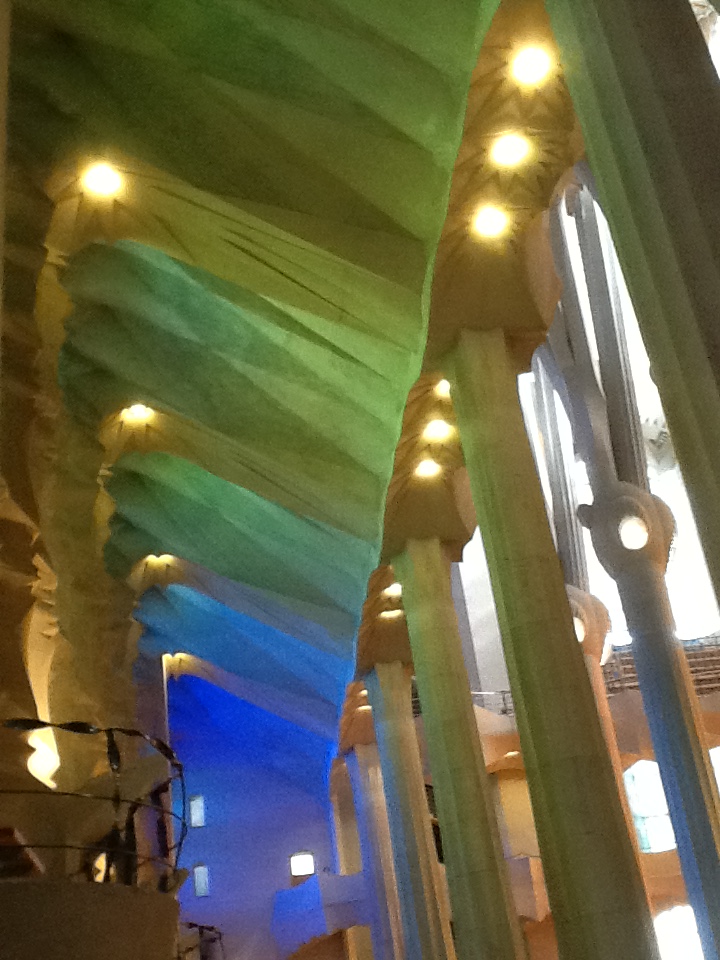
This is how the light from some of the stained glass windows lit up the ceiling. A truly awesome sight.

This is how the light from some of the stained glass windows lit up the ceiling at Sagrada Familia. A truly awesome sight.

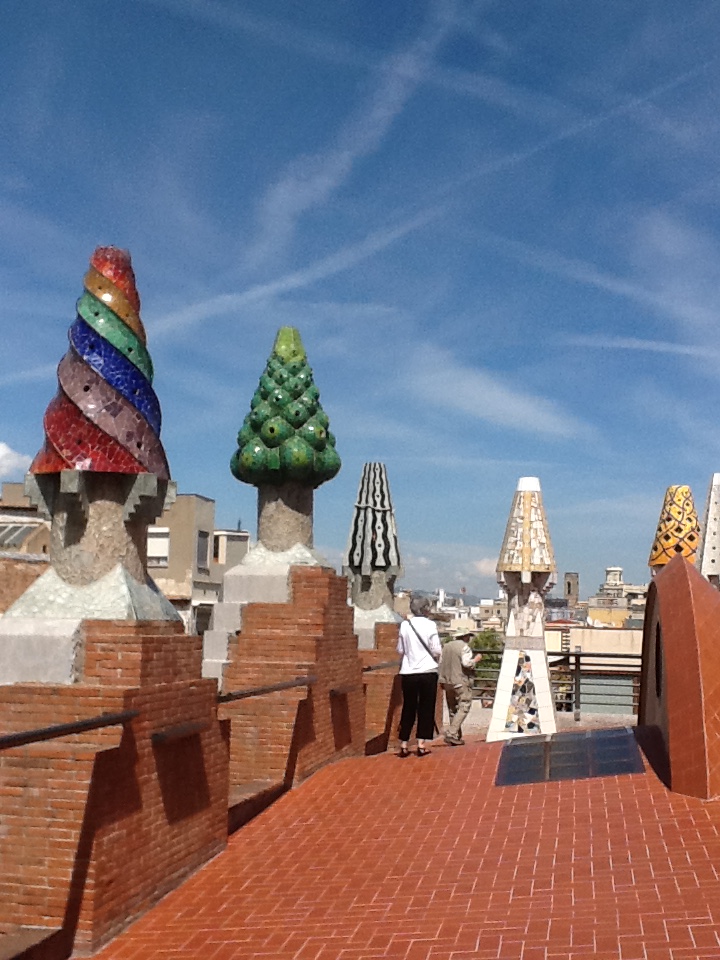
These structures are on the roof of Gaudi's Palau Guell. The inside was magnificent, but the roof was the real Wow! These are all functional vents or smokestacks. He looked at the skyline of the city and wondered why everything had to look just so darn functional and not aesthetically pleasing in any way.

These structures are on the roof of Gaudi’s Palau Guell. The inside was magnificent, but for me the roof was the real Wow! These are all functional vents or smokestacks. He looked at the skyline of the city and wondered why everything had to look just so darn functional and not aesthetically pleasing in any way.

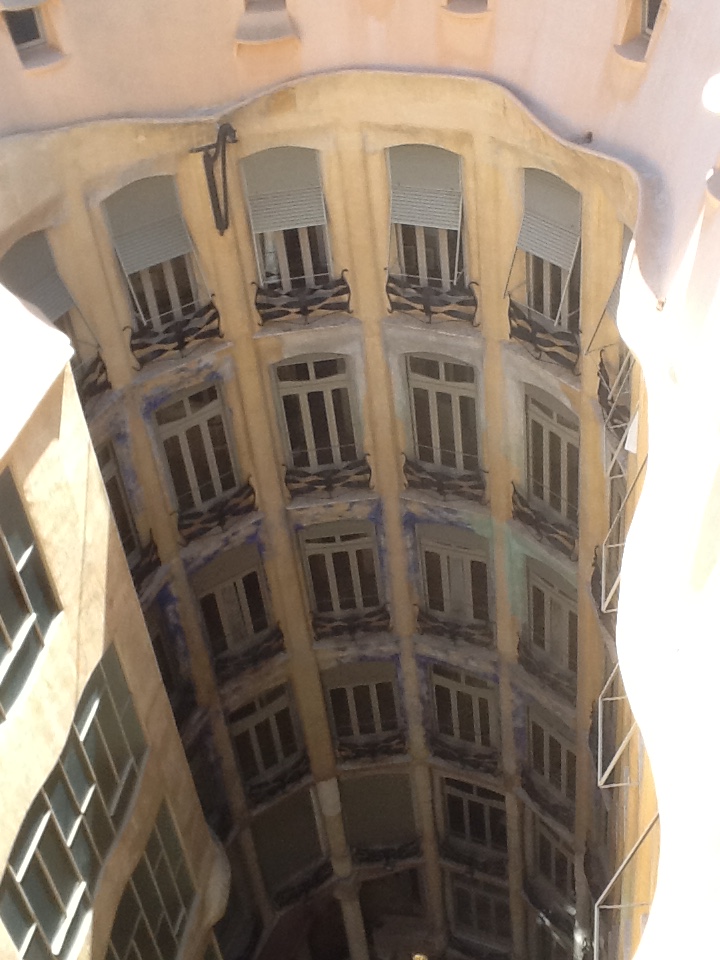
I'm standing on the roof of Gaudi's La Pedrera building photographing into the courtyard below. These are the windows of the apartments across from where I'm standing.

I’m standing on the roof of Gaudi’s La Pedrera building photographing into the courtyard below. These are the windows of the apartments across from where I’m standing. You can see how the shape undulates. Both La Pedrera and Palau Guell are UNESCO World Heritage sites.

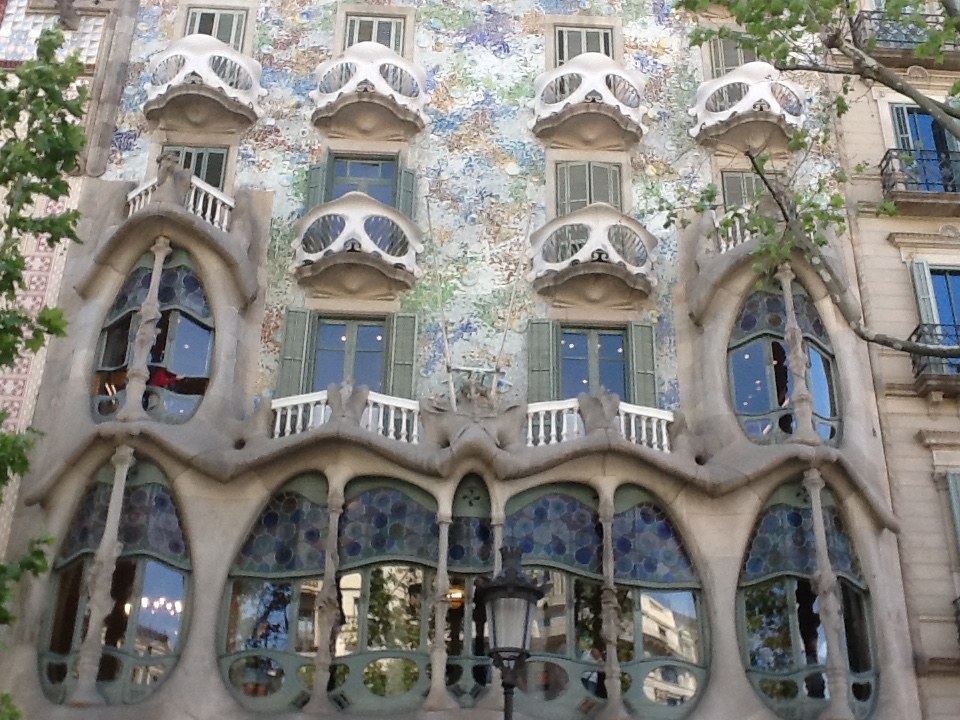
The outside of Casa Batllo, another of Gaudi's fantastical structures.

The outside of Casa Batllo, another of Gaudi’s fantastical structures.

Lest you think us fanatics, it was truly NOT all-Gaudi-all the-time. We also went to the Boqueria market off the famous boulevard La Rambla (quite wonderful, but doesn’t hold a candle to the markets I saw in Morocco), visited the absolutely revelatory Picasso museum that holds works, I assure you, that you would never believe were his, and went to the warm, welcoming Reform synagogue in Barcelona on Friday night for services and Shabbat dinner, where I was called into service to offer an impromptu d’var Torah (then translated into Spanish –possibly into Catalan, the official language,  I’m not positive — sentence-by-sentence), that actually had folks crying! That was a shining moment in my rabbinic career.

On Friday, Julie logged us in at 26,000 steps on her Fitbit step-counter. That’s about 11 miles, and that was on our first day, having arrived sleepless from a red-eye that landed at 7AM (1 AM east coast time)!

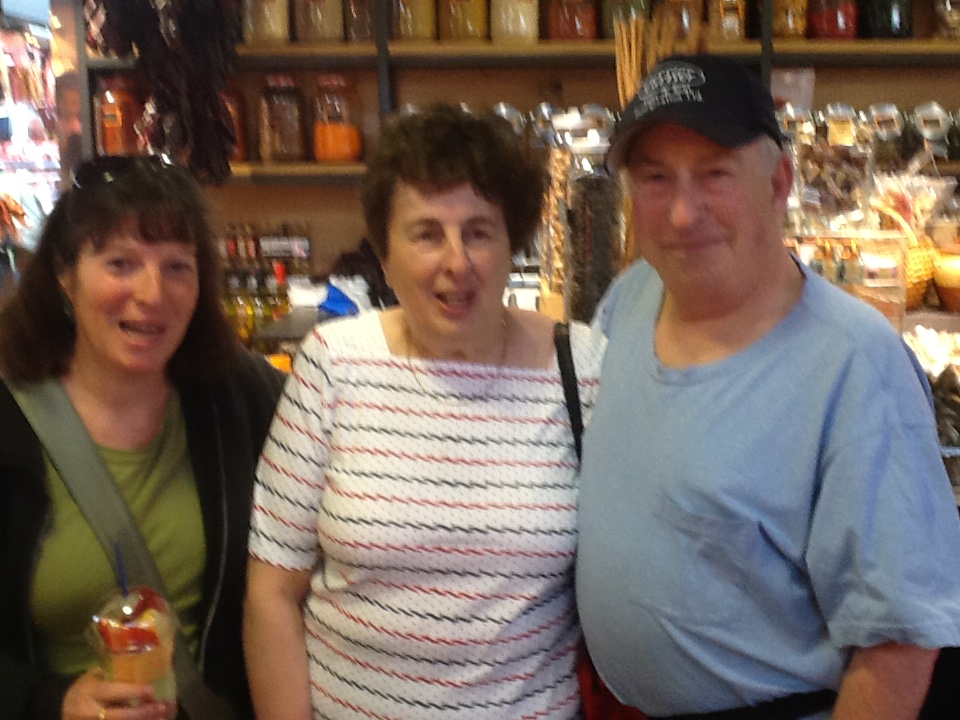
My new friends Yvette and David whom I met in the market. Ask, and I'll tell you a wonderful story about our meeting.

My new friends Yvette and David (former Brits now living in Canada) whom I met in the market. Ask, and I’ll tell you a wonderful story about our meeting.

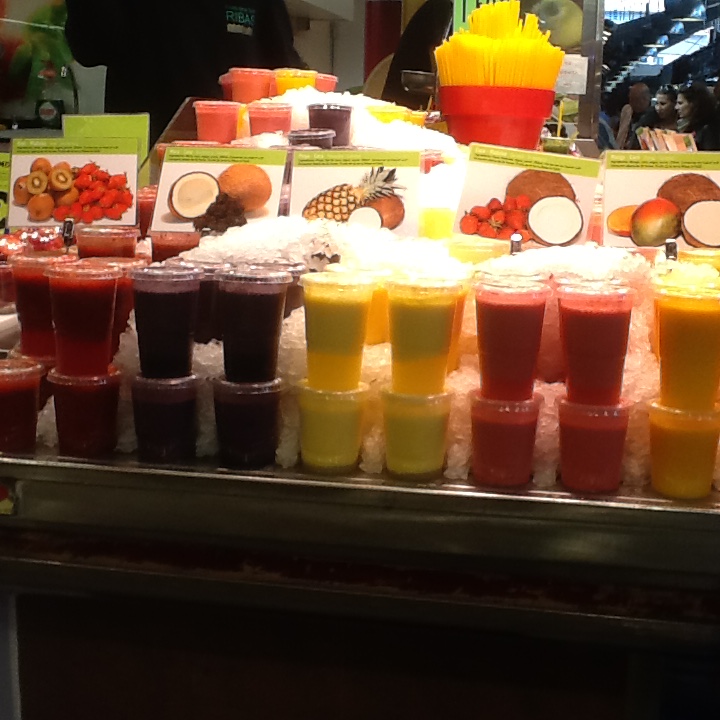
Fresh-squeezed juices lined up at a stall in La Boqueria.

Fresh-squeezed juices lined up at a stall in La Boqueria.

Tomorrow morning we will take a 2-hour private walking tour of Jewish Barcelona before heading to the ship. Gotta come back soon to Barcelona (or do I say that about every place I ever visit?)


Flying over Kauai

I am flying over Kauai, and not just because of the helicopter ride we took yesterday afternoon. Call it high, enamored with, smitten by, or got the bug — they all apply to this magical island.

Some say that the land of Honnalee of Puff the Magic Dragon fame refers to the town of Hanalei where we are staying, and that Puff’s tail perhaps refers to the land jutting out in the picture below. Somehow I got it into my head that there is a Puff museum in Hanalei and was quite disappointed when I found out that I had made it up!

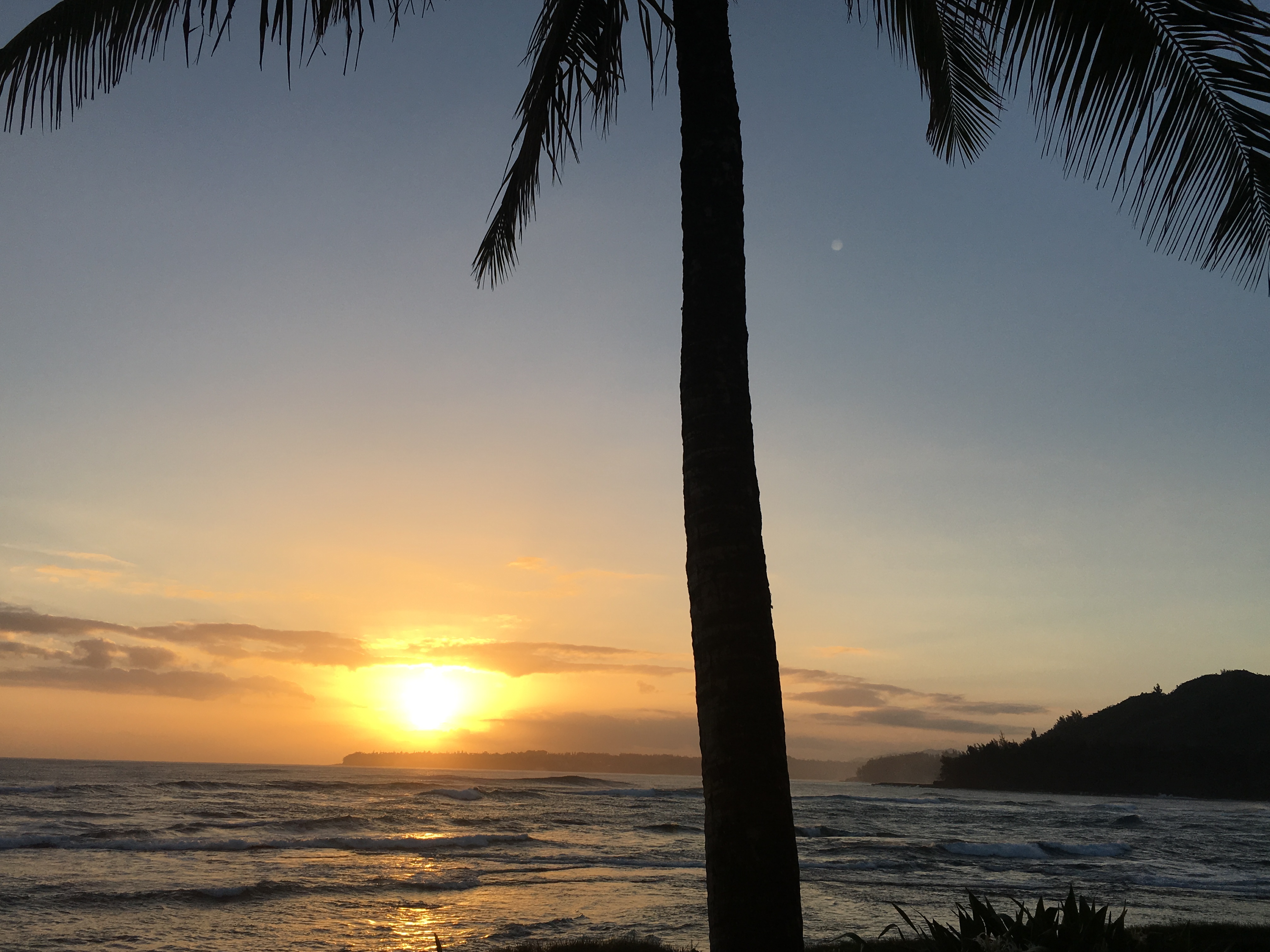
Sunrise from our condos. The land to the right might be Puff the magic dragon!

Sunrise from our condos. The land to the right might be Puff the magic dragon!

I had a great time riding the waves with the kids in the morning, finding one of the few beaches without a no-swim advisory due to dangerous conditions (Kauai is apparently known as the drowning capital of Hawaii, and Hawaii is the drowning capital of the US). Kauai has also suffered tsunamis. There is a cost to living in Paradise.

In the afternoon we had an experience of a lifetime, seeing Kauai from the air, as 70% of this exquisite island is inaccessible any other way. Jurassic Park was filmed on Kauai, which apparently has a helicopter scene showing some of the same sites we got to see. Hurricane Iniki, the most powerful to ever hit Hawaii (1992), interrupted the final day of filming for that film, just weeks after Hurricane Andrew devastated Florida. We saw some of the remaining devastation of trees from the air, though most of the vegetation has recovered.

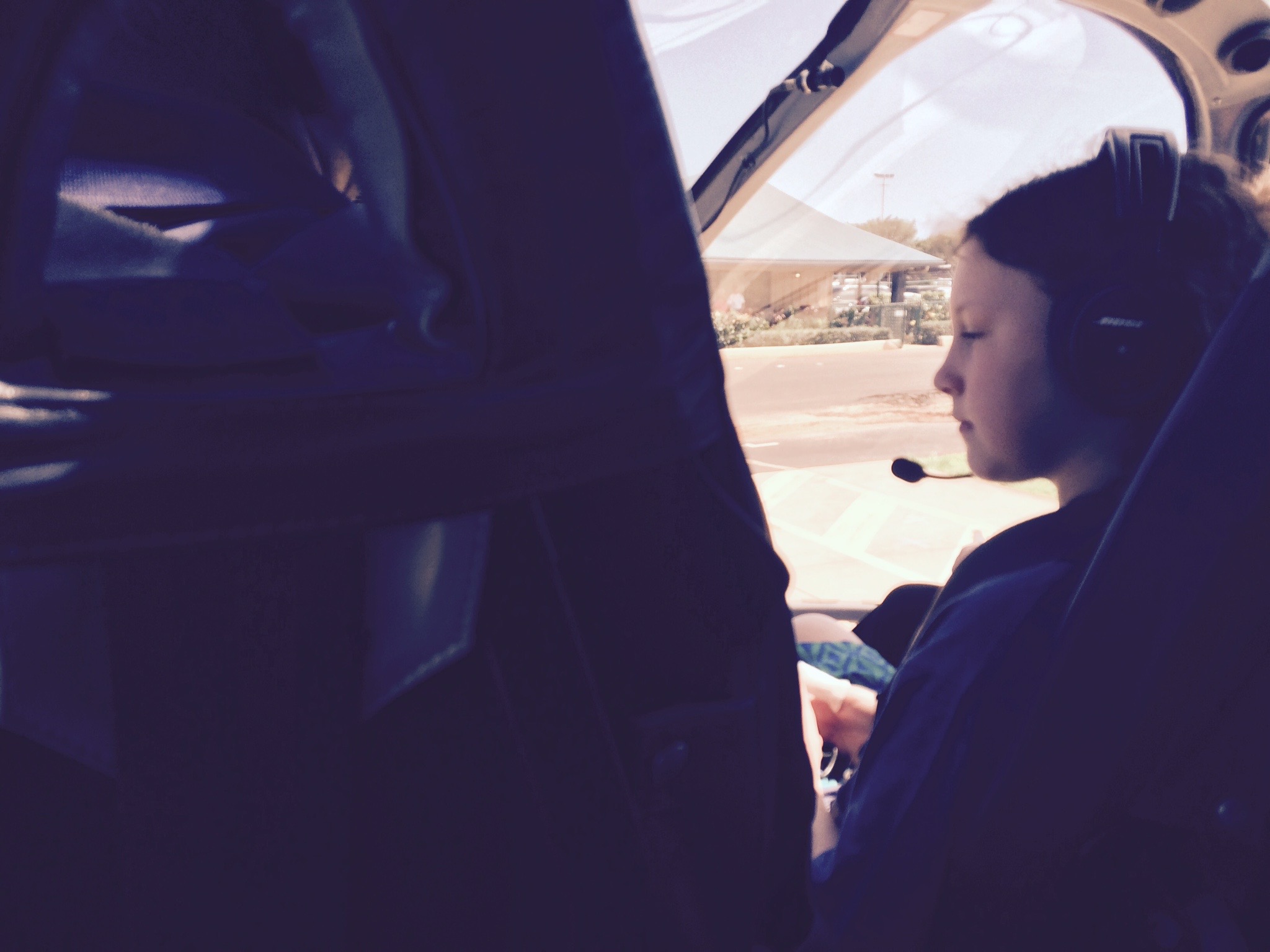
Sarah in the coveted cockpit next to pilot Brody. She asked the question we all were secretly harbor ing:"What happens if you get sick or pass out or something?"

Sarah in the coveted cockpit next to pilot Brody. She asked the question we all were secretly harboring:”What happens if you get sick or pass out or something?”

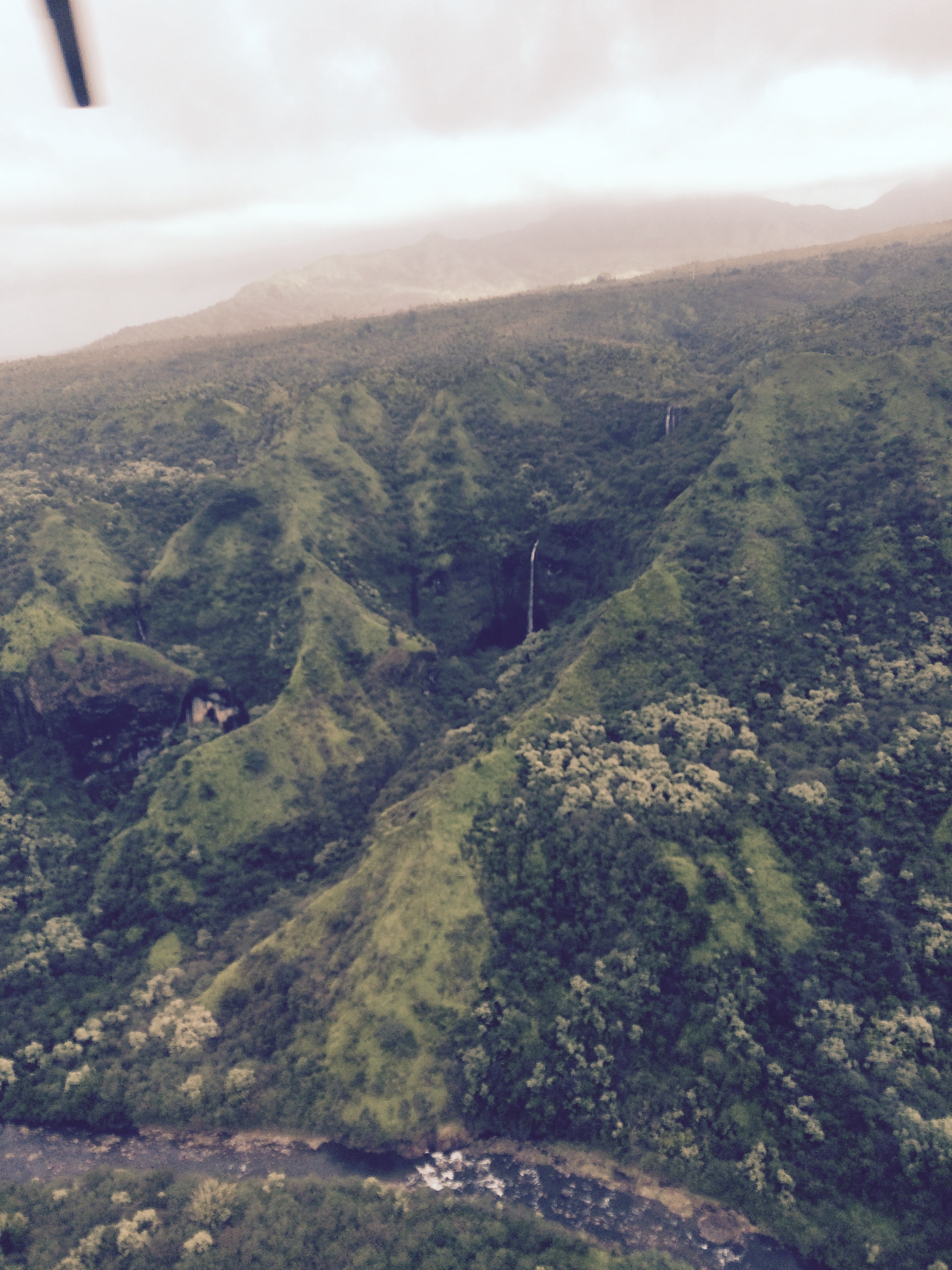
This is Mt. Waialeale, the wettest spot on earth, getting 480 inches of rain a year, and home to unique species of vegetation and animal life.

This is Mt. Waialeale valley the wettest spot on earth, getting 480 inches of rain a year, and home to unique species of vegetation and animal life. There were native Hawaiian tribes who used to live here. The warriors would be let down these mountain cliffs of this sacred valley by rope in order to bury their revered and holy elders in caves and grottos in the mountains. However, because the burial sites of these ancestors could not be revealed, the ropes were cut and the warriors were then left to die there, as well. Archaeologists have found proof of hundreds of human burial sites in these mountains.

We saw lots of waterfalls!

We saw lots of waterfalls!

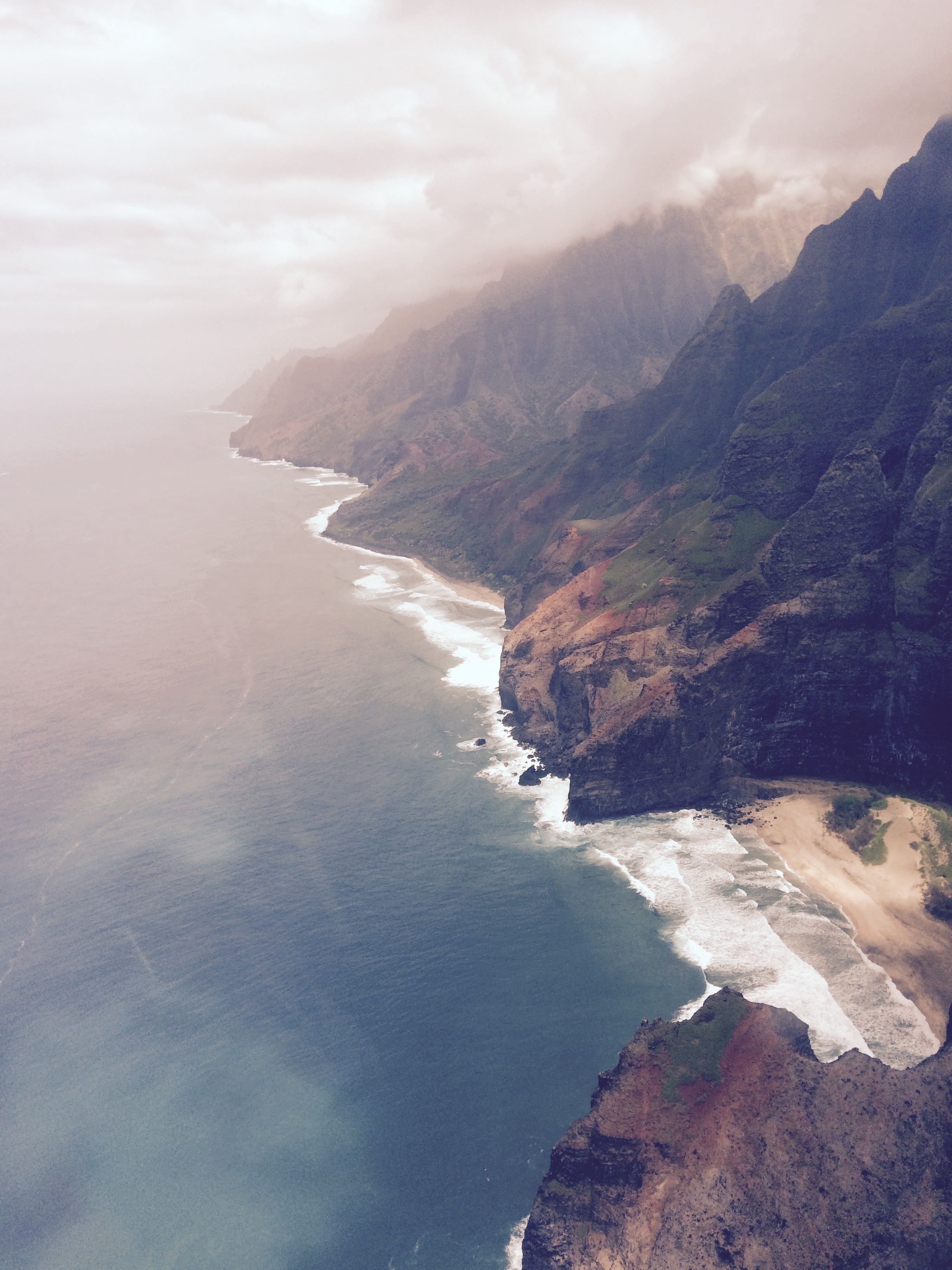
Napali coast from above. Howard and I had hiked over a mountain from the first beach inlet at the top, to the next one. Rob was duly impressed when he saw it from above!

Here is the Napali coast from above. Howard and I had hiked over a mountain from the first beach inlet at the top of the photo to the next one, and then inland. Rob was duly impressed when he saw it from above! Waves along this coast can be from 20-60 feet high, with 1000 pounds of weight per foot!

With my two Shabat candles, all of us in our new Hawaiian outfits

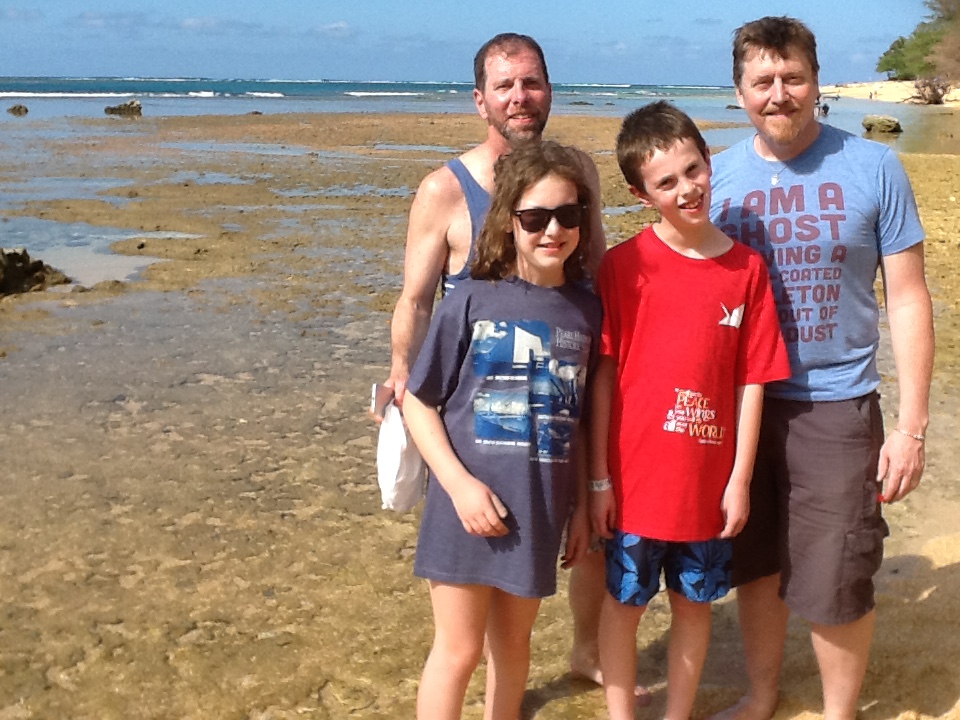
With my two Shabbat candles, all of us in our new Hawaiian outfits. Yes, they, at age 10, are as tall (taller?) as me.

This morning, Howard and I walked in the beautiful Limahuli Tropical Botanical Garden and Preserve which houses many nearly-distinct species of vegetation.

This morning, Howard and I walked in the beautiful Limahuli Tropical Botanical Garden and Preserve which houses many nearly-distinct species of vegetation.

This afternoon we went snorkeling in the coral reefs at Tunnels Beach. I saw the most amazing fish. It was even more thrilling than the helicopter ride in some ways!

This afternoon we went snorkeling in the coral reefs at Tunnels Beach. I saw the most amazing fish. It was even more thrilling than the helicopter ride in some ways!
We went to Princeville to see the sunset and to welcome in the new week. After dinner, Rob taught me (for the 3rd time) how to spot the winter triangle in the stars. If you don't know, I think I can show you!

We went to Princeville to see the sunset and to welcome in the new week. After dinner, Rob taught me (for the 3rd time) how to spot the winter triangle in the stars. If you don’t know, I think I can show you!

Tomorrow Howard, Rob, and the kids leave early to go spend more time on Oahu. I stay on Kauai for a few more hours to visit a Hindu monastery on the island before returning to NY.

There was so much more that we would have wanted to do here. I think it means we will have to return! Aloha and mahalo, Kauai!


Kauai

.

Bruised, blistered, and sore all over today, as Howard and I took a tough hike along the Napali coastline on the Kalalau trail. While most folks stop at Hanakapai’ai Beach and return from there (4 miles round-trip), we ventured on to the Hanakapai’ai Falls (8 miles round-trip). It took 8 hours, and was brutal at parts. While Howard made it to the falls, I ultimately stopped about 1/4 mile short, as I just wasn’t willing to ford one more river with slippery rocks  with my legs as tight and stiff as they were at that point.

Here are some shots from the trail:


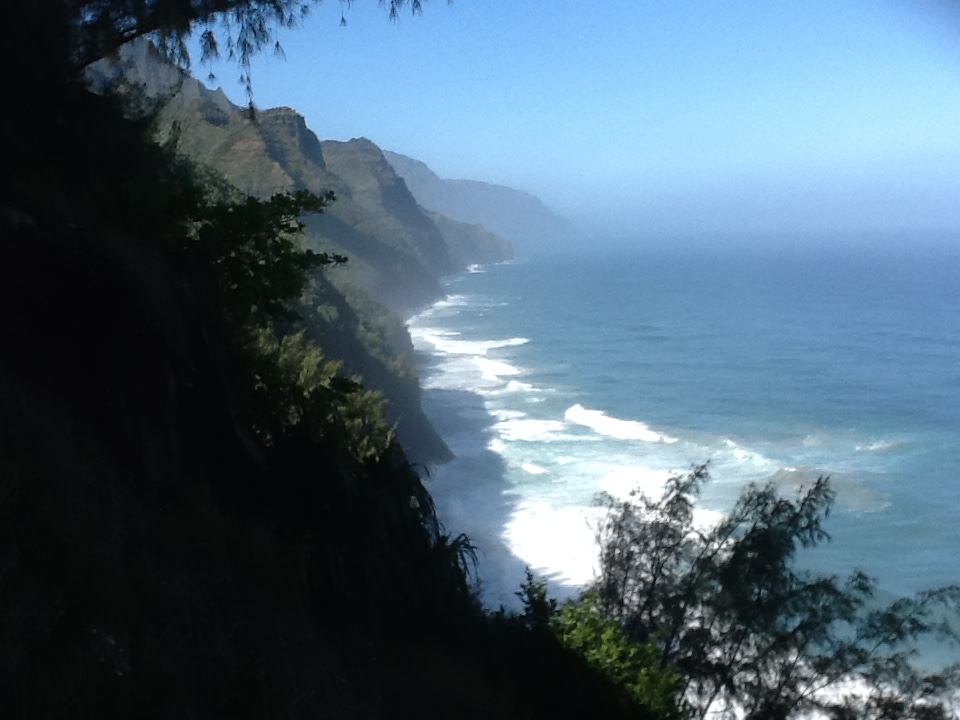
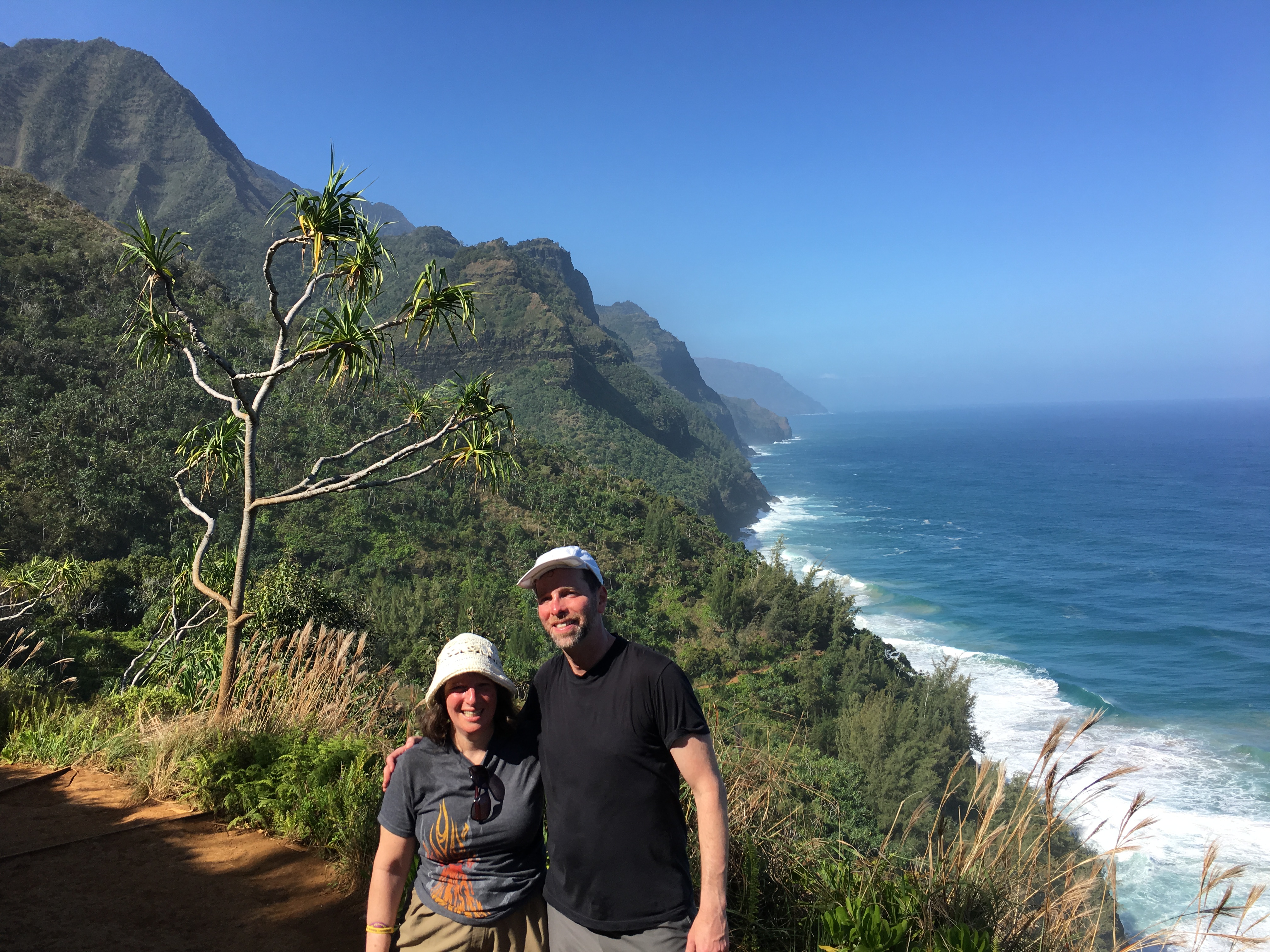
View of the wild Napali coast from the trail

View of the wild Napali coast from the trail

On the trail with the bro

On the trail with the bro

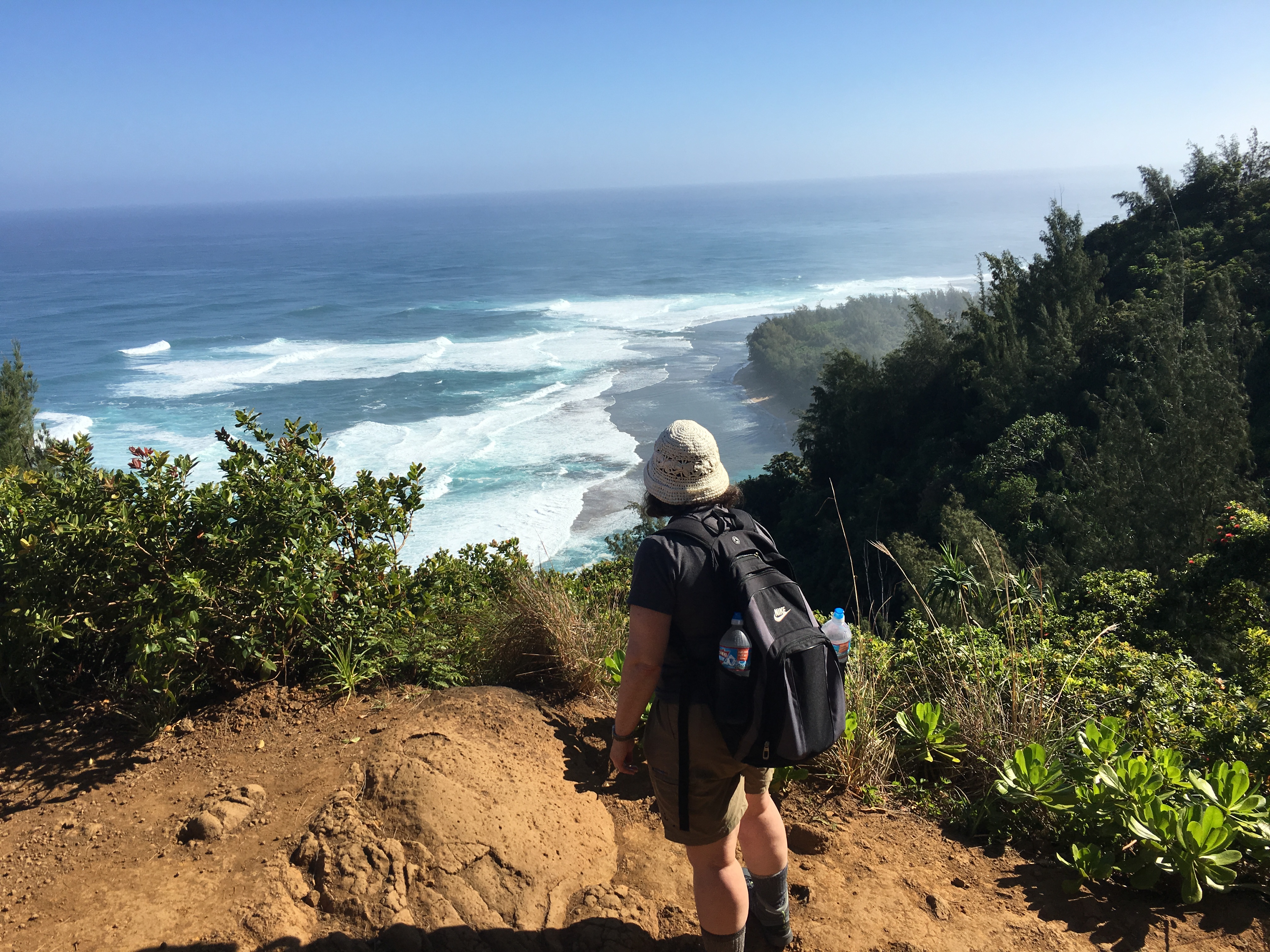
Here I am marveling at the coast below

Here I am marveling at the coast below

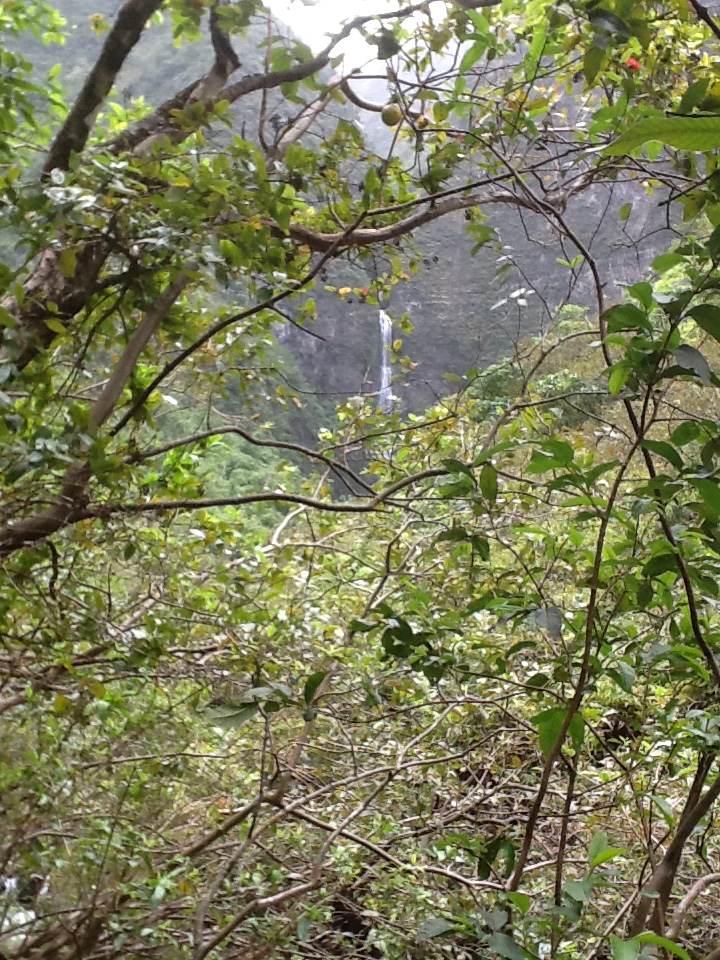
View of waterfall from afar

View of waterfall from afar

Howard enjoying the falls

Howard enjoying the falls

Cairn perfectly balanced

Cairn perfectly balanced

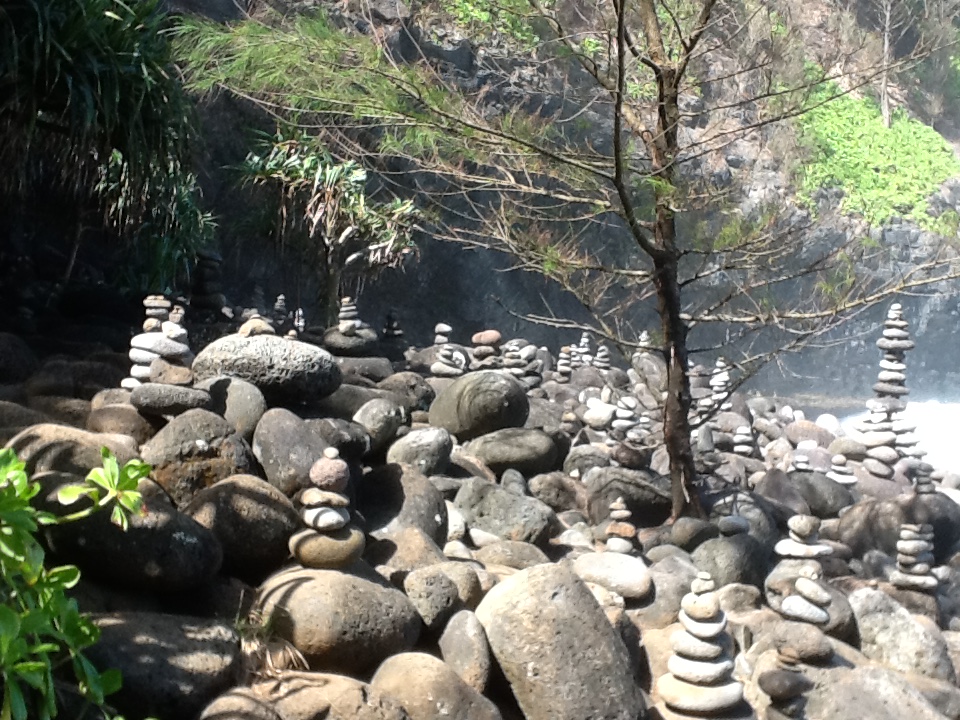
Cairns at the Hanakapai'ai Beach

Cairns at the Hanakapai’ai Beach

Today we go on a helicopter ride over the island, much of it unreachable by road. Hoping to get a good view of Waimea Canyon from above.


Aloha, mahalo, and ohana

There are three Hawaiian words that I’ve learned thus far: Aloha, mahalo, and ohana.

In addition to hello and goodbye, the word Aloha, much like the Hebrew word shalom, means far more. It means affection, mercy, compassion, and peace. The spirit of aloha is an attitude, a way of being in the world. A spirit of aloha here entails patience, equanimity, and generosity of spirit. Car horns are honked only when safety is at stake. People (other than tourists) don’t get annoyed by waiting in long lines. People don’t yell or play loud music in deference to others around them. Clearly, the world would be a kinder, gentler place if we all excelled in aloha spirit. I also wouldn’t have to work so hard on practicing my middot/virtues in my Mussar practice, as it would come more naturally!

Ohana means “family,” whether adoptive, intentional, or blood-related. Thus far, I have been with ohana here in Hawaii. First, I stayed with my dear college friend Peter.

image

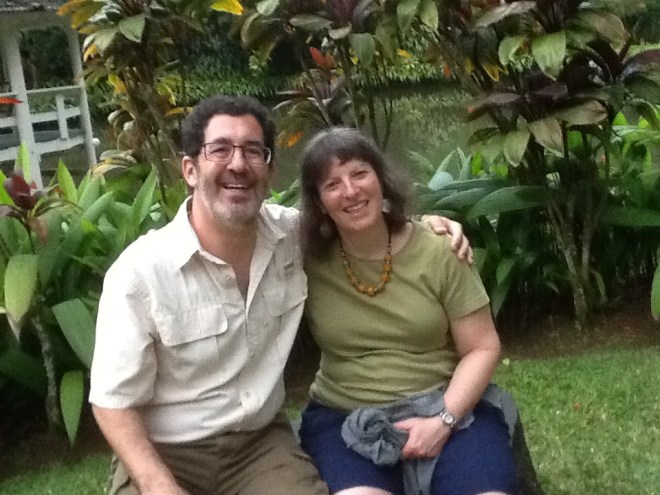
Me and Peter. This was my second visit to Hawaii to see Pater. Nine years ago, my husband Chaim joined me. In addition to our visit to Oahu, we had gone to Molokai Island with Peter, one of the least touristed Hawaiian islands. That is where the famous leper colony was, 1866-1969.

Then on Sunday my beloved brother and his family arrived (or more to the point, my beloved 10-year-old twin niece Sarah and nephew Marcus arrived with their parents).

image

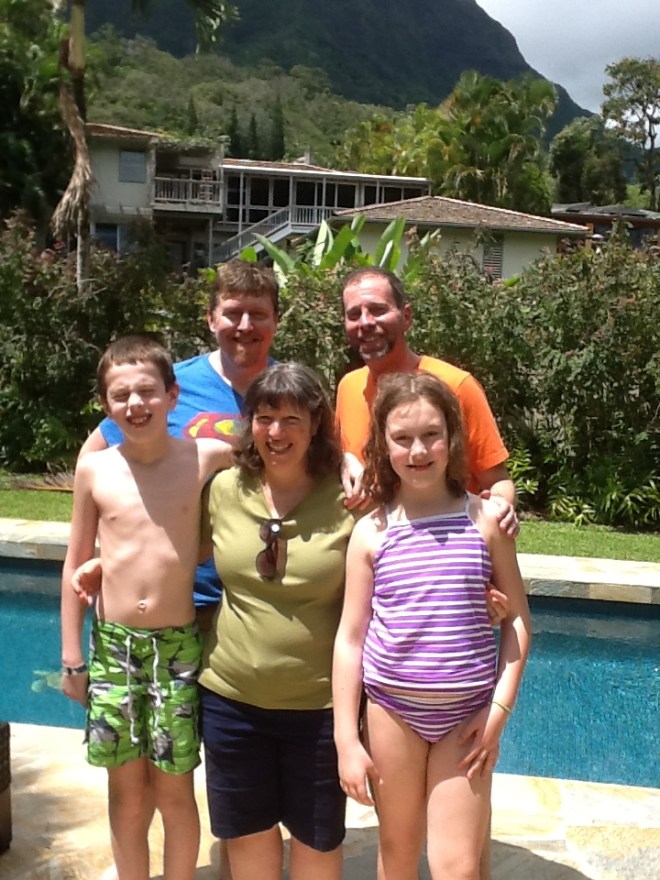
My brother-in-law Rob (back left), my brother Howard (back right), Marcus, me, and Sarah (front from left to right)

image

This is the view from our rental home. It reminds me of Gilligan’s Island.

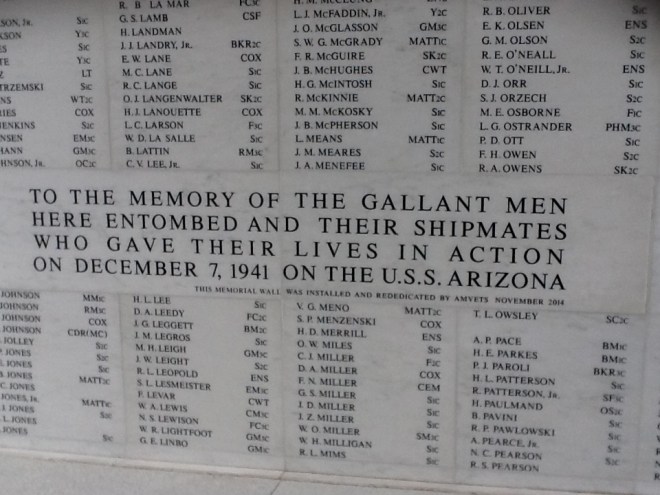
Today, in addition to our swim and surfer-watching at Waikiki beach, we went to Pearl Harbor. We visited the memorial to the USS Arizona, one of the 8 battleships that were attacked on Dec. 7, 1941. This ship exploded and sank, killing 1178 servicemen.

image

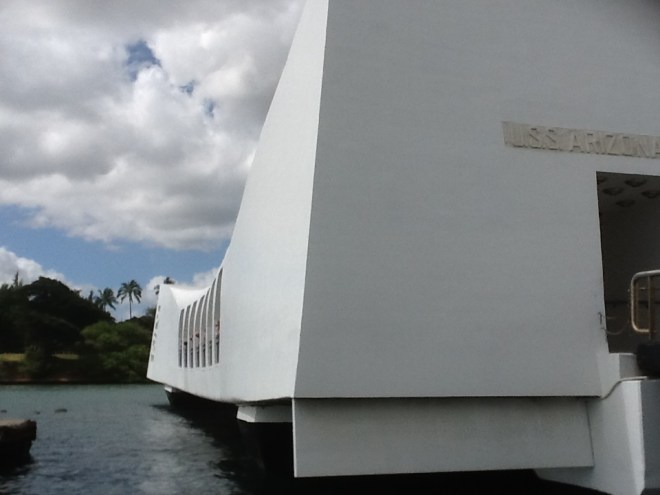
The memorial to the USS Arizona is built over the sunken ship. You can look down and see parts of it, including the oil that is still leaking from it these many years later.

image

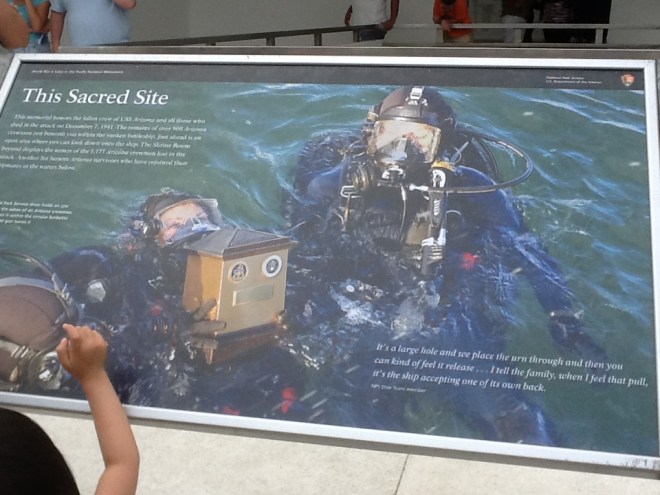
This is a photo of an urn of ashes being taken into the sunken USS Arizona for burial. Some of the survivors of that tragedy have asked to be buried with their military brothers after death. One of the dive team members said, “It is a large hole and we place the urn through and then you kind of feel it release… I tell the family, when I feel that pull, it’s the ship accepting one of its own back.”

image

I cried a lot at the memorial today. It was holy ground, and I felt its sanctity. I also viscerally felt the horror of war and remembered a wallhanging of my teenaged years: “War is not healthy for children and other living things.”


image

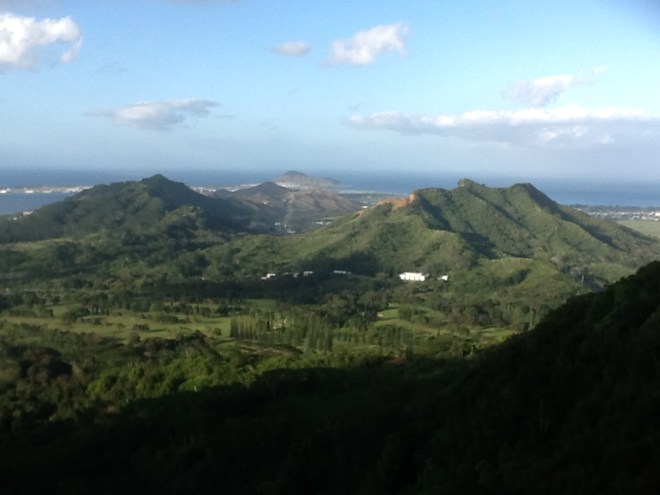
The view from Pali Lookout.

Mahalo means thank you. Mahalo to Oahu and Big Island (and to Peter, Howard, Rob, Sarah, Marcus, and my brother’s friend Bob) for the adventures thus far. More to come from Kauai where we will be for the next five days.

Volcano National Park, Big Island, Hawaii

image

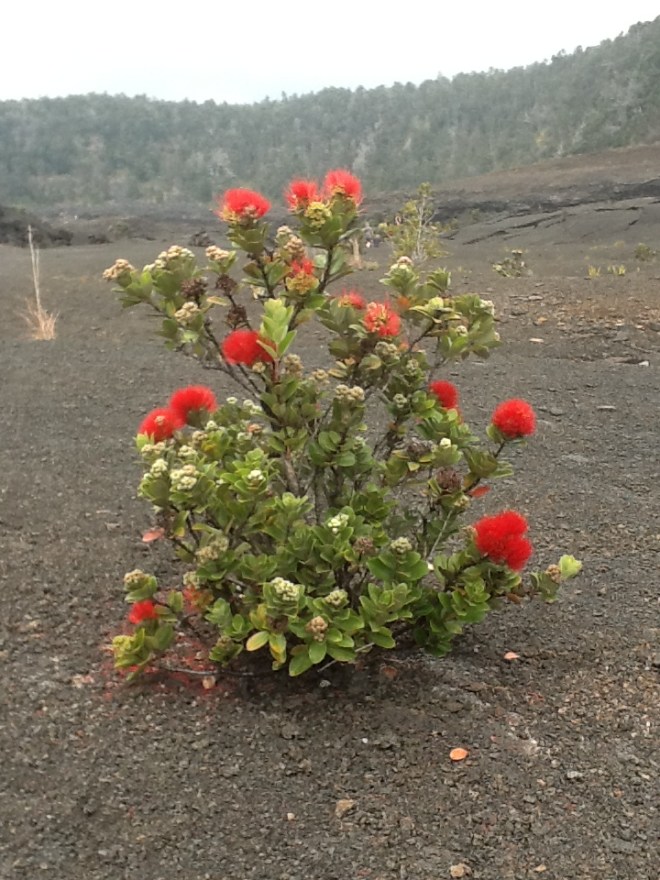
Kilauea Caldera, an active shield volcano. Lava is at the bottom, hence the steam

image

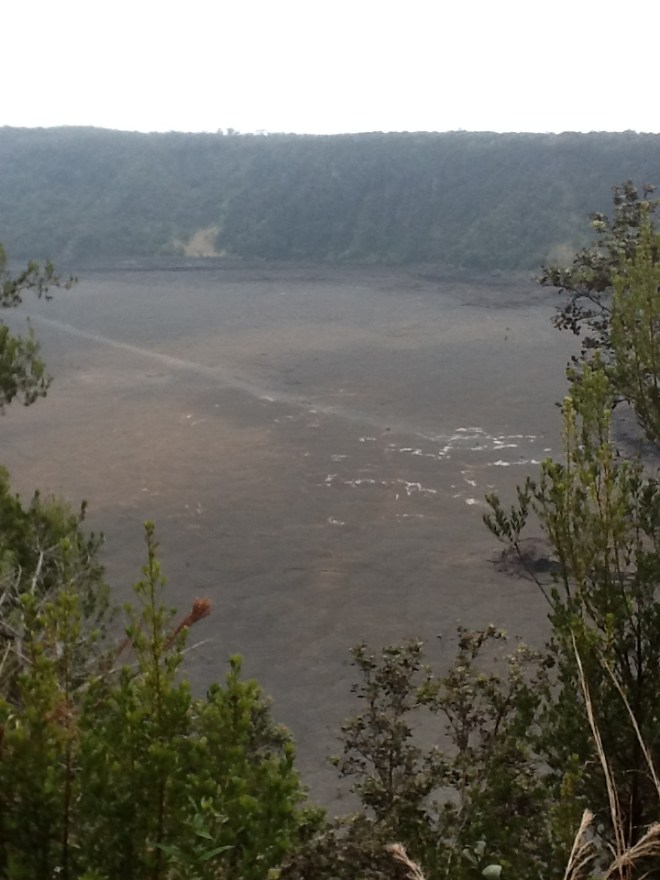
Kilauea Iki, a hardened lava lake crater, which is one of the hikes I took through a rain forest, down into a seeming moonscape

image

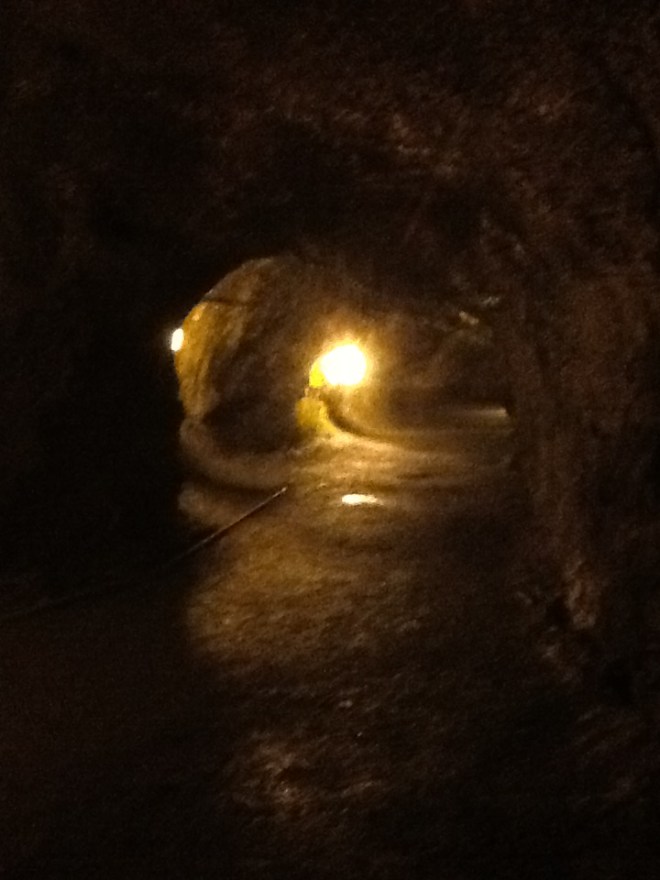
Thurston Lava Tube – sometimes created after rivers of lava flow cool

image

unexpected sight in the middle of a vast lava plain

image

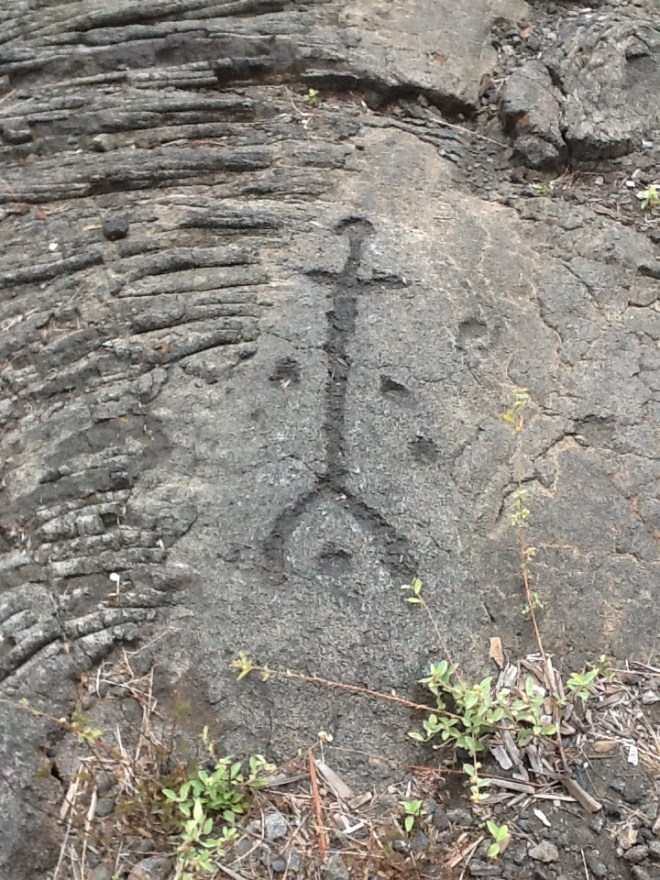
Pu’u Loa Petroglyph — the holes next to the impression were created to house the umbilical cords of newborns in order to tie them to their ancestral lands

image

Rainforest also exists in this incredible national park


Nostra Aetate, 50 Years Later

My ticket for entrance to the UN event

My ticket for entrance to the UN event

Fifty years ago, on October 28, 1965,  Nostra Aetate (“in our time”), a declaration about the relationship of the Church to “non-Christian religions,” was proclaimed by Pope Paul VI.

The full text of this declaration can be found here. In the section on Jews (for whose sake the document was created), the charge of deicide was dropped from Catholic doctrine. This false charge had stood as the centuries-long raison d’etre for anti-Semitism in the Church. In correcting the record, the Church, in effect, created not only a revisionist history but also a revisionist theology. What the document also did was change the Christian relationship to Jews from one of parent/child to one of brothers. Why is this significant? To extend the metaphor of Christianity as children of Judaism necessitates the death of the parent, with the child serving as inheritor. But the metaphor of brotherhood holds no such notion of hierarchy. In this metaphor, Christianity and Judaism are equally valid faiths, both capable of offering salvation, neither usurping the other.

In part, the section on Jews in Nostra Aetate reads as follows:

in her rejection of every persecution against any man, the Church, mindful of the patrimony she shares with the Jews and moved not by political reasons but by the Gospel’s spiritual love, decries hatred, persecutions, displays of anti-Semitism, directed against Jews at any time and by anyone… 5. We cannot truly call on God, the Father of all, if we refuse to treat in a brotherly way any man, created as he is in the image of God. Man’s relation to God the Father and his relation to men his brothers are so linked together that Scripture says: “He who does not love does not know God” (1 John 4:8). No foundation therefore remains for any theory or practice that leads to discrimination between man and man or people and people, so far as their human dignity and the rights flowing from it are concerned. The Church reproves, as foreign to the mind of Christ, any discrimination against men or harassment of them because of their race, color, condition of life, or religion.

After a long hiatus of not offering a new post, I am writing about Nostra Aetate because yesterday I had the extraordinary honor and opportunity to attend a 50th anniversary commemoration at the United Nations, organized by the Holy See and the International Jewish Committee for Interreligious Consultations. I believe I was the only female rabbi in attendance and one of the few rabbis there who did not work for an interfaith organization (such as the American Jewish Committee or the ADL). Among the speakers were Bishop William Murphy who offered the Catholic keynote address, French philosopher Bernard-Henri Levi who offered the Jewish keynote address, Rabbi Lord Jonathan Sacks (who spoke via video), and Archbishop Bernadito Auza, among others.

Rabbi Sacks, author of the new book Not in God’s Name: Confronting Religious Violence, spoke about the greatest crime against humanity in our time being that against the Christians in the Middle East. The Hungarian ambassador to the UN said that, ironically, she was attending our session following taking testimony in another chamber from a young Yazidi girl who had been tortured for her faith (the Yazidis mainly live in Iraq today but are facing genocide).

Bernard-Henri Levi, one of the most prominent intellectuals in France and certainly one of the most influential Jews in the world, spoke eloquently about the history of Nostra Aetate, and why it should not be considered a historical moment in time but part of an ongoing process. Pope Francis continues the evolving nature of the relationship both because of his own close friendship with Rabbi Abraham Skorka (with whom he co-wrote the book On Heaven and Earth) and because of his stunning remark that “in the heart of every Christian there is a part that is a Jew.” Just last week, in honor of the 50th anniversary of Nostra Aetate, the Vatican issued a new declaration about Jews and the renunciation of conversion. The latest issue of The New Yorker contains an article about Pope Francis and his refusal to convert Jews.

M. Levi finished his outstanding keynote by speaking about our need now to express solidarity with our Muslim compatriots and our need to rewrite a Nostra Aetate/In Our Time to reflect that relationship.