
Our tour guide, Uri, keeps reminding us that everyone in this country has been on the frontlines. Ask the barista or the cabdriver what happened for them on and after October 7, and you will understand the collective pain of the nation, and how everyone is only one or two degrees away from knowing someone who died or is a hostage in Gaza.
Yesterday was the day we spoke to the closest front-liners–survivors of Kibbutz Nahal Oz who were hunkered down in their safe rooms while the terrorists tried to get in to torture, murder, rape, or capture them.
Most of the kibbutznikim relocated to Mishmar HaEmek, one of the wealthiest kibbutzim in the country. A kibbutz is about community, so they want to remain together. (We heard of another kibbutz that took over two buildings in Tel Aviv as that was the only way they could stay together as a community.) Nahal Oz had been temporarily housed at Mishmar HaEmek when there were previous security threats, so there was already a relationship.
(As an aside, Mishmar haEmek is the kibbutz where I lived in 1981 when I took a semester off from college and is a place very dear to my heart. There was a beautiful trail on the kibbutz that I would run on, taking me up to a ridge where I would see the entire Jezreel Valley below and cry. When I got back to the US, I never ran again–as nowhere I ran could compare to that regular spiritual heart-opening experience. I wrote about my relationship to the kibbutz when I visited there six years ago and walked that old trail. I’ve been thinking about it again recently because one of my roommates on kibbutz then–Malka– was a young 16-year-old woman from Ethiopia who had walked across the Sudan to get to Israel. For the past few months, I have been tutoring a young 30-something Ethiopian Israeli woman via Zoom, and Malka has been on my mind.)
Nahal Oz sustained 16 horrendous deaths on October 7, and two of their members are still hostages in Gaza (Sachi Idan and Omri Miran). Of course, the kibbutz itself is destroyed, and it could take 5 years or so to rebuild. We had an opportunity to speak with three of the survivors, Naomi, Danny, and Yael, and the Reform rabbi who serves their kibbutz, Yael Vurgan. The stories were horrifying and gripping, as you would expect. Naomi, the mother of 3 young children, said that the only people who are okay after October 7 are the people who admit that they’re not okay, and how hard it is for her to be around people going on with normal life as usual. She isn’t sure she can go back to the kibbutz even once it’s rebuilt. The Gazans who had worked on the kibbutz with her husband in agriculture were cleared of having any role in passing on information to the terrorists (the maps the Hamas terrorists had were provided by some of the Gazans who worked on these kibbutzim), but he nonetheless says he can no longer work with Arabs. Can such a sense of distrust and betrayal be healed?
Rabbi Yael Vurgan, who serves the entire region (10 kibbutzim and one moshav) spoke about the tzimtzum (contraction) she has been doing in her pastoral work over the last 4 months: she is in the mode of learning and no teaching (because she feels she has no answers) and is only listening and bearing witness.
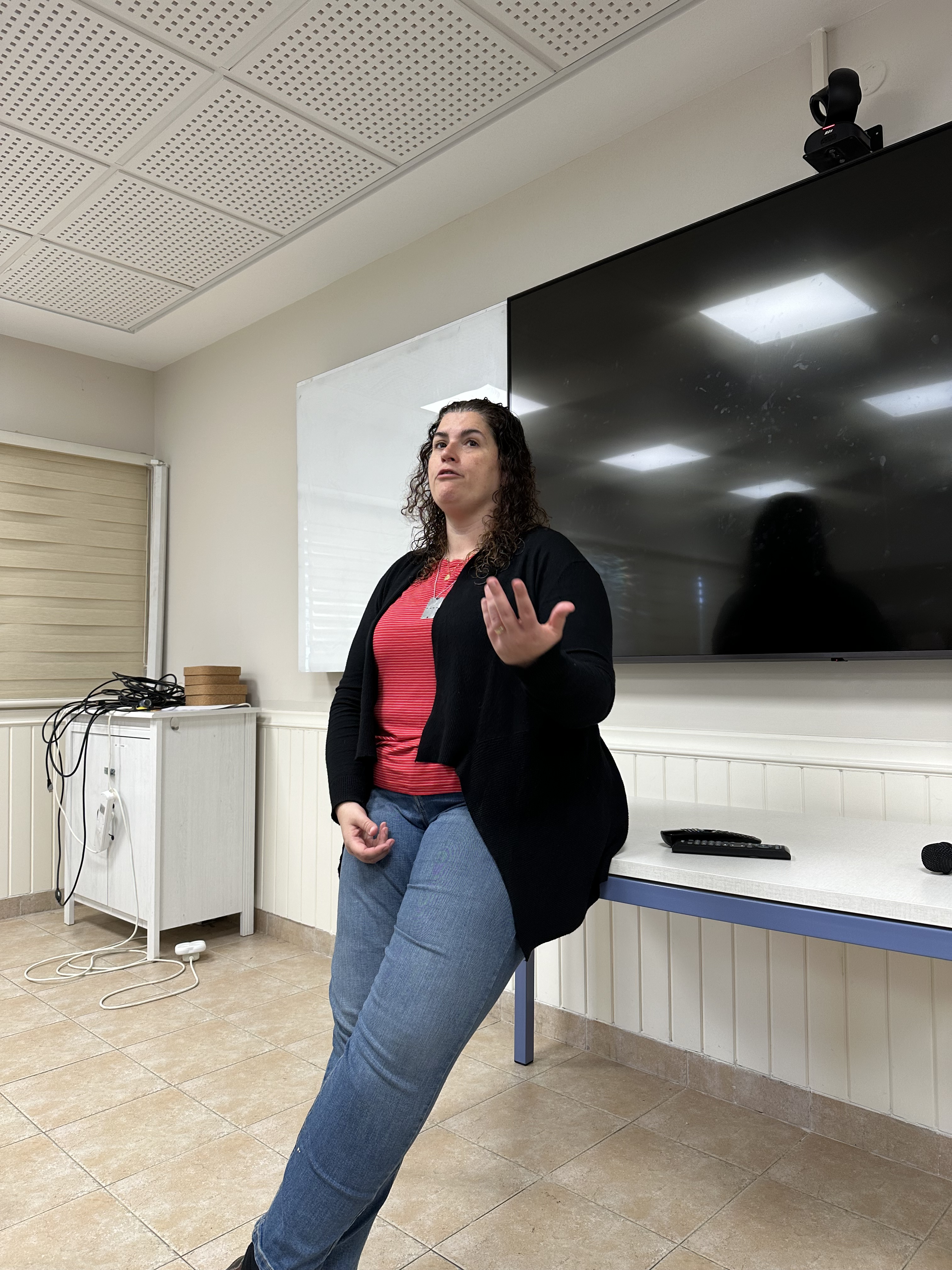
Naomi sharing her story with us
But Danny expressed the fact that he was and remains a peacenik. He remains committed to his belief that there are good people and that there are bad people regardless of race, religion, or nationality and cited the many stories of Israeli Arab and Bedouin heroism on October 7 to save the Nova concert attendees or people on the kibbutzim.
To be a kibbutznik is generally to be a leftist. They are socialist institutions, after all. And in the Gaza Envelope, the members of the attacked kibbutzim were known peaceniks, some of whom were creating business opportunities with and for Gazans, or were driving them to hospitals, etc.) Members of Nahal Oz (including Danny) were at the forefront of the protest movement that rocked Israel for close a year to protest this current right-wing government and its plan to decimate its democratic institutions, specifically its judiciary. So there are a lot of complications now of what it is to be on the left, as a two-state solution is now a long, long way off and may no longer even be possible. So many have lost hope in their vision of a shared society.
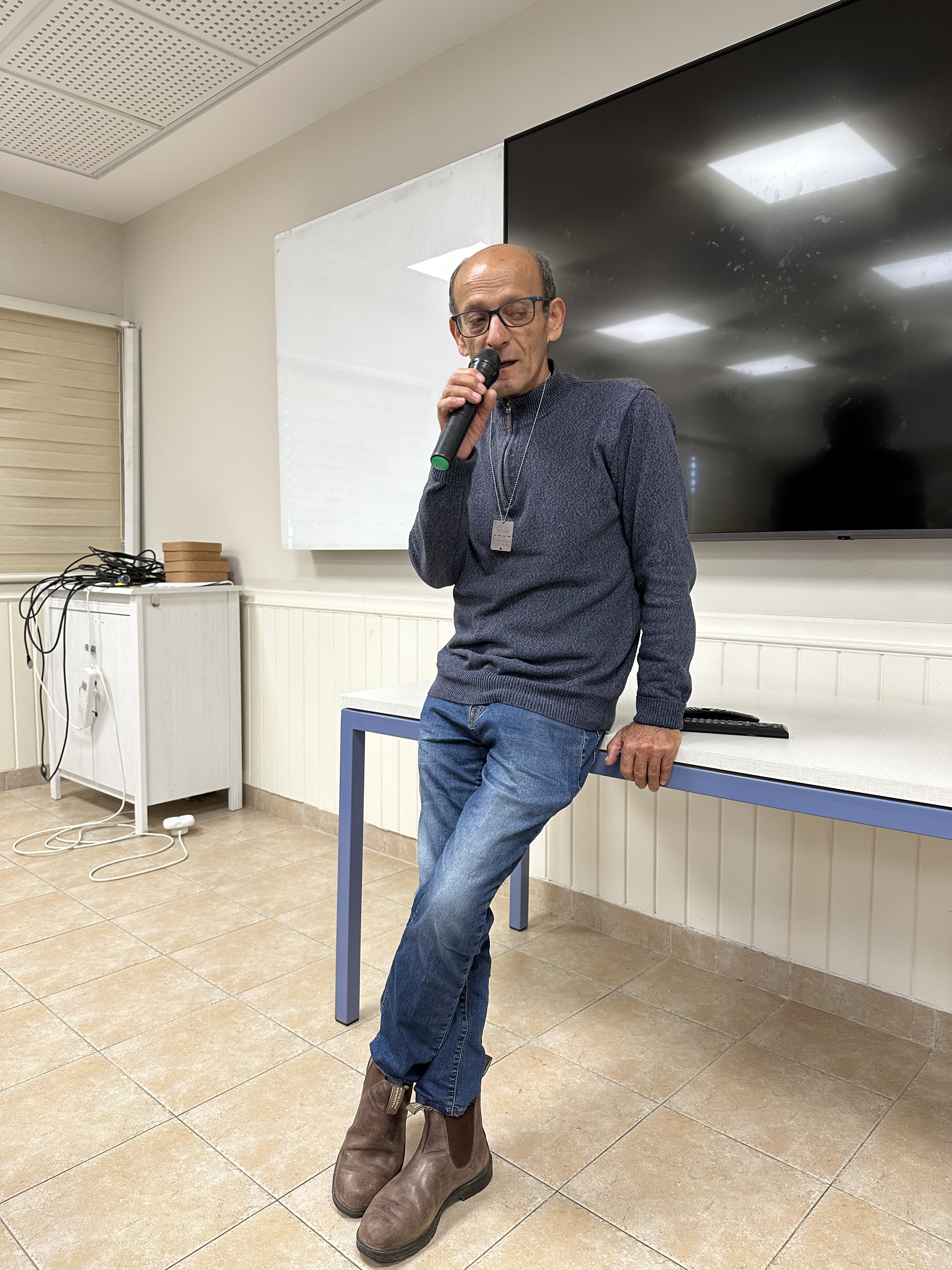
Danny sharing his story
Some of these solidarity missions to Israel have of course, been going down to the Gaza Envelope to see the devastation on the kibbutzim firsthand. Our CCAR trip for Reform rabbis purposefully decided not to do so out of concerns for security (for a group this size, there would not have been a shelter at any of the kibbutzim that could have held us all in case of missiles), but also out of a sense that they didn’t want to participate in tragedy tourism, to be voyeurs to the devastation while the inhabitants are internal refugees in their own country. Some of our group members disagreed with this reasoning and are disappointed, but Danny himself said he felt uncomfortable knowing that people were gawking at the devastation of his home and community, and I appreciate that sentiment. It was enough to see a couple of photos that were shared, like the following:
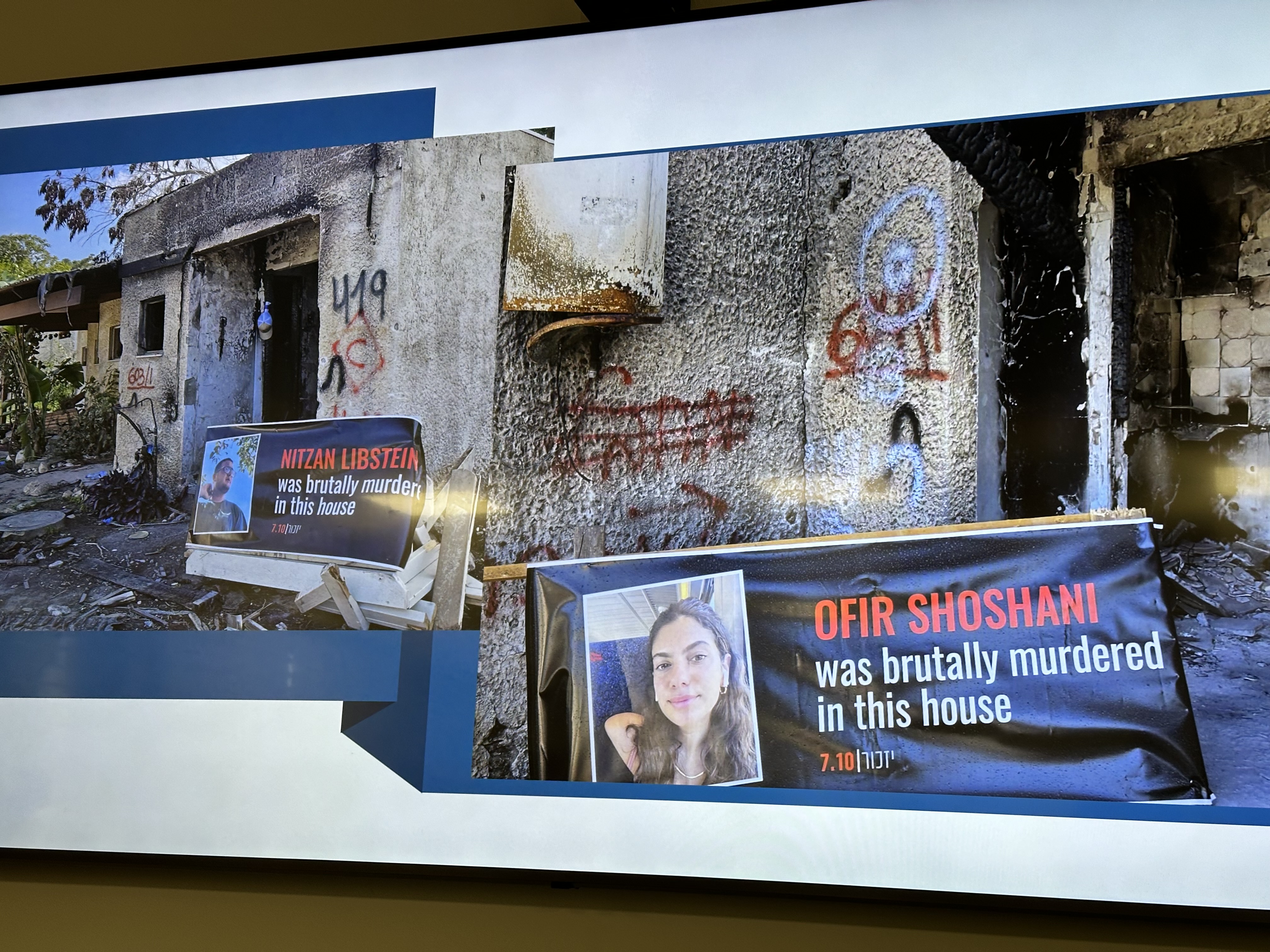
This photo on Nahal Oz bears witness to the devastation and also honors the dead.
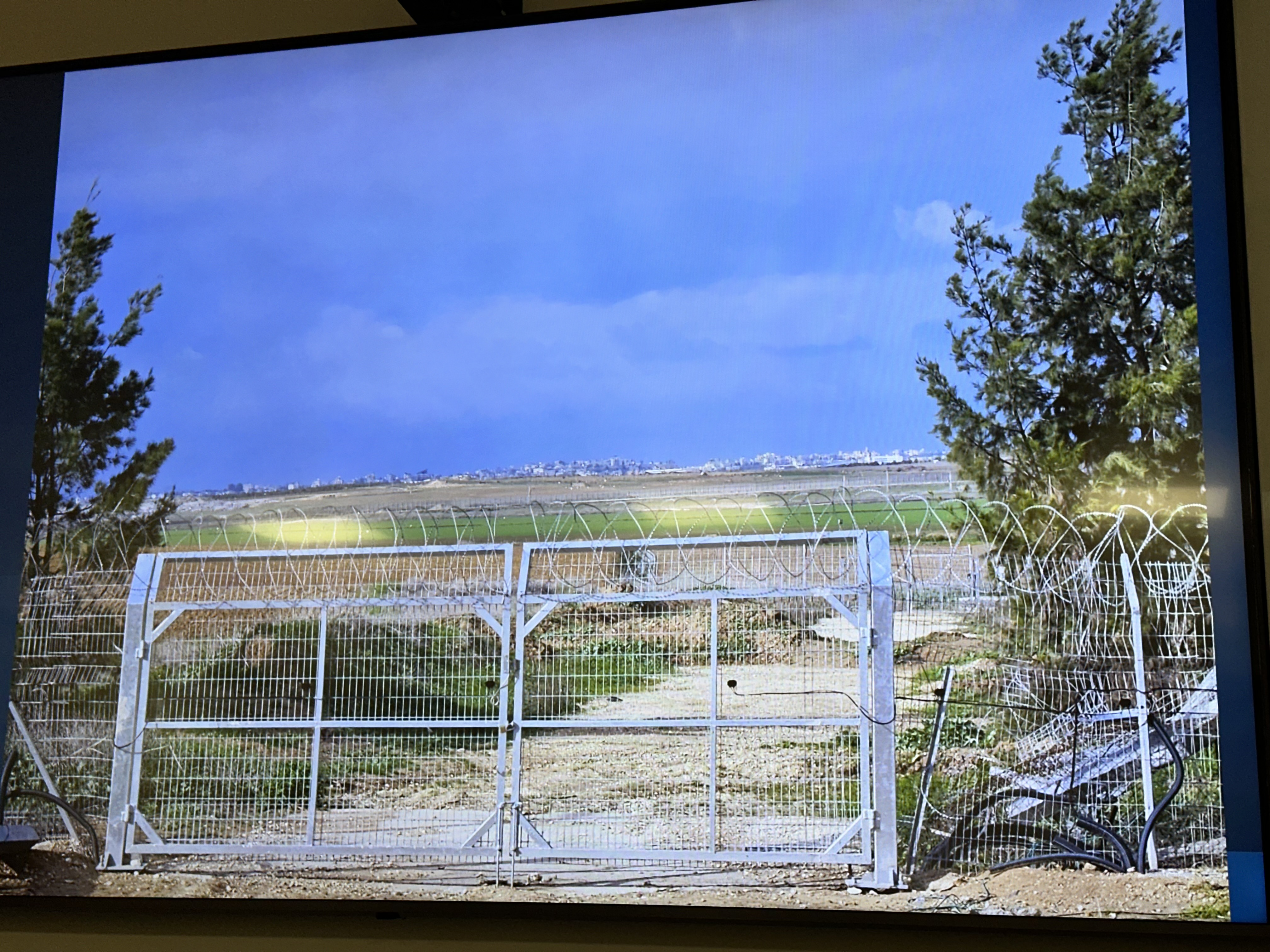
From the Kfar Aza gate (another kibbutz in the region that lost 46 members on October 7) you can see how close Gaza is.
From Mishmar haEmek, we travelled to the town of Shoham to meet another Reform colleague and to prepare food for soldiers (cakes and vegetable platters).
In the evening, we had dinner with the HUC-JIR (Reform seminary) students who are studying here for the year and had a fascinating study session with Dr. Dahlia Marx on the topic of redeeming captives, which is a very important obligation. The Talmud even says that to be taken into captivity is worse than death.
So that is the debate in Israel today. Most of the country wants the hostages to be released, even when knowing that the exchange would include thousands of Palestinian prisoners, some with blood on their hands. This possibility creates a lot of fear since the mastermind of the Hamas attack on October 7, Yahya Sinwar, was released in a prisoner exchange in 2011 (1026 Palestinians for the single hostage Gilad Shalit). Those who are opposed to a prisoner exchange consider it too big a risk to take and are willing to sacrifice the lives of the hostages.
Such are the complications and the calculations. If you haven’t seen today’s New York Times op-ed by Liat Atzili, one of the released hostages and a Holocaust educator, please do, below. But if you don’t have time, just read this:
“Without tekumah [rebirth], we will only sink further into the cycle of mutual anger and victimhood that has plagued our relationship with the Palestinians for too long. That is not the approach that the survivor generation chose, and in their spirit I do not seek revenge for what I have been through. I am humbled by how my fellow Israelis put their lives at risk to fight my kidnappers, but I do not feel any catharsis in seeing the destruction of Gaza. Instead, I want to focus on building a better future for my three children — and for the children of Gaza.”
How did she move through her trauma so quickly to get to this place of clarity and vision? It’s quite remarkable.
Today in brief:
1. a visit to the Jewish Agency to speak with Yaron Shavit and Yair Lipstein, two Reform Jews who are making a significant difference in having pluralistic and egalitarian values on the table for these important non-governmental agencies. When we talked about the disaffection of young Jews from Israel, they floated an idea of bringing some of these young Americans together with young Israelis who are struggling with the same issues. (Who has the money to run with this wonderful idea??) They also said that to make a difference, you can’t walk away, you have to step into the game, strengthen the peace-making progressive forces in Israel. Amen to that.
2. a visit to the new National Library, which really deserves its own post, it was so sensational.
3. free time and a visit with Bili to visit her mother and brother on their moshav. They are my family in Israel, and it was great to see them.

With Bili, her brother Oded, and her mother Yaffa on Moshav Shoeva, my home-away-from-home for 40+ years
And though we likely won’t discuss it until tomorrow as a group, I say Bravo to President Biden for saying “Yesh g’vul/There’s a limit” to the settlers.
 paminjerusalem
❤️
Dear Pam;
Stanley and I are enjoying your very informative and heartfelt e-mails . We shall not be making any more trips to Israel , but we greatly appreciate being there for four visits over our many years. We follow the news with Times of Israel and World Israel News reports online every day. Our thoughts, love, and prayers are with our people
who have suffered greatly , but still manage to look to the future. Chazak! Am Yisrael Chai! As we read Yitro
this week, where it all began, it is amazing that Hashem still looks after us.
On another subject:
We just want to send you a musical greeting on your special day. HAPPY, HAPPY BIRTHDAY.
Love, Susan
Thank you Pam for your beautiful and poignant and painful descriptions of your time in Israel. Be safe. Ann
Your insights and experiences are so valuable to me–thank you, Pam! And Happy Birthday!