Trees, Water, and the Welfare of Children

Water Under the (Beersheva) BridgeClimbing wall

Water Under the (Beersheva Pipes) Bridge            The Climbing Wall in Sderot’s Indoor Playground

Rabbi Yohanan ben Zakkai used to say: If you are holding a sapling in your hands and someone announces the Messiah’s arrival, plant the sapling first and then go meet the Messiah. (Midrash Avot d’Rabbi Natan 2:31)

Blessed are You, Adonai our God, Sovereign of the Universe, who guides us to springs of water. (Isaiah 49:10)

If you are a Jew who ever went to Hebrew school, you probably remember bringing coins every week to fill the pushke/charity box for the Jewish National Fund/Keren Kayemet L’Yisrael. Maybe you even had your own blue and white JNF box at home that got filled by your family. Or you remember sending money directly to the Jewish National Fund to plant trees in Israel. Or when you celebrated a simcha/a happy occasion (wedding, bar/bat mitzvah, or birth of a new child) or experienced a death in the family, perhaps someone else gave JNF tzedakah/charity in your name and you got a nice certificate from them certifying that a tree was planted in your name or in the name of your loved one.

For many of us, JNF was our primary connection to the land of Israel. And TREES was all we knew or thought of when we heard the words “Jewish National Fund”.

And it is true, the JNF is responsible for planting most of the trees in Israel — 240 million of them. Israel is one of only two countries in the world that ended the 20th century with more trees than it had at the beginning of the century. While most everyone else is deforesting, Israel is still reforesting.

The history of JNF and Israel goes far deeper than trees, and it is — as all things in Israel (and in life) are — complicated.

For a long time I refused to donate money to the JNF when it became known that some of the land upon which Israel’s forests had been planted was questionably acquired. (A.B. Yehoshua’s famous short story “Facing the Forest” is a telling critique of the Jewish National Fund’s relationship with Arab land and its impact on Arab-Israeli relations.) During that time, I planted my trees instead through Neve Shalom, an Arab-Israeli peace village. Unfortunately, their project did not survive, so I wasn’t planting trees in Israel at all.

Little did I know then that JNF was involved in many other environmental projects in Israel, often working hand-in-hand with the Society for the Protection of Nature. Much of the work has to do with water, the most important commodity here. Israel recycles and reuses 78% of its water (second place goes to Spain which recycles 17%; the USA only reuses 1%). JNF has built 222 reservoirs that store most of Israel’s recycled water.

As someone who is concerned with water issues around the world (and New Yorkers, if you haven’t already signed a petition or written a letter to Governor Cuomo against hydrofracking, PLEASE do so immediately!) and  knowing that I would soon be in Israel, I wanted to learn more. I therefore registered to attend a Board of Rabbis’ luncheon in November featuring JNF’s CEO, Russell Robinson. Once I had registered, however, I received an email from Rabbis from Human Rights, of which I am a member and supporter.

As you are probably aware, Rabbis for Human Rights-North America has been advocating that the Jewish National Fund (1) not fund efforts to plant over demolished Bedouin villages and on Bedouin land involved in ongoing legal disputes and (2) not fund property transfers and evictions over the Green Line in East Jerusalem.
I’m looking for rabbis who are willing to attend [the luncheon] and ask Russell [Robinson] some questions.

Once I agreed to do so, I was sent many pages of fact sheets about the Bedouin situation and talking points for the Q and A. While the Bedouin situation did not get resolved at that luncheon, I was excited to learn more about the Beersheva river project, the desalination projects, and the reservoirs. (What you need to know is that I am someone who can nearly fall to her knees in gratitude for clean, running water — it is something I try never to take for granted.)

And since I know that there are no perfect institutions (or countries or people… still waiting for that Messianic Age!), so it was that today Chaim and I took a JNF tour of some sights in the Western Negev. As it happened, today was also the day that there was water, water everywhere, thanks to this unprecedented rainfall that Israel has been receiving over the past several days. (We had rain in the Negev for most of the day today and were even greeted by snow and hail upon our return to Jerusalem.)

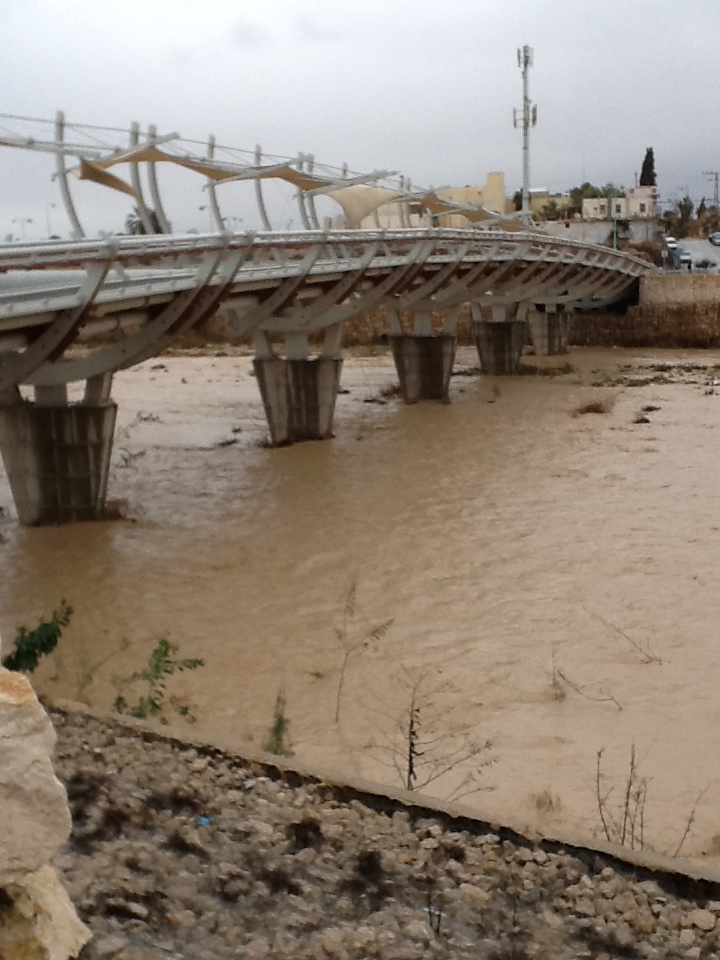
So my first picture is of the normally-dry river in Beersheva flowing with water today. JNF has done wonders in creating a river park/promenade/bike path in a city that needed a way to bring in tourists. JNF is in the process of creating another reservoir/lake (of reclaimed water) there for boating.

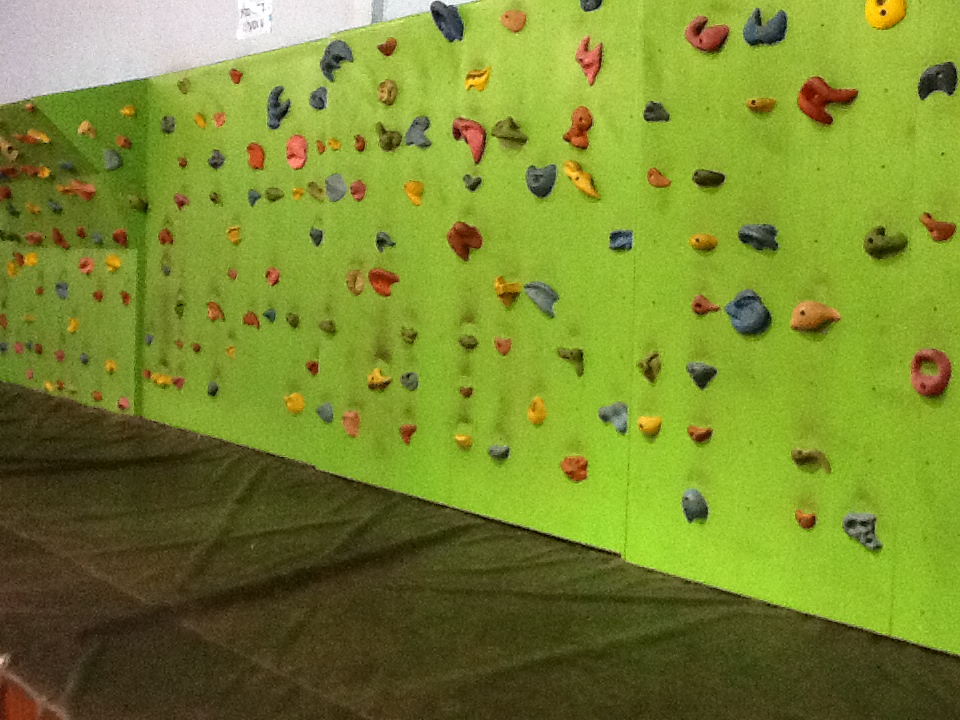
My second picture is of a JNF-built full-service indoor playground for kids of all ages in S’derot. S’derot is a town in the Western Negev desert which has suffered thousands of rocket attacks from Gaza (which is only a mile away), traumatizing its children and adults. This magnificent indoor playground features a climbing wall, a soccer field/bomb shelter, a computer room/bomb shelter, a happy birthday room/bomb shelter,  a disco party room/bomb shelter, and non-bomb-sheltered play stations of all kinds. (When the alarm sounds for an approaching rocket, there is the “fifteen second rule” — fifteen seconds to get into a bomb shelter.) So the playground has secure (and fun) bomb shelters along the outer walls of the playground that can be easily reached from anywhere in the building within 15 seconds.

I featured a photo of the climbing wall because we were asked, “Why do you think this climbing wall does not reach to the ceiling of the room?” No one knew.  The answer, of course, is “the 15-second rule.” Once a kid gets up the wall, if the alarm goes off, s/he has to be able to get down, get out of his/her harness, AND into a bomb shelter within 15 seconds — so the wall is only so high.

Needless to say, this playground has done wonders for the psychological and spiritual welfare of S’derot’s children (and parents.) Anyone who wants to see further photos of this playground, let me know.

Today was a full and wondrous day of seeing and learning. I will save stories about the fascinating Ayalon Institute/Kibbutz Hill for another time. But the takeaway of it all is that JNF (like Israel itself) is a wondrous and imperfect entity, one which I’m interested in re-engaging with, even while remaining a Rabbi for Human Rights.

28 Tevet/January 9, 2013
Axis Mundi

map

The newspaper Ha-Aretz claims that yesterday’s storm was the worst Jerusalem has seen in ten years! No more guilt for staying in most of the day yesterday (except for our early morning outing to minyan).

Today was another rainy day (though less windy than yesterday with some nice rainless patches) and a museum seemed in order. However, the must-see Israel Museum does not open until 4 PM on Tuesdays. My next choice was the Museum on the Seam, a socio-political contemporary art museum which raises controversial social issues in its art. I had seen a very provocative exhibit about laborers in Israel and around the world when I first visited in 2006 and wanted very much to go back.  We walked well over an hour to get there only to be disappointed — the museum is closed until early February.

So we wandered. We happened upon the Jerusalem Print Workshop, a small gallery featuring a small selection of work from several different artists. We passed some lovely churches, as well as the city municipal building (a beautiful grand plaza just outside the Old City). We passed through an ultra-Orthodox neighborhood with two big billboards, one which exhorted outside groups not to enter at all (probably because of noise or the fear of women conversing with men), and the second which concerned immodest dress of women, which essentially read, “Please don’t pass our neighborhood in immodest dress. Modest clothes include a closed blouse with long sleeves and a long skirt — but not tight. Please don’t bring us sorrow by disturbing the holiness of our neighborhood and our lifestyle as Jews who are faithful to God and His Torah.”

I was wearing pants and wasn’t in a sorrow-bringing kind of mood, so we didn’t pass through.

From there it was my aim to get us to Yad L’Kashish/Lifeline for the Old, a workshop of beautiful craft items handmade by the elderly who are empowered by the art they create and supported financially by it, as well. This shop has been a must on every trip I’ve ever taken to Israel and is where I bought many gifts today since the profits go to such a good cause. When we left there we thought to go to Mahane Yehuda again to replenish our fruit and vegetable supply (“real” Israelis buy their produce on a daily basis), but the rain started up heavily so we headed home, stopping at Heichal Shlomo to peek at the Wolfson Judaica Gallery where we saw an amazing exhibit of multi-media pieces by an Israeli artist, Yossi Arish.

By the way, I am doing all the navigating, since I know the city far better than Chaim does. So much has changed since he was here last time, he is still a bit disoriented. Those of you who know Chaim know that he is a mega-walker who typically clocks between 5 and 13 miles a day. So our 4-5 hour walks here are nothing for him. I am mostly a swimmer who doesn’t normally walk to the extent that Chaim does, but am also really enjoying the long walks. We have avoided public transportation thus far. My aim is to return to the U.S. at least ten pounds lighter, and I think I am walking the righteous path in that regard…

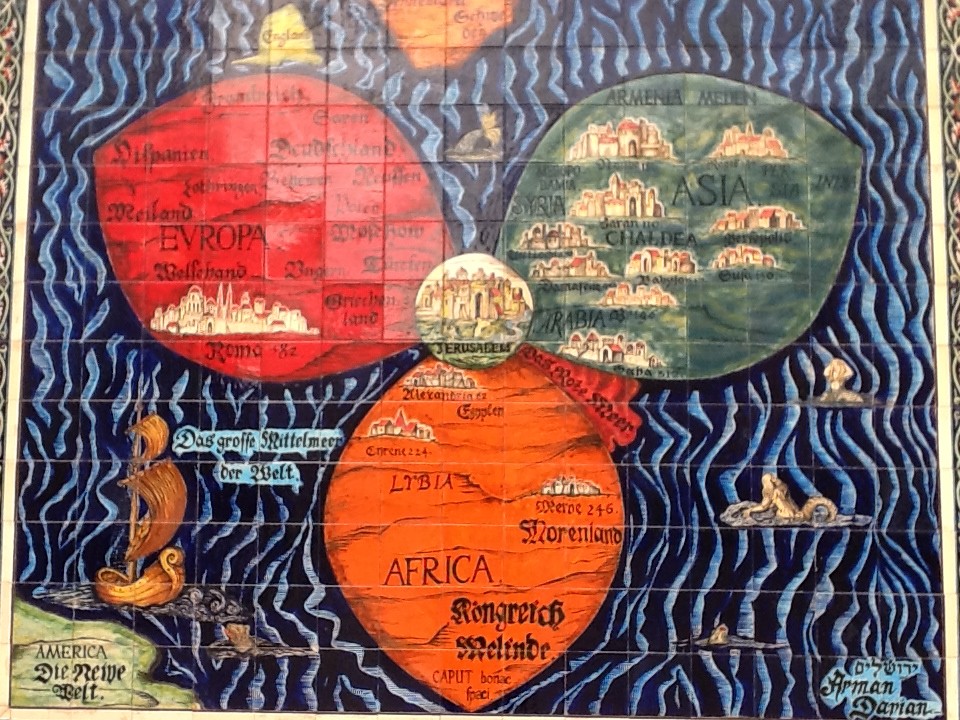
The photo I posted today is a copy of the Clover Map, originally drawn by Heinrich Bunting in 1585 and re-created as a large bright-colored ceramic installation in Safra Square (right next to the municipal building). The map places Jerusalem in the center of a large-three leaf clover comprised of three continents of the world (Europe, Asia, Africa — apologies to North and South America, Australia and Antarctica!) As a New Yorker, I love the famous New Yorker cartoon which places New York as the center point of the world. As a Jew, however, my soul resonates with the belief that Jerusalem is that place, the axis mundi, where heaven and earth meet. Traditional Jews believe that the location where the Temple stood was the specific location of the axis mundi within the already-holy city of Jerusalem. Hence the emphasis on the Wailing Wall, the only existing remnant of the  ancient Temple.

There is a wonderful folk story about two anonymous brothers who farmed the land where the Temple later stood. One was single; the other married with a family. They divided the produce of the land equally. One night, however, the single brother woke up in a panic. “My brother has a family to support and should have more than half the bounty.” As a result, he got up, went to the piles of grain and added from his own pile to that of his brother.

On that same night, the married brother woke up worrying about his single brother. “After all,” he told himself, “I have the joy of a loving wife and family, what need have I of such material abundance?” So he got up and placed some grain from his pile onto that of his brother.

This exchange continued night after night until the brothers met in the middle of the field and suddenly realized why their own piles never seemed diminished. They hugged and cried, and God, watching from above, said, “This is very good,” and decided that that should be the very spot for the holy Temple to be built.

Jerusalem, Yerushalyim in Hebrew, literally means “the city of peace.” Perhaps the potential of being the axis mundi exists here, but I tend to think it won’t be realized again until Jerusalem (as a metaphor for the whole of Israel, as a people — which includes Jews everywhere — and as a place) lives up to its name as a place/people of peace and love and generosity as exemplified by that folk story … until the two brothers of the same father again put the welfare of the other before their own.

27th Tevet/January 8, 2013

A Sukkah of Peace

26th of Tevet, Monday evening, January 7, 2013

The wind howled all last night, keeping me awake. As we walked to synagogue early this morning, Chaim and I had to navigate downed trees which held up traffic. As a result of the weather there was no tenth for a minyan until the very, very end of the service, with me nearly in tears for fear there wouldn’t be one at all. (A minyan is a quorum of the ten required in order to say certain prayers, including the mourners’ kaddish which I was there to recite in honor of my mother’s yahrzeit. Fortunately, one of the recitations of this prayer occurs at the very end of the service.)

Observing yahrzeit (the anniversary of a death) and yizkor (a memorial service that takes place 4 times a year on the holy days of Yom Kippur, Shemini Atzeret, the last day of Passover, and Shavuot) is very important to me. Typically, I lead the morning shacharit service or read Torah on the days of my parents’ yahrzeits to honor them. This year was a compromise, only going in order to recite the mourners’ kaddish prayer. When that door looked closed, I found myself getting incredibly anxious, wondering where I would find another minyan at that now-late hour of 8 AM, since most weekday services here start between 6:30 and 7 AM.

I was sobered (many egalitarian congregations seem to have a tough time getting a quorum for a daily minyan), but ultimately relieved, as we headed home through pouring rain and a wind that kept blowing my umbrella inside out. Near our corner a very large tree had newly fallen across the main thoroughfare, blocking traffic in both directions, pulling down electric wires, and causing a power outage in our neighborhood. It took most of the day, about seven hours, for the power to be restored. (Now I can commiserate even more with friends and family who lost power for days during Hurricane Sandy). In the meantime, Chaim and I hunkered down in many layers of clothing in the cold to read by what light we had in the apartment. Every time we attempted to venture out to a cafe thinking there had been a break in the rain, another downpour sent us scrambling back home with even more wet clothes.  I hadn’t slept all night, so I wasn’t even up for a museum on this cold and lay-low day. Tomorrow it is even supposed to snow, a rare Jerusalem occurrence.

We are staying in a little neighborhood called the Greek Colony on Yehoash Street, Yehoash being one of the ancient kings of Israel mentioned in the Bible. Every neighborhood seems to have a theme (or multiple themes) in its street names. We live in a neighborhood of kings and other Biblical characters (including Yehoshafet, Ruth, and Jonathan, all of which branch off a main street named Rachel Immenu, Our Mother Rachel). A few blocks away are a few streets named for pre-State Hebrew newspapers like Ha-Melitz Street (a Hebrew newspaper published in Russia), HaTzefirah Street (published in Poland), and HaMaggid Street (published in Prussia and distributed throughout the Pale of Settlement). Close to those blocks is another section named for statesmen like Prime Minister Lloyd George of England (not sure why he got a street named for him in Israel since he considered Hitler “the greatest living German”), Prime Minister Jan Smuts of South Africa, and Czech Prime Minister Tomas Masaryk, still considered the great symbol of democracy to both the Czech and Slovakian Republics. (There is also a Kibbutz Kfar Masaryk in the Galilee that was founded by Czech Jews.)

Another neighborhood, where my friend Susan lives, is named for the sons of Jacob (also known as the 12 tribes of Israel): Asher, Dan, Reuven, Naftali, Shimon, Levi, Yehuda, etc. Further towards the city center there are a couple of streets named for Yiddish writers like Shalom Aleichem and Mendele Mocher Sefarim.

Walking the streets is walking Jewish history through the ages, both ancient and modern. Some of the signs give the footnotes to the name while others don’t, which encourages us to come home, Google, and learn. (Regarding the Googling, my friend Bili spent over an hour on the phone with a guy named Max from the Israeli phone company, Bezeq, and got my Internet up and running. Apparently Macs — no pun intended — have a hard time synching in Israel.)

While the street names honor both Jew and non-Jew in the history of the city, one of the disturbing aspects of the names is the Judaizing of certain long-standing neighborhood names. Though we are close to a neighborhood well-known as Katamon (a Greek name meaning “under the monastery) it has been given an official Hebrew name, Gonen. Likewise, the street signs directing you to the neighborhood of Baka’a (Arabic for “valley) call it Geulim, with Baka’a in parentheses. Nonetheless, everyone still calls it Baka’a. An even more vicious outgrowth of the “invisibilizing” of the Muslim culture of Jerusalem is the blotting out of the Arabic in signs and placards around the city that routinely offer explanations in Hebrew, English and Arabic. We noticed this on informational signs outside the Jaffa Gate to the Old City, as well as on “Slow Down” traffic signs for drivers around the city. It is a kind of vandalism that breaks my heart, it being so purposefully malicious and intolerant of the Other, as if the very language of Arabic is to be despised and expunged. As we travel around, I will continue to monitor this phenomenon to determine how widespread and rampant it actually is.

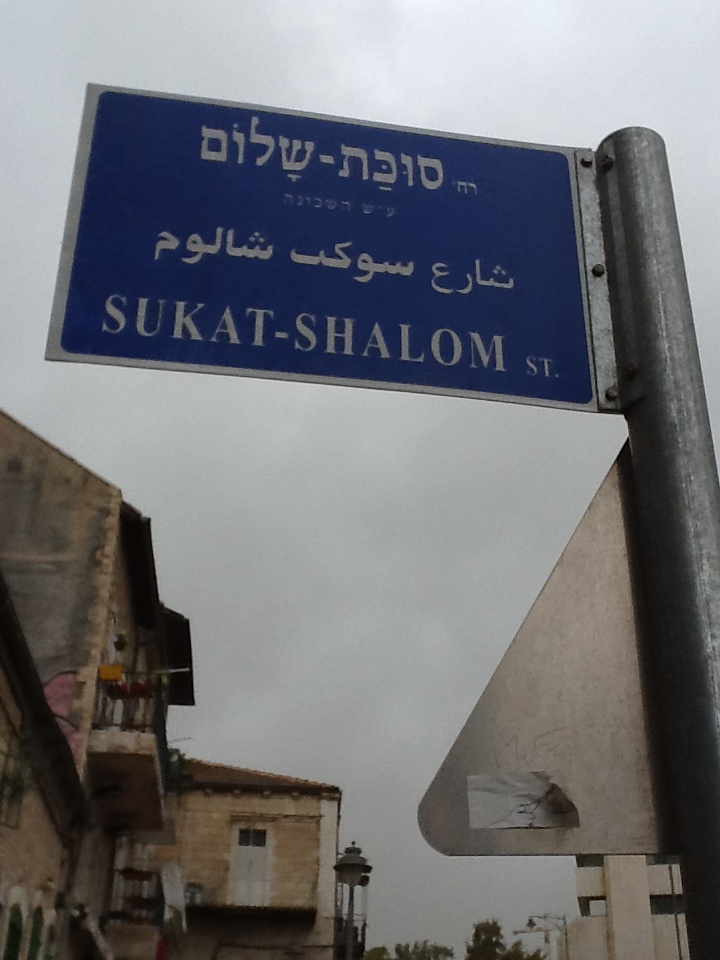
So the photo I post today is a street name that brought me great joy and a modicum of hope when Chaim pointed it out to me yesterday, just outside of Mahane Yehuda market. It is Rehov Sukkat Shalom, the Shelter of Peace Street.

A sukkah, like peace itself, is a fragile and vulnerable thing. It is a temporary structure that Jews build on the holiday of Sukkot to symbolize our vulnerability in the face of Mother Nature or in the face of political events (even God’s own House, the great Temple in Jerusalem, destroyed first by the Babylonians and then by the Romans, is referred to as a sukkah) .

A sukkat shalom/a sukkah of peace never claims to be permanent, but it is the most we can ask for in a world waiting yet to be redeemed.

So when we Jews pray for peace, invoking an image of a sukkat shalom, the tradition apparently doesn’t expect us to demand (or receive) the whole kit and caboodle. Praying for and receiving even a bissele of peace, a little sukkah of peace (like what I experienced at Congregation Kol HaNeshama on Shabbat — the visit from the Muslim-Jewish delegation on Friday night and  the Kadi’s sermon the next morning) is enough for a start.

SukkatShalomSt

In memory of my mother and of my teacher, Carmi

photo-1

25th of Tevet, January 6, 2013

T. Carmi, the Israeli poet of blessed memory, was my Hebrew literature professor during my first year of rabbinical school in Israel, from 1988-9. He encouraged me in my own writing and was a source of inspiration, wit, and great humanity.

On our walk to Mahane Yehuda today to buy more fruit and vegetables (after having already walked for over three hours to Yemin Moshe, the Jerusalem YMCA, the amazingly beautiful campus of Hebrew Union College — where I attended my first year of rabbinical school  — and the Old City, including all 4 quarters — Christian, Armenian, Arab, and Jewish — and the Wailing Wall, where I placed prayers in the nooks and crannies for dear ones), Chaim and I passed a used bookstore. In the window I spotted a book with a drawing of a man who looked familiar to me, and then I realized that it was Carmi. His name was hidden under a sticker on the cover, but I went into the bookstore, grabbed the book from the window and started leafing through it. It opened (miraculously?) to page 196, in which the poem is entitled “Mot Imi/My Mother’s Death.” I bought the book (pictured above).

I bought the book to honor my teacher, but I also bought the book because at the end of 1988, my first semester of rabbinical school in Jerusalem, I received a phone call from my father to fly home immediately because my mother was dying. My brother, also in Israel at the time (on a kibbutz) and I were only able to get a flight home at the busy traveling season at the end of December because the bombing of Pan Am flight 103 (the Lockerbie bombing) had just occurred a few days before. No flights had seats for us except for Pan Am, due to cancelled reservations. As a result of that airplane tragedy, my brother and I had a few days with our mother before she died on the 25th of Tevet, January 2, 1989.

Tonight, as I write, it is the 25th of Tevet, my mother’s 24th yahrzeit. The candle burns nearby, and in the morning I will attend synagogue to recite the mourners’ kaddish in her memory.

But there is more. During my stay in the U.S., keeping up with my schoolwork as best as I could, thanks to my teachers and classmates (a shout-out now to Stacy, in particular), and having a classmate (thank you, Lisa) deliver my first sermon on my behalf, one that interwove my thoughts about the verse “This month shall be the first of months for you” from Parashat Bo in Exodus 12 with my thoughts about my mother’s impending death, Carmi had assigned a new story. It was about the death of a mother (I believe it was a S.Y. Agnon story, but I’m not positive now). My classmates apparently thought this was not the wisest move. Carmi checked it out with me; I assured him it was fine, and that’s the story we read.

Today on the eve of my mother’s yahrzeit, I found Carmi’s own homage to his mother’s death. It was almost a psychedelic experience for me — what some might call a symptom of Jerusalem syndrome — my mother’s death, Carmi’s mother’s death, Agnon’s mother’s death all coming together in Jerusalem in the hours just before my mother’s yahrzeit. (Look it up. It’s real. According to Wikipedia,  “the Jerusalem syndrome is a group of mental phenomena involving the presence of either religiously themed obsessive ideas, delusions or other  psychosis-like experiences that are triggered by a visit to the city of  Jerusalem.”) 

So tonight, after going to a movie (an Israeli film, Filling the Void) and lighting my mother’s yahrzeit candle, Chaim and I sat down to translate Carmi’s poem. Carmi wrote about his mother’s death when he was 43, 23 years after she died, looking back. He writes about the nurse telling him to leave the room, of his not leaving the room, of his memory of hearing his mother’s soul ascend, of her yellow skin, her being only skin and bones, and of his ultimately agreeing with the nurse that “there are things that a son, a human, never forgets.”

Carmi himself died in 1994 at age 68. He was a masterful translator of poetry and of Shakespeare. In an ironic twist (thanks to Rabbi Bill Cutter for sharing this story with me a number of years ago in a class about Hebrew translation), Carmi’s erudite translation of Othello shortly before his death was rejected by the Israeli theater company that had commissioned it, deeming it too sophisticated a Hebrew for the audience to understand. (Since when was Shakespeare’s English perfectly understandable to an English-speaking audience?) Apparently, this was a great disappointment to Carmi and a shame on that theatre company.

Tonight is 24 years after my mother died, and I am looking back. There are things that a daughter, a human, never forgets. One of them is her mother. One of them is her mother dying and hearing her soul ascend. My father, sister, brother and I were all privileged to hear that whisper, as we gathered around the hospital bed, each massaging one of her limbs.

Zichrono livracha — may the memory of my mother — and of all of our mothers — be for a blessing.

And may we all be blessed with teachers whose memories are also a blessing.

Shavua tov! (1)

May 2010 003Jerusalem, June 2011 022-1

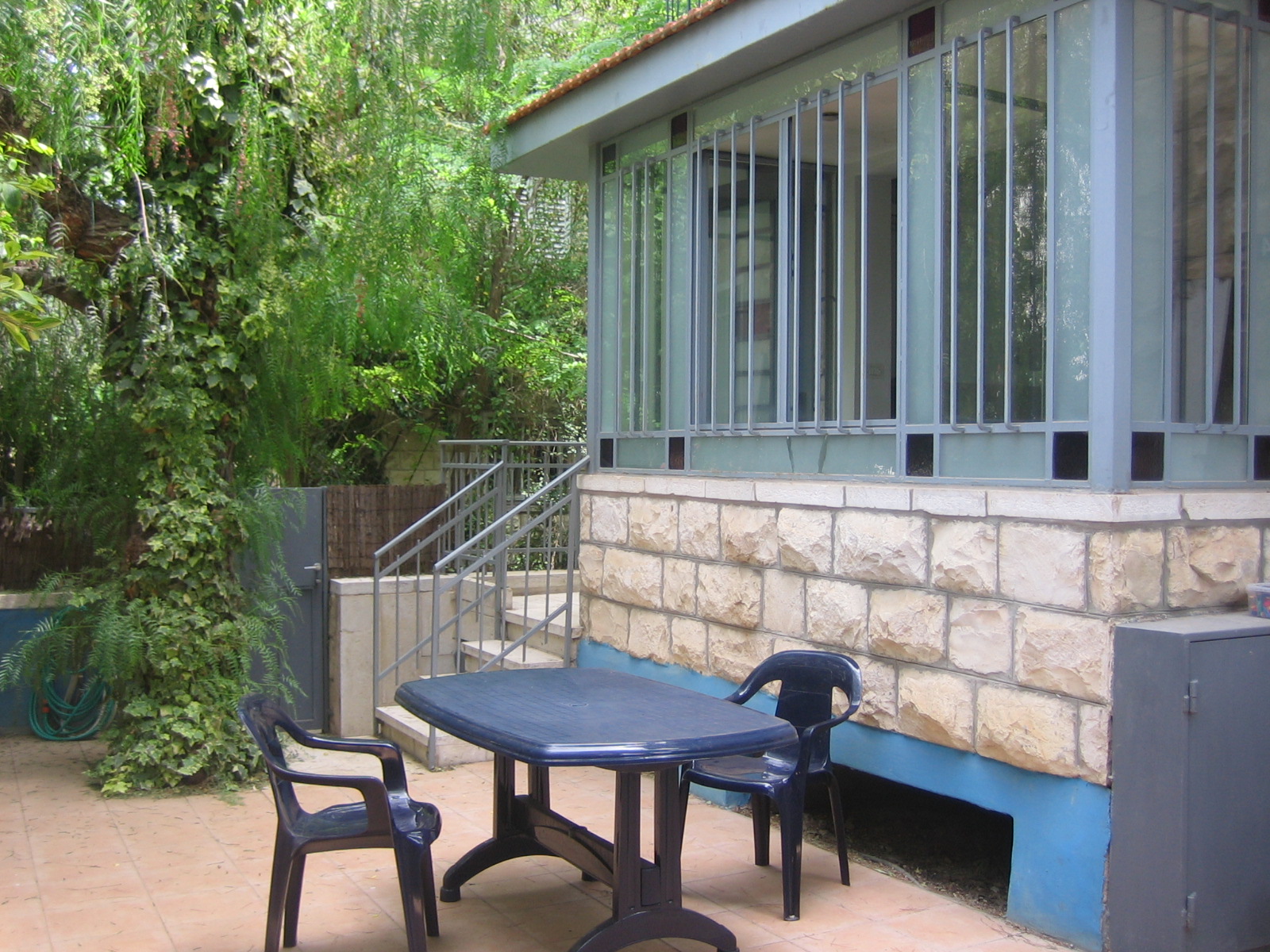
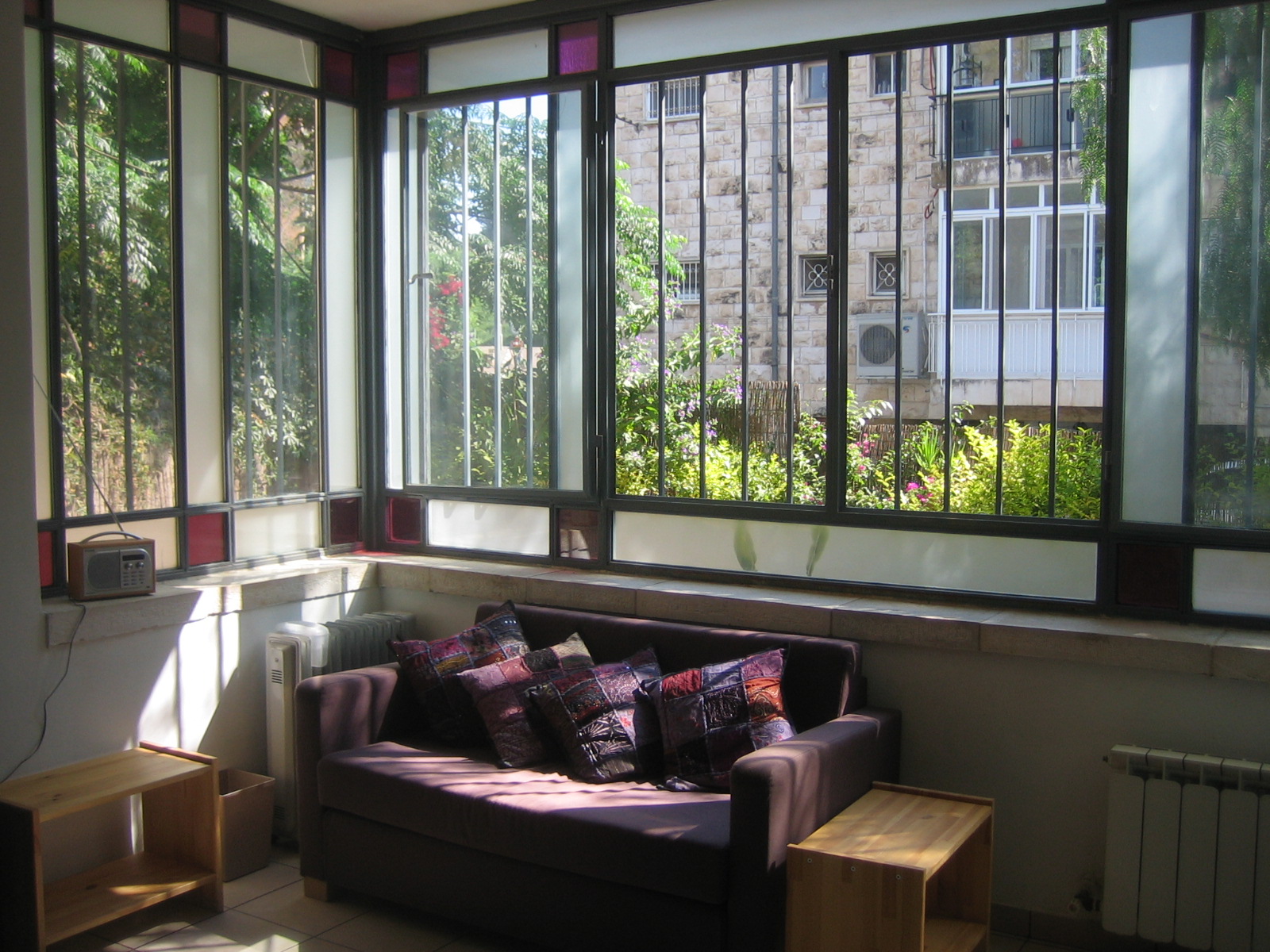
These are inside and outside views of our apartment in the Greek Colony (same windows in each). I myself have not taken any photos yet (these were provided by the owner), though I am anxious to take some shots of all the political posters around town, Israeli elections being held in a couple of weeks.

Chaim and I had a wonderful, relaxed Shabbat, catching up on much-needed sleep and hoping that our internal clocks are now in the right time zone. Last night we attended a vibrant Reform synagogue (named Kol HaNeshama), about a 15 minute walk from our apartment, which was my home congregation during my first year of rabbinical school in Jerusalem. Next to me sat a young Muslim woman from Jerusalem who was there with a group of young Jews and Muslims from Israel and Long Island, NY. The group is called Hamsa, a joint project of the Suffolk Y on Long Island and a Jerusalem youth center, and I was very moved especially when we sang the song “Od Yavo Shalom Aleinu/Peace will still come upon us” in which there is a stanza in which we sing “Shalom! Salaam!” To sing that song while sitting next to an Israeli Arab brought tears to my eyes. (Perhaps you can tell that I’ve been tearing up a lot so far on this trip!)

This morning that sense of hopeful possibility for peace between Arab and Jew continued at Kol HaNeshama, because the head judge of the shariya court in Jerusalem, Kadi (Judge) Iyad Zahalka, gave the sermon. The Torah portion today, the first in the Book of Exodus, speaks about Moses’ commission as prophet. The Kadi’s sermon was entitled “Moses (Mussa, in Arabic) the Prophet as Understood by Islam.” This was the Kadi’s first time speaking in a synagogue, and I hope it won’t be his last. Even with my non-fluent Hebrew, I was impressed by his knowledge of Torah and its similarities and differences with the Koran, and how the sharing of Moses between our cultures can provide a bridge of understanding. For anyone interested in Moses in Islam, go to Surah 28:7-43 in the Koran. This is the passage he shared with us.

For more information about this liberal Kadi and the courts, read the blog of my colleague Rabbi Ron Kronish, director of the Inter-religious Coordinating Council in Israel at  http://blogs.timesofisrael.com/my-friend-the-sharia-judge/

By the way (just to name-drop), sitting in front of us in synagogue this morning were Dan Shapiro, the U.S. Ambassador to Israel, and Jodi Rudoren, the New York Times Jerusalem bureau chief. I also ran into Rabbi Michael Marmur whom I was able to thank for an important and prescient pre-9/11/01 phone teaching he had offered me (and a group of rabbis) about 5 typologies of fear, based on a passage in Talmud Shabbat 77b. That teaching became the basis of my High Holy Day sermon that year post-9/11, and I have returned to it time and again in my Mussar studies and teachings about fear and equanimity.

In addition to Shabbat’s spiritual take-aways from synagogue, we were enriched by the company we kept over our Shabbat meals. My dear friend Bili (who has complicated my life by now writing her name in English as Billy, which I refuse to do after 40+ years of writing Bili) helped us inaugurate our temporary home by coming for Shabbat dinner. She caught me up on her family (which was my family-away-from-home during my visits to Israel, starting with a semester during my junior year of college) and her journalist husband, Mats (a Swede currently back in Sweden working on a film about a Swedish diplomat named Folke Bernadotte who was responsible for the release of about 31,000 prisoners from German concentration camps during WWII, but who was assassinated by a radical Zionist group in 1948).  Bili herself works for Israeli t.v. in the archives department (which is how she and Mats originally met, when he first came to Israel in the 90’s to research Bernadotte.)

Today Chaim and I spent Shabbat lunch with my friend Susan (a Reform rabbi who was in my rabbinical school class) and her family. She and Yosef have 5 children ranging in age from 9-20, two of whom were adopted from Ethiopia.  Susan is a writer and Yossi is working in the solar energy field. It was truly wonderful to be with them, and Susan offered me the opportunity to parallel play with her any time I want — that we meet in a cafe and each work on our writing. She also invited me this week to join her for the inaugural meeting of a Rabbis and Comics Torah Study Group that she is starting.

I will report back on any and all jokes that are worth passing on!

I almost forgot to mention that is has been pouring rain all day (and now into the night). As Yossi said to us as we walked through the rain to his home from synagogue, “In the desert, the more rain, the more peace.” If I can find a cheap raincoat, I will say, Amen to that!

Shabbat Shalom 1

I cannot get the internet to work in the apartment, and all of the cafes are shutting down in preparation for Shabbat (it is now 3 PM and Shabbat starts in about an hour). In fact, the table and chair I was just sitting at was pulled out from under me, and I am crouching against a wall to type this message while I still have the Wifi! Dinner is already in the oven, soup is hot on the stove, since Chaim and I prepare all of our Shabbat food before Shabbat (he is strictly observant in that way — I, not so much).

We walked from our neighborhood (the Greek Colony) to Mahane Yehuda, the marvelous market in central Jerusalem for our fruit and vegetables today– a very, very crowded and busy place on a Friday, but always colorful and exciting!

We are looking forward to hosting Bili, my Israeli pen pal since I was 10 years old, for Shabbat dinner tonight. Tomorrow we go to my friend Susan’s for Shabbat lunch.

More tomorrow night. May your Shabbat be sweet and restful.

Shehechayanu

Blessed is the One who has given us life (shehechayanu), sustained us, and has allowed us to arrive at this moment.

It was, indeed, a spiritual homecoming. We landed about 5 hours ago and arrived at our lovely apartment about 3 hours ago. I cried on the plane reading Tefilat haDerekh, the Prayer for the Journey, and then through some other prayers in two rich compendiums for anyone traveling to Israel: Larry Hoffman’s Israel: A Spiritual Travel Guide and Birkat Artzi: Blessings and Meditations for Travelers to Israel, published by the Central Conference of American Rabbis, my Reform rabbinic organization. I cried again reading my (and Chaim’s) friend Debbie Friedman’s, of blessed memory, version of the Traveler’s Prayer (“May we be blessed as we go on our way/May we be guided in peace/May we be blessed with health and joy/ May this be our blessing, Amen…”) and realized that we are coming up on the second yahrzeit of Debbie’s death during the time that I will be in Israel. I therefore cried some more for the brilliant creative life that was her legacy and the loss of all of those songs and teachings that she still had to offer the world.

And I cried yet again as the plane prepared to land and I saw buildings, the LAND — THE land — while Chaim focused on the weather report on the t.v. screen. “I’m having a spiritual moment, and you’re worried about the weather, not even looking out the window?” “In Judaism,” he reminded me, “the physical IS the spiritual.” I can concede that point. One of my favorite teachings of Rabbi Israel Salanter (founder of the Mussar movement) is that most people “worry about their own bellies and other people’s souls, when we all ought to be worried about our own souls and other people’s bellies.” The physical and the spiritual are inextricably linked. This reminds me of how far I feel from God in times of physical pain and why I so love our morning blessing for the body (asher yatzar) in which we affirm how impossible it would be to “stand before God” (to pray/worship/thank) if one of our body’s openings or cavities would be open when it should be closed or closed when it should be open. Sometimes there is a dichotomy, sometimes an overlap between the spiritual and the physical. While we have countless examples of saints and holy people of all religions (including Judaism) who were impoverished in body but spiritually rich, for most of us, physical well-being creates the necessary grounding upon which a spiritual life becomes possible.

My hope is that these experiences will be woven together during this trip, the physical and the spiritual, and I believe that my two spiritual guidebooks will be helpful on that front — offering prayers and reflections for so many specific places that we will visit in Jerusalem and around the country, as well as blessings for eating on a kibbutz, for a place of Muslim or Christian worship, for seeing/hearing Hebrew all around you, and for visiting a place of recent tragedy. I am looking forward to infusing my trip with what I call “mezuzah” moments of spiritual awareness. (Just as kissing the mezuzah upon arriving and leaving the home is meant to provide an awakened mindfulness about our comings and goings, so can we create such moments throughout our day.)

I assure you, however, that I did not only cry upon my arrival. I laughed my way through Passport Control when the man asked me his questions in Hebrew and I chose to be brave and respond in Hebrew. He patiently tolerated all of my grammatical mistakes, and I promised him that my Hebrew would be greatly improved when I leave in 3-1/2 weeks. When I found out that he asked Chaim (whose Hebrew is fluent) his questions in English, I laughed even more. “Rak b’ivrit, I said to Chaim afterwards, making him promise that he would speak only Hebrew to me this trip (a promise that I imagine we will keep and break and renegotiate along the way).

I broke my Hebrew promise with the man at the falafel joint around the corner from us. I told him (in Hebrew) that we had just arrived and had no shekelim (shekels) on us, would he accept dollars? “Where did you arrive from?” he asked in English. “New York.” “Yeah, I moved here from Staten Island!” In English I had to commiserate with him about Hurricane Sandy and how it had affected Staten Island, and learned that his parents lost their home (the water reached their bed on the second floor of the house!) and had temporarily moved to California, and we then ranted about Congress miserably failing to pass emergency aid for the disaster.

We have our first neighborhood friend.

Thursday, January 3, 2013


Leaving on a jetplane….

New Year’s Day, and it’s time to pack.

I want to bring clothing for all contingencies, books for every mood, medications for every potential malady, and all of my middot (soul-traits) in perfect balance — enough faith, patience, humility, and generosity to get me through this trip with my soul and my integrity intact.

But El Al only allows me one check-in bag of 50 pounds and one carry-on (which has to include my laptop), so I have already unpacked some of my patience and generosity of spirit, and I might have to leave some books behind, as well. Surely I will need my siddur (prayerbook) and Tanakh (Bible). Must I leave behind Jerusalem: One City, Three Faiths by Karen Armstrong? Or that extra blue sweater? When the choice is books or clothing, I will usually (not always) choose the books. I did download a couple of library books to my I-pad in order to lighten the load just a bit, but technophobe that I am, I can’t be sure I will figure out how to open them up to read them!

Chaim is traveling light, and I envy him his middah of simplicity. But he is right: I am not a camel who can carry any load. I am almost 53 with a bad back, and travel light I must. No Karen Armstrong. No extra blue sweater. But let’s add some extra patience and a lot more faith. I do have a lot of fears going into this trip — for safety (will the ceasefire hold?), for comfort (how well will my Hebrew serve me? will it be too cold in January?)

More from Jerusalem on the 3rd!

Blessings to you all for 2013!