Justice, justice: a P.S. to Guatemala posts

I have been home now from my AJWS global fellowship trip to Guatemala for almost two weeks, and every day I am still thinking about what I saw and learned there, inspired by those we met who continue the struggle for justice despite the odds.

I was delighted to share my experience in person with my dear friend and college roommate, Julie, who was visiting this past week while in the Berkshires to play at Tanglewood (she is a violinist). Julie had travelled to Guatemala during the civil war when the army presence was quite apparent and when the poverty was much worse than what I witnessed.

A number of years ago, sensing the injustice of classical music only being affordable for the monied, Julie  started a non-profit called Shelter Music Boston, which brings classical concerts to the homeless shelters of Boston. She has touched lives, possibly saved lives, brought dignity to the downtrodden, and received awards and accolades for her innovative work.

Yesterday I was on the pulpit officiating at Shabbat services for Parashat Shoftim. I offered a text study during the service based on a teaching from Ruth Messinger, president of AJWS, about Deuteronomy 21:1-9, a section about an unidentified corpse and no known killer. Who is responsible? The townspeople who live closest, according to a mishna in Sotah, had the communal duty to protect that passer-by against real and potential dangers. By not noticing his presence in the first place, they had failed in their obligation to him. We therefore all have an obligation to see and to notice, not just to do.

After the service, in our more extended Torah study, we looked at the verses from the same Torah portion,  Deuteronomy 16:19-20, “You shall not judge unfairly: you shall show no partiality; you shall not take bribes for bribes blind the eyes of the discerning and upset the plea of the just. Justice, justice shall you pursue” and studied both Jewish and non-Jewish sources on what justice is. Thanks to my sister global justice fellow Rabbi Marla Feldman (executive director of Women of Reform Judaism), I learned (sort of) how to use a computer program called Publisher to create a Talmud-like page of commentary (see below).
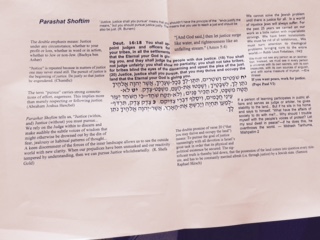
talmud page

Here are some highlights of the texts about justice that I included:

“At his best, man is the noblest of all animals; separated from law and justice, he is the worst.” (Aristotle)

“If you want peace, work for justice.” (Pope Paul VI)

“Equal rights, fair play justice, are all like air: we all have it or none of us have it.” (Maya Angelou)

“Until the great mass of the people shall be filled with the sense of responsibility for each other’s welfare, social justice can never be attained.” (Helen Keller)

And this wonderful poem by Eleanor Wilner:

Judgment

When they removed the bandages
from Justice’s eyes, she had long since
gone blind. She had been too many days
in the dark, too long alone with
the scale in her numb hands; she could
no longer tell the true from the false.
She had stood so many years in the cold
outside the courts, as the law rushed
past, clinging to the sleeve
of power – until the chill
had turned her veins to marble,
her eyes to opalescent stone.
Yet those who tore the veil away
could swear they were being watched,
and though it must have been a bit of glass
that caught a ray of sun, it was not unlike
a bright, appraising eye. Whatever it was,
they felt caught out, ashamed,
and late at night, at home, they locked
their windows tight and slipped into the room
where the children slept, and looking down
on them – for what they couldn’t say – they wept.

I love that poem, and I feel the shame that it bespeaks. What am I meant to do to alleviate that shame I carry for my privilege, my complacency and relative inaction, my yet-unfulfilled longing to make a lasting impact on the very real problems in our broken world? That is what I am trying to discern.

The poem reminds me of the lack of justice in Guatemala, nearly twenty years after the end of its civil war, with 200,000 of its people dead or disappeared.

Last night I viewed the documentary Granito: How to Nail a Dictator, by documentarian Pamela Yates. In 1982, at the height of the Guatemalan civil war, she made a different documentary entitled When the Mountains Tremble (you can see it here on YouTube), which brought international attention to the massacres of the Mayans. Featuring Rigoberta Menchu, it is possible that Menchu’s receiving the Nobel Peace Prize was due to the international exposure that that film offered her (in addition to the testimonial biography I, Rigoberta Menchu which was essential pre-reading for my trip, helping me understand Mayan culture and the history of the war).

But that film also had interviews with Guatemalan president/dictator and army general Efrain Rios Montt himself. Therefore some of the outtakes from When the Mountains Tremble contained important footage that was later used to bring Rios Montt to trial for genocide. Granito follows the story of how that first documentary film was used to bring a conviction, in addition to wonderful interviews with Mayan and human rights activists, as well as with the forensic anthropologist Fredy Peccerelli who digs up mass graves to help bring closure for the families of the disappeared. He is also featured in a TED talk from January 2015, “Fredy Peccerelli: A forensic anthropologist who brings closure for the disappeared,” the only TED talk that comes up when you search under “Guatemala.”

I cited in a previous post that Rios Montt was convicted of genocide and crimes against humanity on May 10, 2013, but the conviction was overturned only 10 days later. According to a story (“Guatemalan Ex-Dictator Rios Montt Found Mentally Unfit for Genocide Retrial”) featuring Pamela Yates on NPR’s All Things Considered on July 8, 2015, he was declared unfit for the genocide re-trial that was supposed to be taking place now. I also mentioned previously that his daughter is running for president of Guatemala in the election to take place on September 6.

Granito makes clear how important justice would be for the healing of Guatemala. I do a lot of forgiveness work with my clients — it is clear that people who feel wronged often cannot move on without justice — whether in the form of true repentance and remorse from the perpetrator or in the form of legal action against the perpetrator. What happened in Guatemala can not be forgotten or forgiven without some sort of justice and accountability. The stories, the testimonies, the memories are sitting there under the surface, and only now are the children learning about this painful history of their country. As Pope Paul VI said, there can be no peace without justice. And Guatemala deserves both.

Having been there, having seen, I, too, am responsible. As Rabbi Abraham Joshua Heschel said, “where terrible wrongs exist, some are guilty, but all are responsible.”

And his student, Rabbi Marshall T. Meyer said:

Is it sheer stupidity to bother yourself for another’s well-being? Isn’t it much wiser to not become involved in your neighbor’s misery? Why should one take trouble to listen to the moans and groans of others? For one very good reason. Because life without sensitivity and responsibility is an ode to narcissism, a cacophony of egocentrism, to say nothing of the fact that your silence is acquiescence, and in the ultimate analysis, culpability.

I am in a place of discernment. What is my role as a global citizen? How to I take my experience as an AJWS global justice fellow to the next level? I am listening for the call.


P.S. For those interested in further reading on Guatemala, here are a few more interesting links, one about labor/union rights in Guatemala concerning Coca Cola (and a case brought against Coca Cola in the U.S.), another about Guatemalan activist Helen Mack and the ongoing efforts to try human rights cases in Guatemala, and a third about the ugly effects, both human and environmental, by the palm oil industry in Guatemala.
Guatemala Day 9 — and Home Again

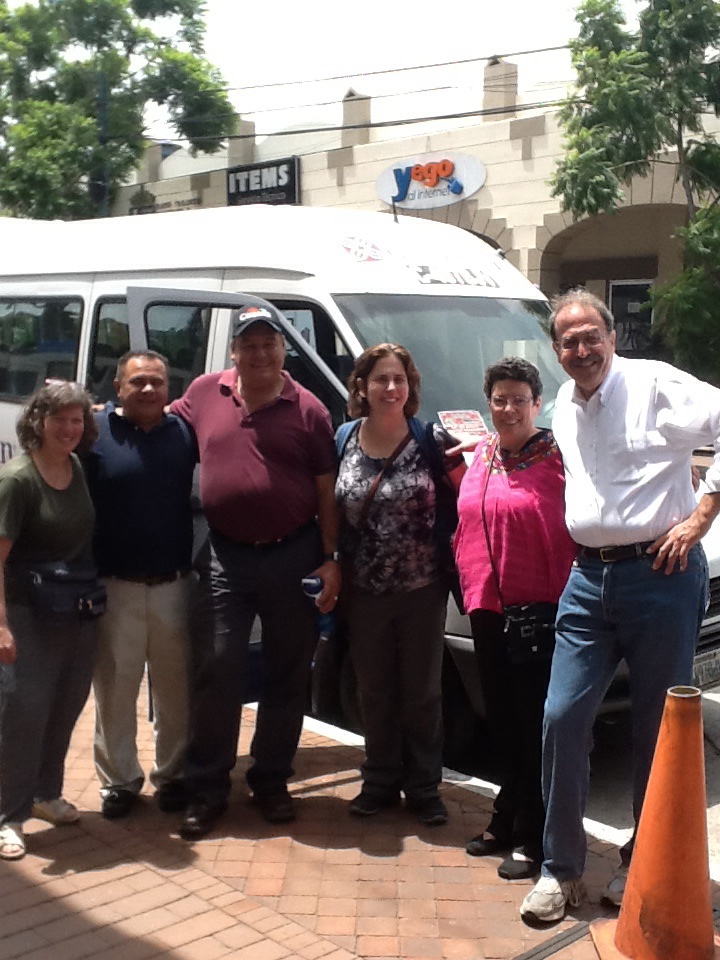
Saying good-bye to Rambo, our guide, and Gato, our driver

Saying good-bye to Rambo, our guide, and Gato, our driver

I got home at about 1 AM last night, and now, after a decent night’s sleep, better than any I’d had in Guatemala, I am ready to start the day.

I wrote this while on the plane home from Guatemala City yesterday:

We concluded our program this morning (Monday) with three beautiful rituals. First, Stacy facilitated our sacred space. She had a pitcher of water and four glasses, each representing either fire, air, earth, or water, four of the Mayan elements we had learned about from the two welcoming ceremonies we had participated in with the midwives. Stacy invited us each to come up and reflect on something we are each taking home from this trip and how it relates to one of the four elements, and then to pour some water into that cup.

Some of the responses were about the land, about the volcanoes, about our having to be so conscious this week to use only bottled water to brush our teeth or drink, about breath, and words, and the candles in the welcoming ceremonies themselves. We mentioned names of the people we had met and places we had been.

Secondly, Mark continued our tradition of reading our own Torah — the memories from the previous day’s adventures.

Then Adina and Lilach led us in a very powerful, tearjerker good-bye ritual with each other. Half the group formed an inner circle facing those on the outer circle. Those on the inside closed their eyes. Those on the outer circle responded to the following prompts (there were many more, as well) by putting a hand on the shoulder of the people who had fulfilled them, as they circled those in the inner circle:

You taught me something this week
You exhibited spiritual leadership this week
You made me think about something in a new way this week
You made me laugh this week
I will stay in touch with you to keep me on the path of justice
I believe you have moral courage

With my eyes closed, feeling all of those hands either touch my shoulders, warmly grab my shoulders, hold and massage my shoulders — it made me cry. Then I got to move to the outer circle and thank others in the same way, for being fellow travelers  in the cause of justice.

And then, poof! The first group needed to leave for the airport, leaving four of us behind for the second shuttle.

  • I am thinking about Claudia. I asked her what had politicized her. She told us that when she was a baby, her grandfather’s house was bombed while she was asleep there. She was peppered by glass, but all survived. To this day, she is afraid of loud sudden noises. (This is a problem as firecrackers are set off regularly to celebrate birthdays and holidays.) She also told us how her father, a physician, hid other physicians when they were being targeted. It didn’t matter if they were on the right or the left.
  • I am thinking about Juana, the young midwife with an entrepreneurial spirit, who has a beauty supply business with a couple of relatives, how she thanked me for my song, and her beautiful smile.
  • I am thinking of Archavia, who, though illiterate, plans to vote in the upcoming election, and how she trusted me with her sacred story because our eyes had met and I’d asked her her name, and we connected across boundaries of culture, class, and language.
  • I am thinking of Flor, who became politicized when so many girls in her class got pregnant and the nuns offered nothing but ostracism.
  • I am thinking of Christian who told us that he had been sexually abused.
  • I am thinking of Ayida whose dreams were fate and who delivered her own sister.
  • I am thinking of Delia who said that every midwife undergoes a spiritual trial.
  • I am thinking of Luis, the head of the CCDA, who is running for Congress in the upcoming Guatemalan election. May he win and not be corrupted by a corrupt system.
  • I am thinking of all the women who shared their stories of being doubly discriminated against — for being indigenous women and for being women — and all of the sexual violence they have suffered, and how they now know that that is not their fate, that they can stand up for their rights.
  • I am thinking of the midwives who usher in new life in with their commitment to serving their people as healers and spiritual guides and keeping ancient traditions alive.
  • I am thinking of the proud Mayan history and civilization of building majestic cities and their incredible ability to read the heavens, and of being now second-class citizens.

Already, emails were flying to each other this morning amongst our group. Some folks missed their connections, some got home safely. I recommended a film I saw on the plane called Guten Tag, Ramon, about a Mexican man who is unsuccessful in getting to the U.S., so he goes to Germany (the film has interesting Holocaust references, as well). Jill recommended the film Granito, which she watched on the plane, and now I have ordered it — it’s a documentary that “reveals the thirty year struggle to bring Guatemala’s ex-dictator Ríos Montt to justice for genocide against the Mayan population.” And Margaret started reading the book The Locus Effect, which I will now have to read, as well, about how to address poverty. You can go to www.locuseffect.com for more information, but it seems that the authors were in Rwanda after the genocide there and write about how the end of violence is integral to the end of poverty.

I will keep reflecting on the aftershocks of this trip and how I keep moving along on the journey.

Me with R Faith Joy Dantowitz and Rabbi Stacy Friedman, both my rabbinical school classmates, plus I was friends with Faith's sister growing up and my brother was friends with Faith

Here I am with R Faith Joy Dantowitz and Rabbi Stacy Friedman, both my rabbinical school classmates. It’s amazing that the 3 of us were AJWS fellows together. (Plus I was friends with Faith’s sister Debby z”l growing up and my brother was friends with Faith Joy — though she has now been renamed Fe Alegria, which must make me Pamela Alegria!


Guatemala Day 8-9

Group picture above Lake Atitlan, volcanoes in background

Group picture above Lake Atitlan, volcanoes in background

Yesterday was another long day which began at 7 AM and didn’t end until we got back from dinner at 10. The bus rides had been bumpy and I was in a lot of physical pain by the time the day was done, so I didn’t get to post last night. (Sadly, I’ve had to pop muscle relaxants  and pain meds like candy all week, but tried hard to stay focused and participate as fully as possible.)

We began yesterday morning with a two-hour ride to see the Mayan ruins of Iximche. Before we got off the bus, Adina invoked the Amichai poem “Tourists” that I posted the other day, reminding us of the lens through which we should view the ruins. How can we view the Mayan ruins and the real people whose history this is? How do Mayans today relate to this ancient site? What does it mean to “look with” rather than “look at?”

Rambo, our tour guide, had a wealth of knowledge to share with us about this site and ancient Mayan culture. We learned that this site was set off by a moat and was only for the elite of Mayan culture — king, shamans, spiritual guides, healers, mathematicians, astronomers, timekeepers, and ball players. Timekeepers dealt with the calendar — a system of 13 months with 20 days each. One’s birthdate determines one’s “nawal” (animal spirit), which provides insight to one’s identity and destiny. Lest you think that ball players have all the fun, they were actually warriors whose games could go on for days until death. This Mayan site had two ball fields.

Claudia of UDEFUEGA (Human Rights Defenders Protection Unit of Guatemala)

Claudia of UDEFUEGA (Human Rights Defenders Protection Unit of Guatemala)

One area of the Mayan site is still used for Mayan worship and sacrifice today. We saw a family there whose altar contained musical instruments. Rambo assumed therefore that they are a family of musicians making their yearly sacrifice. All I heard as I approached was the word “gringas,” to refer to our respectful, but nonetheless obvious, intrusion as non-natives.

At the Mayan ruins of Iximche

At the Mayan ruins of Iximche

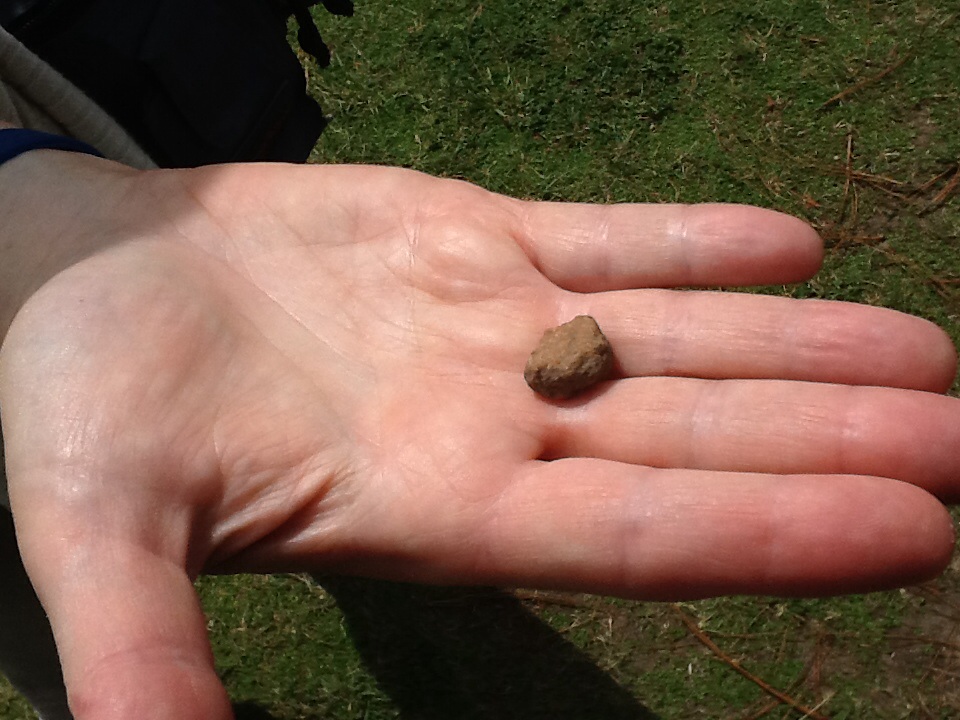
Pottery shards at the Mayan site are easily found, but you will get cursed if it leaves the land, so I took a photo instead

Pottery shards at the Mayan site are easily found, but you will get cursed if it leaves the land, so here’s a photo instead

There are those who vacation in Guatemala unaware of its deep social and political problems. One could easily go to Lake Atitlan or to the lovely town of Antigua (our next stop after the Mayan ruins), hear a lot of English spoken, see a lot of white faces, buy a lot of beautiful crafts, and assume that Guatemala is a perfect vacation destination. And yet, we were swarmed with hawkers (indigenous peoples from villages around Antigua, each selling their specialized crafts — wooden musical instruments, bright-colored, woven and embroidered fabrics, jewelry) upon departing the bus. This had happened, too, in San Lucas to a lesser extent, when we left the bus to board the boat to cross Lake Atitlan — little kids who wanted a tip to help us schlep our luggage, so who could say no?, our tips would buy dinner for the family. White people with money, too weak to carry luggage on our heads as they could. And it is true. My privilege is something I pondered again and again all week. Lilach gave our breakfast leftovers to a girl in Antigua. These beautiful people selling their exquisitely beautiful crafts were hungry.

We therefore re-read the following piece by Jamaica Kincaid (a piece we’d studied and discussed earlier in the week) over our lunch in Antigua (a lovely place with photos of Bill Clinton on the wall because he had eaten there in 1999) to remind us of the deeper truth of these lovely tourist destinations:

“You decide to venture from the sanctity of your tropical compound. You see natives. You marvel at the things they can do with their hair. The things they fashion out of cheap twine or ordinary  cloth. Squatting on the side of the road. Hanging out with all the time in the world. You might look at them and think ‘They’re so relaxed, so laid-back, they’re never in a hurry.’

“Every native of every place is a potential tourist, and every tourist is a native of somewhere. Every native would like to find a way out, every native would like a rest, every native would like a tour. But some natives — most natives in the world — cannot go anywhere. They are too poor. They are too poor to go anywhere. They are too poor to escape the realities of their lives, and they are too poor to live properly in the place where they live, which is the very place you, the tourist, want to go — so when the natives see you, the tourist, they envy you, they envy your ability to leave your own banality and boredom, they envy your ability to turn their own banality and boredom into a source of pleasure for yourself.” (Jamaica Kincaid, from “A Small Place”)

Beautiful wares were sold on the streets of Antigua

Beautiful wares were sold on the streets of Antigua

Cut fruit for sale on the street in Antigua

Cut fruit for sale on the street in Antigua

When we returned to Guatemala City (coming full-circle back to the hotel where we had begun last Sunday), we had the great privilege of meeting Claudia, the head of UDEFUEGA (Human Rights Defenders). She is the epitome of moral courage, defending those who are defending human rights in this country, fighting the corruption, offering safety and security workshops, monitoring human rights violations, convening different groups who might be allies with each other to face common threats such as hydro-electric dams or mining. She was representing the last NGO we would be meeting with on this trip, and she was the appropriate voice, bringing together so many of the issues we had been addressing all week with the other NGO’s. (Better yet, she spoke English, so we didn’t need a translator.) Claudia travels and speaks widely around the world and has been especially involved in addressing problems of late in Mexico, whose human rights defenders are also under great threat. But here in Guatemala, 4600 human rights defenders have been attacked (including herself), and 196 have been killed. Her daughter, who looks like her, has also been attacked. At one point, she said to us something about “the calling we all have to be prophets” and I prayed that she was right, that I might have a prophetic voice as she does to speak truth to power and maintain my moral compass on these issues of justice and human dignity.

On the bus rides yesterday we began practicing and critiquing the stories we each plan to tell upon our return. And last night over dinner we had chevruta study on “taking stock” that made us accountable to one another for what we will commit to in the days and weeks ahead in terms of learning, leading, and taking action. We then had a ‘siyum,’ a closing ceremony in which Ruth spoke to each of us about what we brought to the group this week and her charge to us, and presented us each with a personalized plaque for our being an AJWS global justice fellow and the commitments that that entails. AJWS has invested a lot of money and resources in each of us, and each of us therefore has much work to do to be worthy of this great gift.

I am looking forward to more personal dialogue with those of you who have been following the blog, and I hope that some of you might be interested in bringing me in to speak or teach about the issues: upstream/downstream ways of addressing social problems, how to hold our Jewish particularism and work for universal causes, and how to support the amazing, awe-inspiring work of AJWS. I hope that I have inspired you to do the following: to contribute to AJWS, to take your vacations with more awareness of the underbelly of the exotic places you might visit, to think about addressing root causes of social problems and not just band-aid solutions. If you can, think about joining me in NYC on November 17 for the AJWS gala, where you can hear directly from several of their grantees from around the world (as I have had the privilege it do here in Guatemala).

Buenos Dias! It is now 7:30 AM here on Monday morning, and we are off to our finally Sacred Space and journal reading of yesterday’s day, as well as more good-byes before the first group leaves for the airport. I will post again at least once more about my trip when I got home.

Again, though I don’t know all of you who are reading unless you post a comment, I am assuming that there is an audience out there.  I am grateful for your attention and look forward to speaking further.

Hasta luego! (One of my learning commitments was to learn some Spanish so that I can come back in a few years and accompany Megan on her visits to some further-flung AJWS grantees in Guatemala.)

Guatemala Days 6-7

Yesterday (Friday), we left Quetzaltenango at 7 AM to make a 4-hour trip along winding roads to San Lucas to meet with folks from the CCDA, Comite Campesino del Altiplano (Highlands Committee of Peasants). On the bus ride, we reviewed some of what we had each learned at our Wellstone action trainings last year (I had flown to Chicago for an intensive training in political advocacy work last November as part of my AJWS fellowship): how grassroots organizations (step 1) can put enough pressure on electoral politics (step 2) to make real and lasting policy change (step 3). We know that the Civil Rights movement in the U.S. was a successful model of this kind of grassroots pressure (and I watched the amazing movie “Selma” through my Wellstone-trained eyes), and it’s pretty obvious through this lens that the Occupy movement was a failed grassroots effort, as it did not move on to the electoral politics stage to make lasting political change.

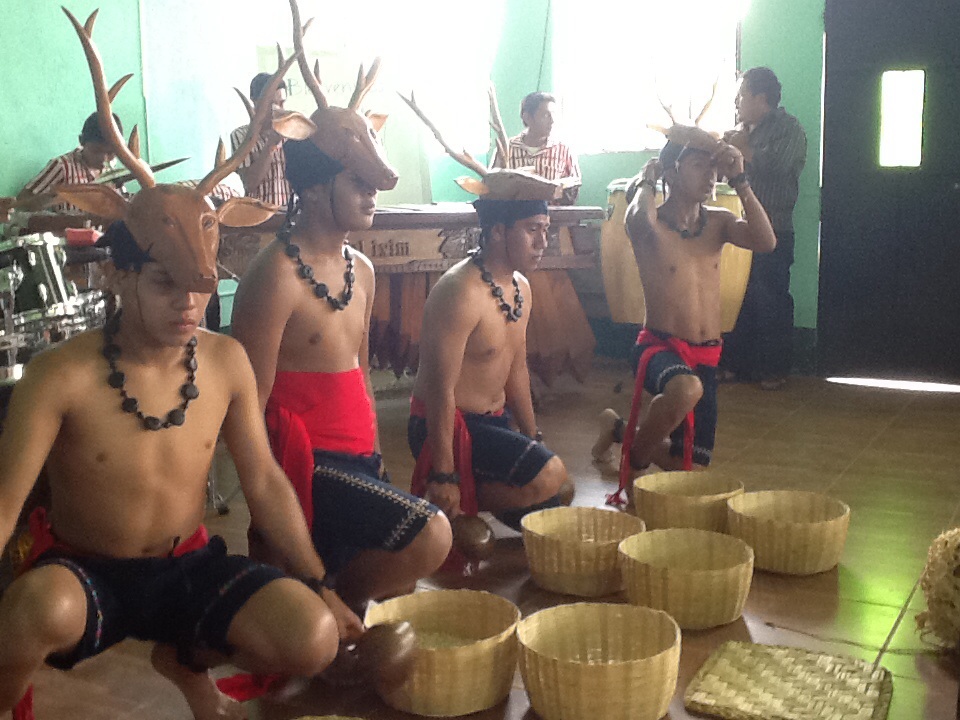
Corn Dance performed for us at CCDA

Corn Dance performed for us at CCDA

CCDA is a grassroots organization (the kind that AJWS likes to fund) which has been successful in the political realm. They do organizing, training and advocacy work. The CCDA works in 13 regions throughout Guatemala to confront land rights challenges for mainly rural, Mayan populations (many Mayans have been displaced because of mining and hydro-electric dams — here’s my REMINDER to you to see the documentary “Gold Fever”), including compiling accounts of human rights abuses against indigenous farmers and advocating for national legislation that will protect their rights. In the last 15 years, they got back the rights to 76 fincas (plantations) that had been improperly appropriated, and another 15 farms will be returned to their proper owners by the end of 2015. Equally impressive is that in the upcoming elections, they have 36 candidates running for congressional as well as mayoral and other municipal positions.

They also harvest and sell 25 different brands of coffee, in addition to macadamia nuts, honey, and raw sugar. (Buy fair trade coffee, folks! It is the just thing to do! This plea is to my husband, first and foremost, who is inconsistent about buying fair trade coffee, despite viewing the world through the lens of economic justice). By helping local farmers gain organic certification for their coffee beans and then selling them to global partners willing to pay fair trade prices, the CCDA has improved the economic stability of indigenous communities. The profits they generate are distributed to the farmers’ families and also invested in local projects like chicken coops and community gardens which benefit the entire community. In our small break-out group, Soyla told us that she is able now to send her daughter to school because of the chickens she raises. Her neighbors have seen how she has benefited economically and are now interested in joining CCDA. This is life-changing in the indigenous communities where 52% of children under age 5 are chronically malnourished and 58% of the people live in poverty.

However, for all this work of protecting the land, of producing food, of diversifying the local economy, and doing training to offer their youth skills with computers, cameras and a radio station, 84 of their community leaders have arrests out against them for challenging the status quo. One young man who uses Facebook says he doesn’t use his own name because it would be dangerous to do so.

In our small group comprised of CCDA members representing each of 3 areas (the youth, the production, and advocacy),  I asked what each of them thought CCDA’s greatest achievement was. These are among the responses:

— “bringing women to the forefront and hearing our voices because in Guatemala women don’t usually have that opportunity.”

— “involving children again in agriculture the way their ancestors did.”

— “growing our own food.”

— “the trainings for defense of our way of life. We as indigenous people are exploited, our voices are not listened to, and we don’t want to live like that anymore.”

— “we want to struggle for a better life — access to land, health, education, dignity — so the government is more responsive to the needs of women, young people and old people.”

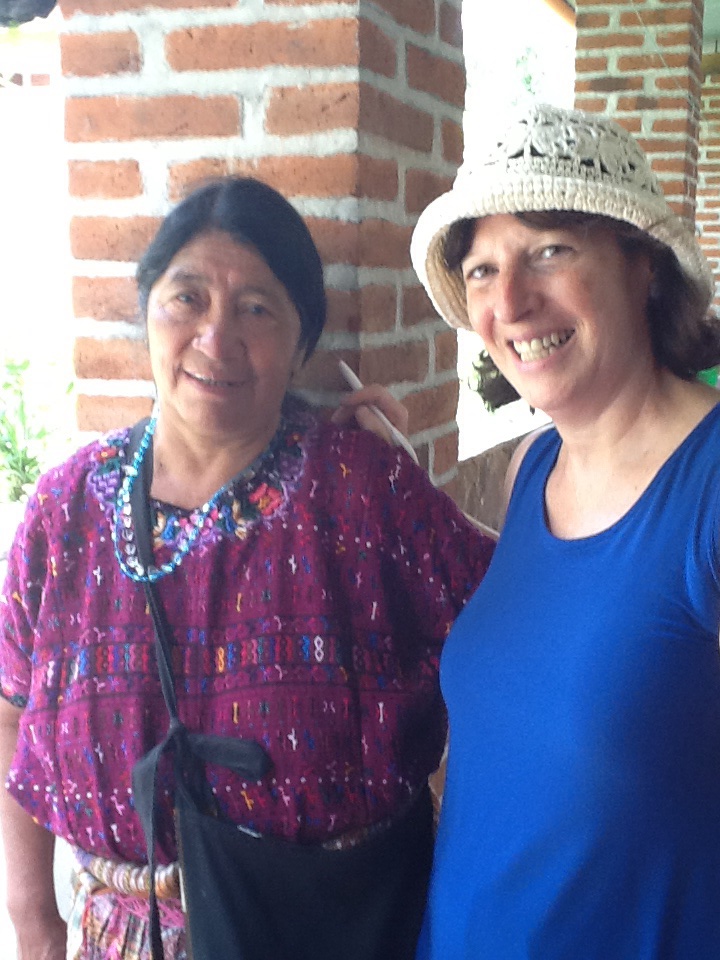
Of all those who spoke, I most connected with Arkavia who held my eyes as she said, “The land used to belong to us and it’s been taken from us. Our ancestors possessed this wealth and then they were tricked into giving it away. We, as women, have a right to demand.” Later she told me that a lot of blood has been spilled. “We have to be strong because of the violence in 1982. The army killed my husband. We have to be strong.” She is an organizer who teaches women the milpa system, a holistic system of growing the “3 sister” crops of corn, beans and squash which support each other for healthy land. Though both Rambo (our guide) and Megan (AJWS in-country consultant) had told us about some of their experience of the war, Arkavia’s was the first shared at one of our NGO visits. She cried telling it (she spoke in Spanish and someone interpreted for me), and I’m grateful for her open heart which pierced mine.

After our visit with the CCDA, Ruth Messinger said that the organization has become far more sophisticated since she last visited around 4 years ago. She also noted that the AJWS natural resources portfolio (under which CCDA falls) is a hard one to sell to donors, as it’s not sexy like the civil/political rights or the SHR portfolios (sexual health and rights). But it was such a holistic organization, working on so many fronts, that I found CCDA to be incredibly compelling.

Arkavia shared her story with me

Arkavia shared her story with me

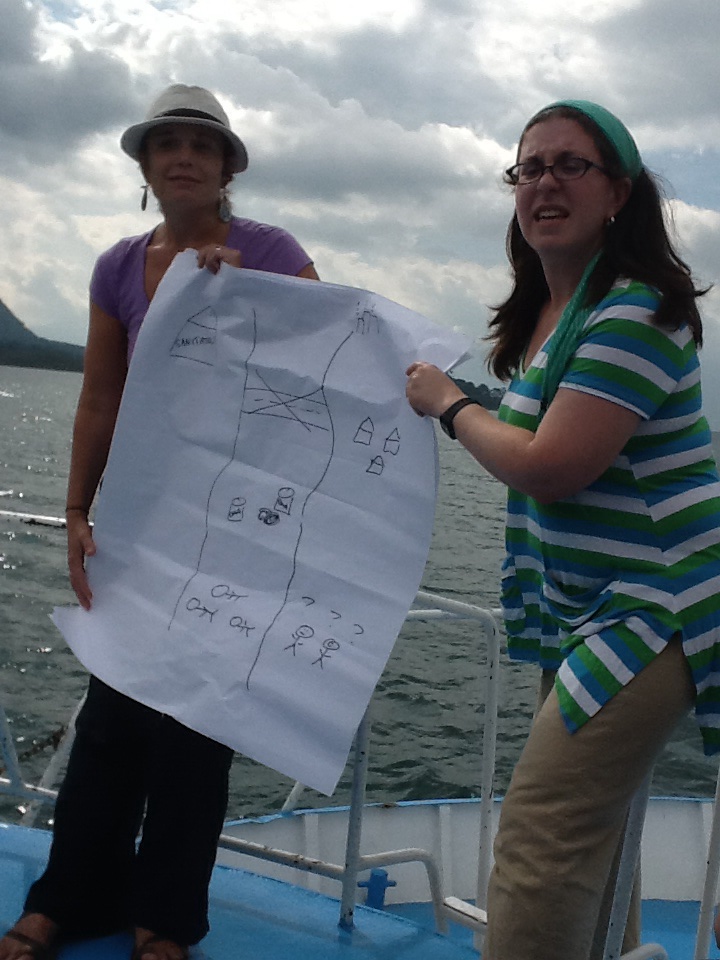
Teaching even took place on the boat en route to Hotel Atilan (AJWS staff Lilach and Adina)

Teaching even took place on the boat en route to Hotel Atitlan (AJWS staff Lilach and Adina)

If I didn’t make it clear already that this trip is very intense, let me reiterate. If we are not visiting with an NGO, we are processing that meeting and applying what we saw and learned to the next piece of learning, or reading something to discuss, or hearing Ruth’s perspective on U.S. foreign aid, or having to prepare something to share with the group. There has been so much learning above and beyond our visits with the NGO’s that I will be very excited to share and to integrate into my teaching and my worldview.

That is all to say that even the hour-long boat ride across Lake Atitlan to get to our hotel was used for learning. Lilach and Adina taught about a concept used in public health called “upstream/downstream.” Except for disaster relief, the AJWS method is to work upstream where the problems start rather than downstream where you may see immediate results for your charitable giving, but which doesn’t address the real underlying problem. Advocacy work is the name of the game, and that’s what all of these organizations we’ve met with do as a big part of their mission.

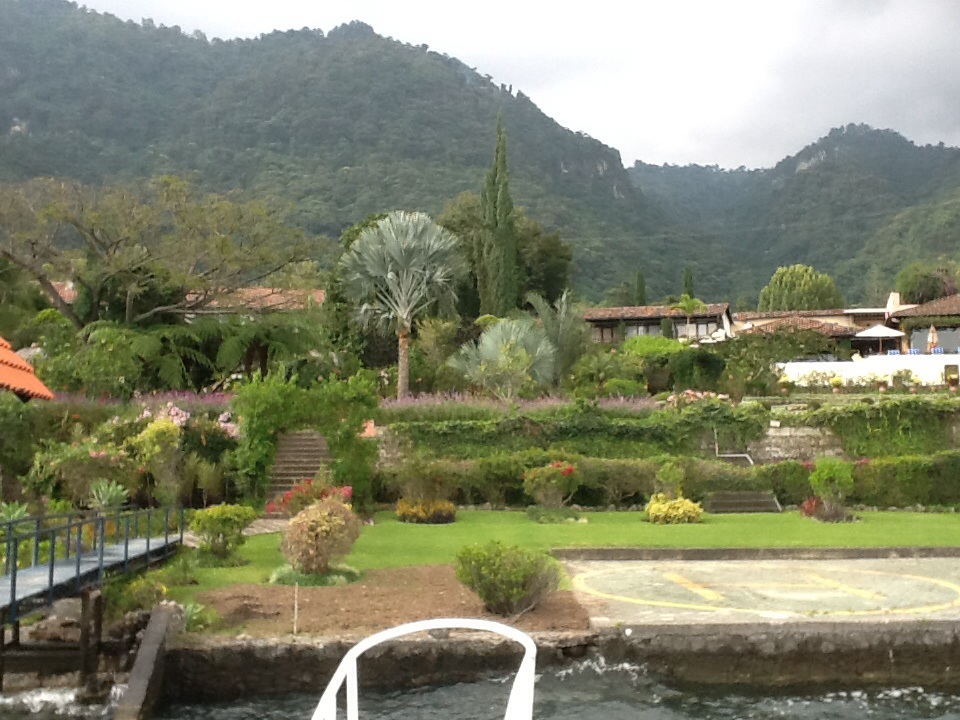
View of Hotel Atilan gardens as we arrived by boat

View of Hotel Atitlan gardens as we arrived by boat

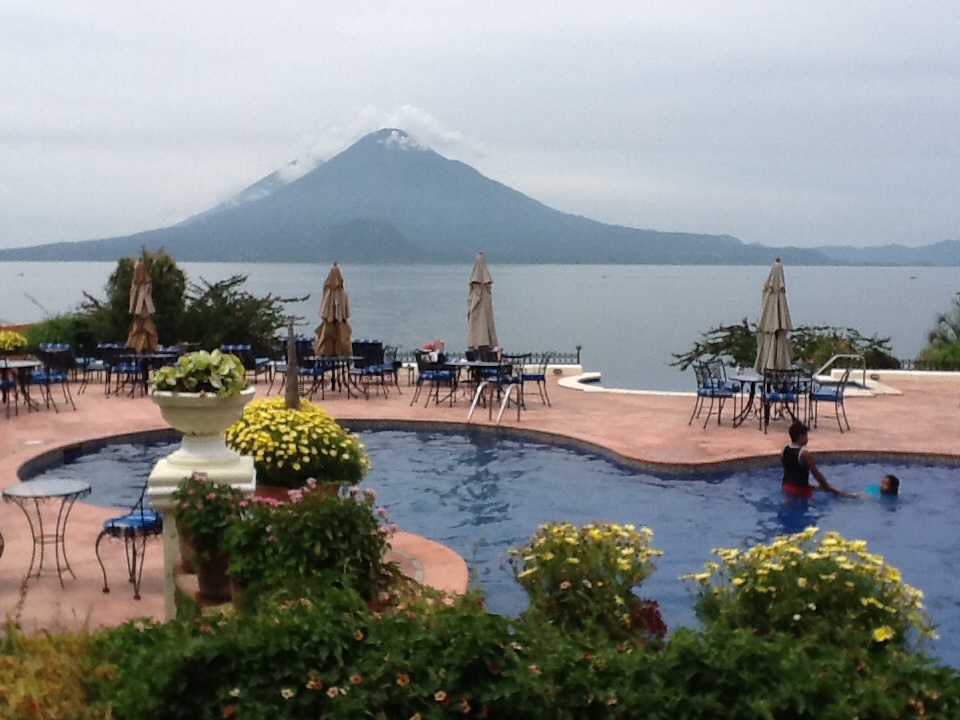
View of Lake Atilan with volcanoes in background. Both were cloud covered Shabbat morning and felt to us like Mt. Sinai!

View of Lake Atitlan with volcanoes in background. Both were cloud-covered Shabbat morning and felt to us like Mt. Sinai!

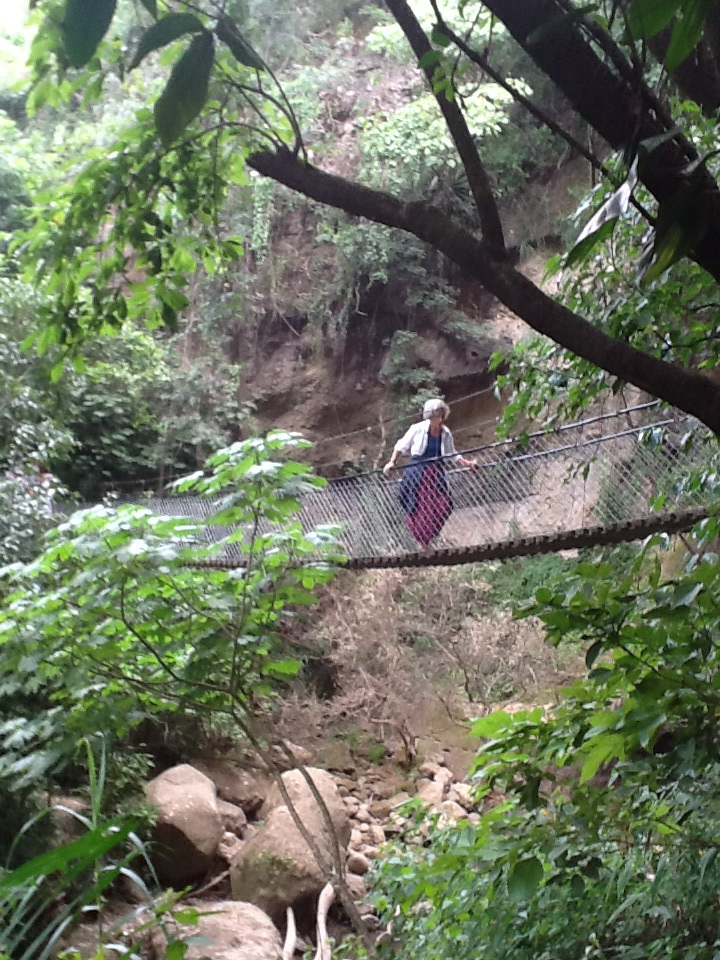
We spent Shabbat in Paradise, where lush gardens and toucans and parrots could be seen from both my front door and on the back terrace. I was thrilled to finally get a swim, and to share lovely worship and conversation with now-beloved colleagues. This morning we each took and led something from the service. Ruth gave an incredible teaching about our responsibility to the other based on Mishna Sotah. In the afternoon, we walked to a local nature preserve abutting the hotel property to see spider monkeys and the butterfly gardens, and we crossed three quite wobbly suspension bridges to see a waterfall.

Because AJWS is so intentional about its work and about process, we already began the conversation about transitioning to home and how we will respond to the question “How was your trip?” We are using bus time tomorrow to ask each other that question and help hone in on the message we want to give.

So, please be sure to ask me how my trip was. What you have gotten in this blog isn’t even the half of it.

BTW, to get this blog done, I’m getting by on 4-5 hours of sleep a night, but it’s really important for me to keep this learning close by writing about it and to keep you in the loop, day by day. I’m so grateful that you are reading!

Ruth crossing suspension bridge

Ruth crossing suspension bridge in the natural preserve


Guatemala day 5

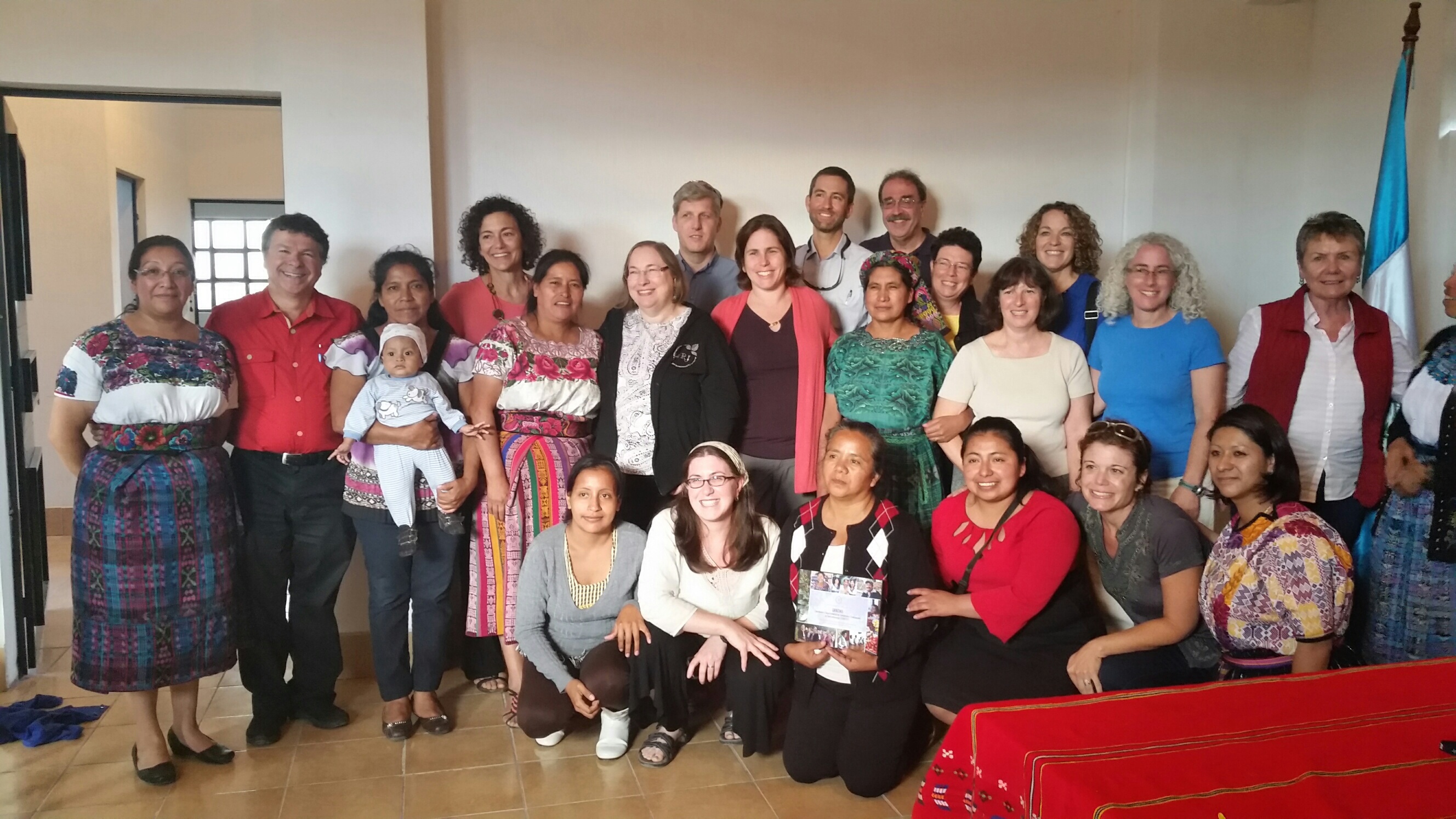
Our entire group with CODECOT

Our entire group with CODECOT

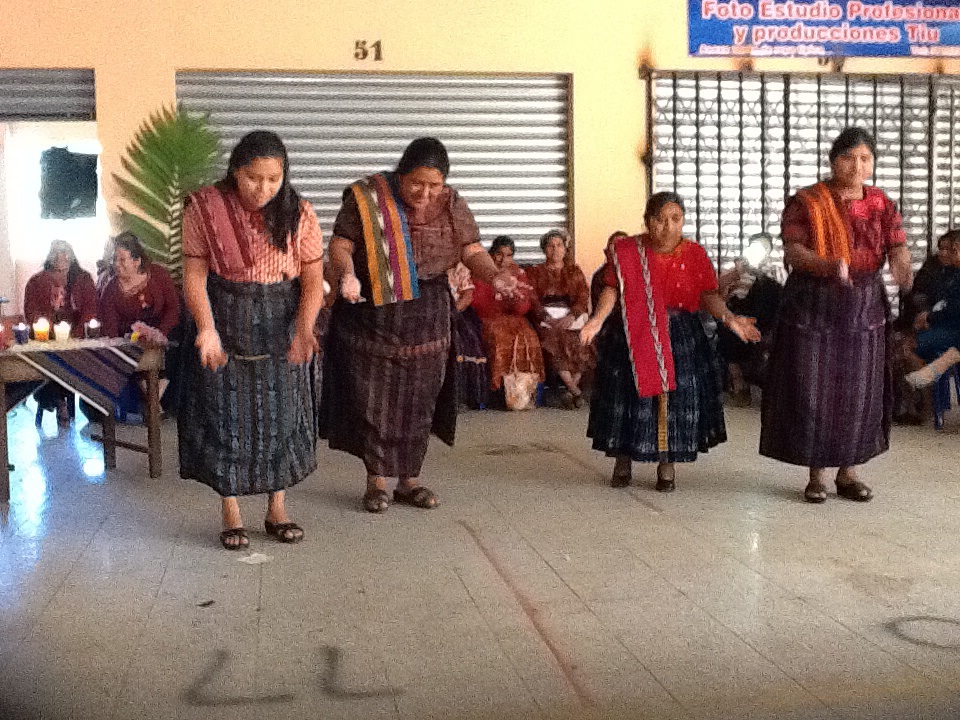
Dance performance by 4 of the Mayan midwives

Dance performance by 4 of the Mayan midwives

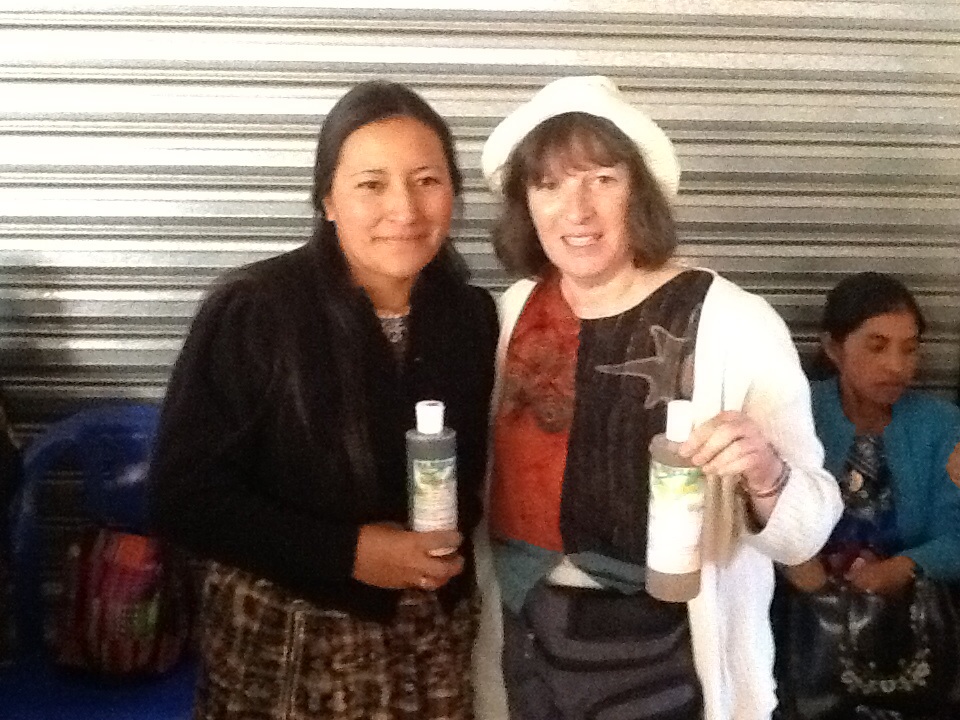
Me and midwife Juana displaying some of her beauty supply products --I bought camomile shampoo

Me and midwife Juana displaying some of her beauty supply products –I bought chamomile shampoo

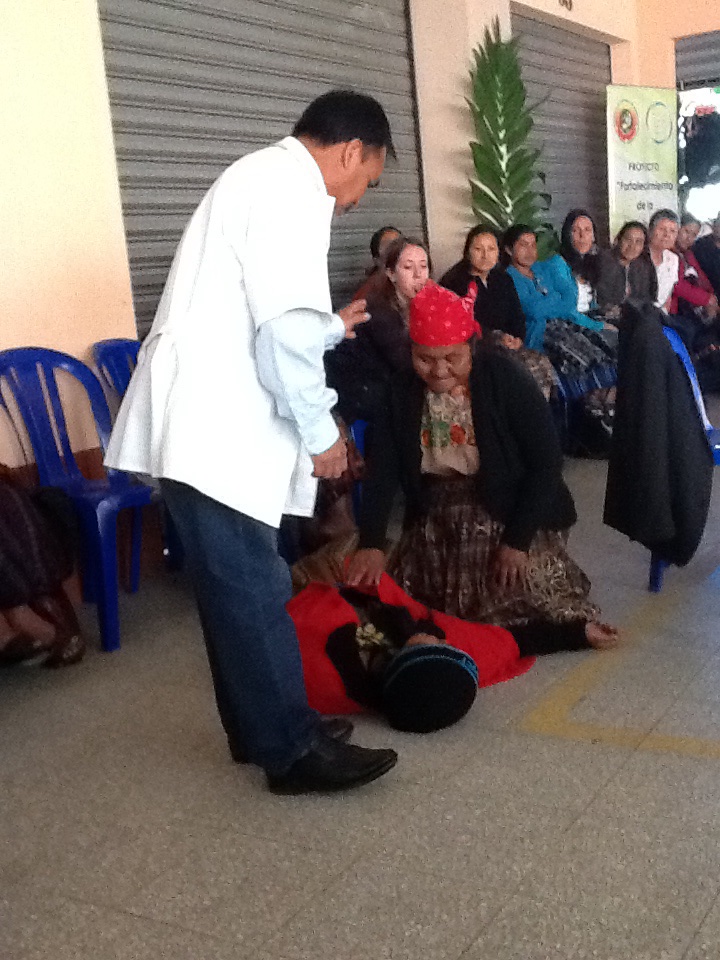
Acting out discrimination against indigenous women

Acting out discrimination against indigenous women. The man playing the doctor is a midwife and paramedic

Pervasive electioneering wherever you look

Pervasive electioneering wherever you look

Our visit with CODECOT yesterday was a spiritual experience with a welcome so genuinely warm and loving, speeches filled with blessings for us, and a candle-lighting ritual, I teared up again and again. Delia and Ayida, the two midwives who participated in my break-out group, both shared their “becoming a midwife story with us,” and both stories were filled with a sense of destiny and purpose in this work.

Ayida was 9 when she got training to give injections (for vaccinations and when people were sick) on the finca (plantation) where she lived. Shortly thereafter she dreamt a dream of outstretched arms and receiving babies in her open hands. At age 17, she delivered her own sister because her father couldn’t get the midwife in time. From then on she was considered a midwife. She said that that first experience was frightening, very unlike her dream, but that dreams have served her in other ways. Another time she dreamed about delivering twins. Not too long after twins were to be delivered, a complicated birth for which they needed to get to the hospital, but  the roads were washed out because of rain. She let her memory of what she did in the dream guide her through the successful delivery. Later still, she delivered her own daughter without the help of another midwife!
Delia told us that there is a spiritual test for each woman who becomes a midwife. For her it was severe back pain for which she could get no relief from either Western nor traditional medicine. She said that when she became a midwife 15 years ago, the pain went away! I, who was sitting in tremendous discomfort (as I have been for much of the trip due to a pinched nerve), asked how soon I could get certified to be a midwife!
The AJWS sign logo and name appeared throughout their building (which consisted of offices, meeting rooms, and an exam room for prenatal care). Three of the rooms were built with money from the municipal government, following a long process of advocacy to be recognized.

My colleague Rabbi Nancy Kasten, in introducing our group to the CODECOT women (we take turns both introducing our group to the NGO and then thanking them at the end), invoked the memory of the midwives Shifra and Puah from the book of Exodus whose courage saved the lives of so many baby boys, including Moses, our redeemer. It was a perfect connection to make with them from our tradition.

These women serve as gynecologist, pediatrician, medicine woman, bone healer, spiritual guide, and Mayan priest. As a group, CODECOT is advocating for recognition as midwives, as they are discriminated against by the Western medical system of Guatemala. They have become great advocates for themselves and while that battle led to recognition from the Ministry of Health that they should be given hospital access, it is still an uphill battle. They want their work to be valued and not to be abused.
A painful part of Guatemala’s social problems is that it traffics not only drugs, but also babies. Ayida and Delia told us horror stories of Mayan women in the hospital being told that their baby had died but not being given death certificates, of nurses stealing babies for money, and of women who are offered money to steal babies within their own communities. Sometimes it is for the harvesting of organs that babies are stolen. Therefore, some women fear gringo foreigners, and it is certainly a component of their fear of hospitals.
I had asked the midwives in the larger setting what they did when a woman came to them who did not want to keep her pregnancy. They were very clear that they are for vida and that they counsel women to keep the baby, though there are some midwives who know which plants to use for termination. I was very curious to know whether they would accept such a woman into their consortium of midwives, but I was advised not to push the issue in terms of the cultural sensitivity.
Today the women of CODECOT met us in another municipality (Palestina Los Altos) about 1-1/2 hours away to meet with the women (and one man) who have been trained by them to be midwives. All told there were about 50 midwives there today. They greeted us with speeches (including one from their very supportive mayor), and blessings, dances, music, and a very funny (but apparently accurate) dramatization of what happens when a pregnant Mayan woman comes to the hospital with her midwife and how she’s treated versus how the sexy Ladino woman in her tight jeans is treated. The women were laughing (actually, they were roaring!) at the skit, but we also knew that this was painful reality for them.
One young woman sang a song whose words were something like:
Though we are discriminated against
Women, you have rights to your traditional dress
You have rights to literacy, etc.
We don’t know enough, 
but we thank CODECOT for the training we are receiving.
After about 2 hours of presentations from them (a process elongated by the need to translate from Spanish to English, and in one case from Mam — one of the many Mayan languages– to Spanish and then to English), they wanted to hear from us. I got up spontaneously, dragging my old friend Faith Joy with me to sing for them Debbie Friedman’s song Brachot ha-Ba-ot whose words invoke the Shechinah, the Divine feminine. That song provided a powerful spiritual connection with these women. At the conclusion of our meeting, we all just started dancing together, grabbing hands and sharing hugs. Even without language in common, we shared a deep spiritual bond.
We returned to Quetzaltenango for lunch where I had the opportunity to ask our translator V. more about what brought her to Guatemala from Canada. In the evening Megan, AJWS staff in Guatemala, who has lived here since 1952 (her parents came originally to farm) told us her story over dinner, as we had all been curious.
On our morning bus ride we had been asked to read an amazing article (because why waste any time to catch up on sleep or for extraneous conversation when we could still be learning?) “Where Does Moral Courage Come From?” http://opinionator.blogs.nytimes.com/2014/12/18/where-does-moral-courage-come-from/?_r=1
as prep for our afternoon reflection session. After a thirteen-hour day (AJWS pushes us long and hard), I will have to share more about that deep learning another time.
Tomorrow we leave at 7 AM to make our way to San Lucas for a meeting with Comite Campesino del Antiplano (CCDA), the Highlands Committee of Small Farmers.
From there we will go to Lake Atilan (apparently by boat!) for Shabbat. I cannot wait to be able to sleep in on Saturday morning — our service won’t start until 10:30 AM (a time set by rabbis who generally never get to sleep in on Shabbat morning!)
I may not get a post in before Shabbat.

Guatemala Day 4

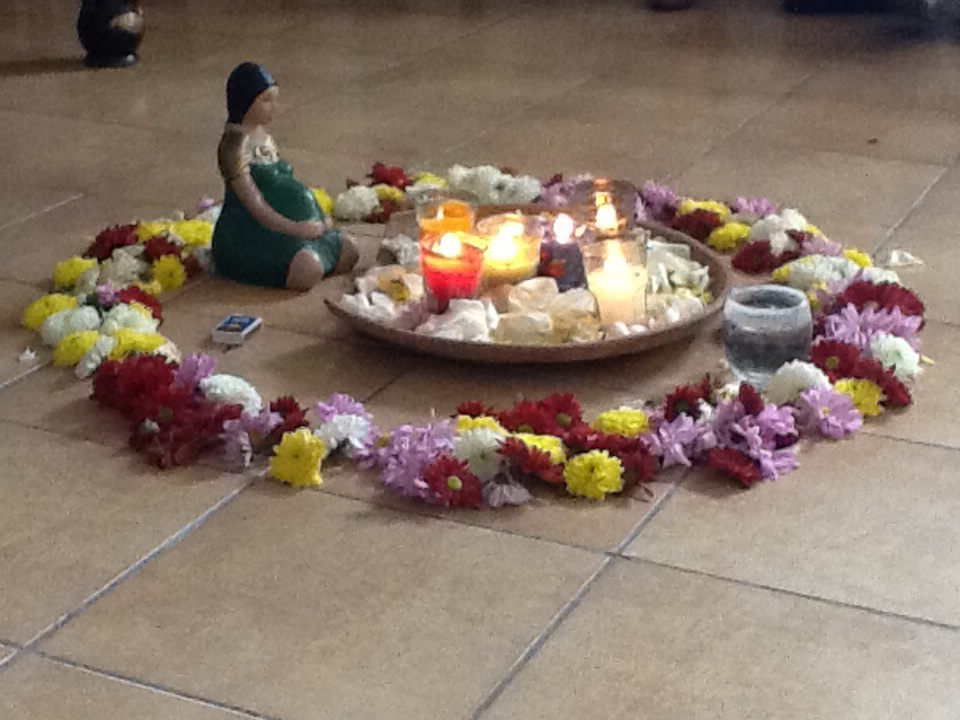
The welcoming ceremony  consisted of lighting each of these candles. Red is for sun, heat, blood, energy of flowers. Black is for rest. Yellow is for the energy of water. White is for everything pure, transparency, air. Blue is for sky. Green is for mountains and trees.

The welcoming ceremony at CODECOT consisted of lighting each of these candles. Red is for sun, heat, blood, energy of flowers. Black is for rest. Yellow is for the energy of water. White is for everything pure, transparency, air. Blue is for sky. Green is for mountains and trees. Note the pregnant woman statue.

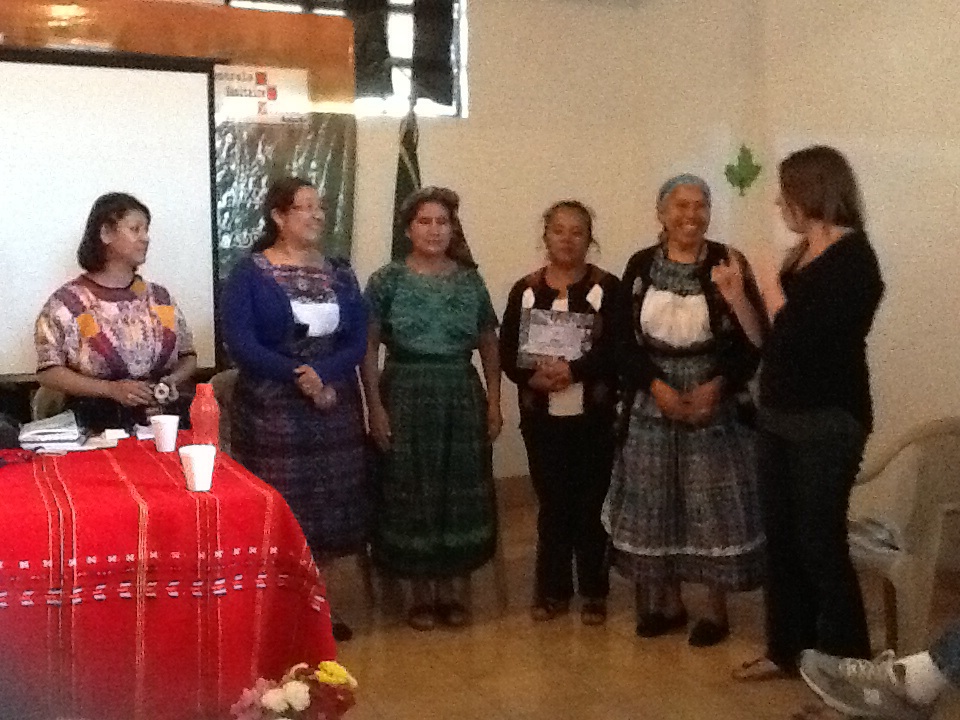
Some of the CODECOT midwives

Some of the CODECOT midwives

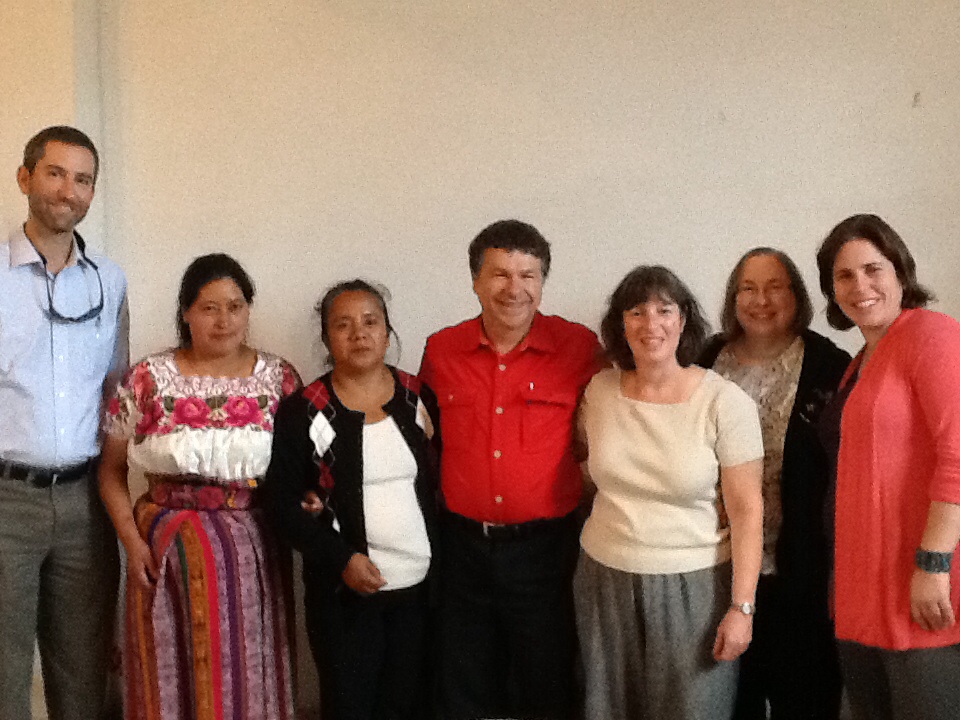
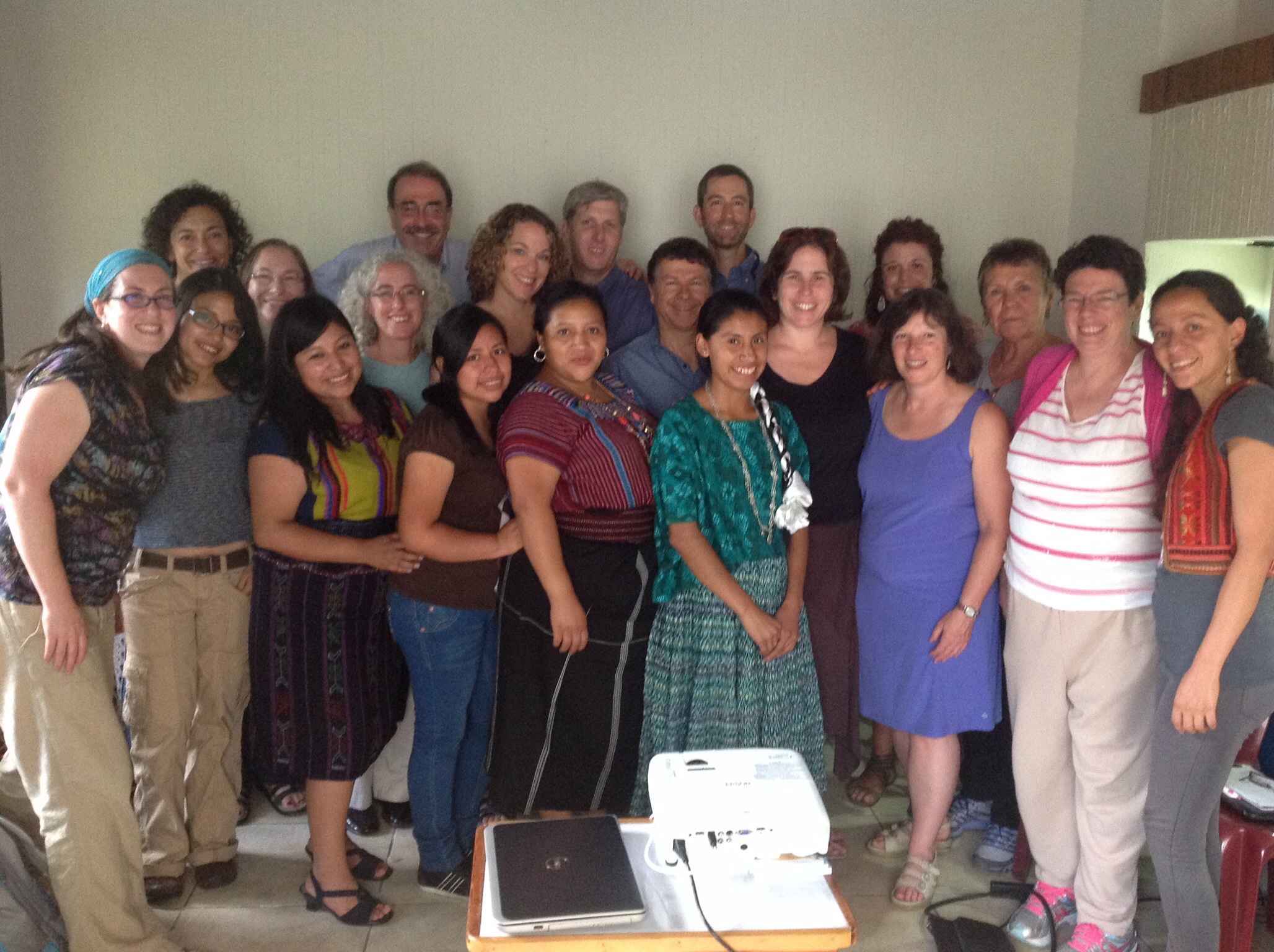
Our small group: Rabbi David Englander, Delia, Ayida, R. Elliot Baskin, me, R. Marla Feldman, R. Jill Borodin

Our small group: Rabbi David Englander, Delia, Ayida, R. Elliot Baskin, me, R. Marla Feldman, R. Jill Borodin

My day both began and ended with the incredible Ruth Messinger. She and I went for a 45 minute walk this morning at 6 AM (at the policy summit in DC in May, she and I were also among the handful at the gym at 6 AM), and over dinner this evening she offered the group the State of AJWS Address, along with her own story of self.

In between those two events, we had a four-hour drive northwest from Guatemala City to Quetzaltenango, during which we had Sacred Space, a fascinating chevruta study on human rights, in addition to hearing the story of our guide “Rambo,” a fascinating and complicated character: He was born in Guatemala, raised in Canada, and returned to Guatemala at age 15 because he wanted to enter the military academy; he was a commander in the Guatemalan forces during the bloodiest part of the civil war in the 80’s; he speaks some Hebrew (both because he was trained in Israel in intelligence work and because as a guide he specializes in Israeli tour groups); and he apparently believes that all should be forgiven and forgotten about the civil war, while also saying that “if there were another conflict, I might be on the other side.” I also seem to recall that he attended the School of the Americas, though I hope I’m wrong. Nonetheless, because of his military past and the complications that that history raises, he cannot attend any of our meetings with us due to the sensitivities of the NGO’s.

(FYI, an unfortunate truth is that Israel sold Guatemala its arms during the civil war when the U.S. no longer supplied them, and therefore Israel  is neither beloved by the right nor the left in Guatemala today. The right feels that Israel should have supplied, not sold, the arms — Guatemala recognized Israel’s independence in 1948 and apparently felt it deserved something more generous in return. The democracy and justice-seeking left feels that Israel took the wrong side in the civil war.)

In the meantime, we have two translators on our trip, one who works for an NGO that takes testimony from women about their experiences from the war and believes that there can be no forgiveness without justice, and the other translator who is finishing her PhD about the security forces during the war and bemoans the fact that kids are growing up with no knowledge of the bloody history of this country, nor with understanding of why they’ve been displaced from the places that their ancestors had lived. (I should also note, now that I’m mentioning our Spanish-English translators, that there are 21 different indigenous languages in Guatemala, that Spanish is a second language for all of the indigenous women we are meeting, and not all of them even speak Spanish. This can make them organizing amongst themselves difficult.)

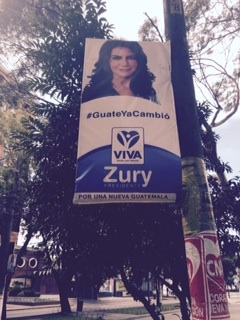
The war (“la violencia,” to some) is a painfully sticky issue here, one yet to be reckoned with despite a truth and reconciliation commission established in 1994 and despite the ongoing testimonials that are still being collected. Over 150,000 people were killed and 50,000 disappeared, more than that of El Salvador, Nicaragua, Argentina, and Chile combined. In 2013 former military dictator Efraim Rios Montt was indicted for genocide and crimes against humanity. The court overturned the conviction less than two weeks later, a big blow to Guatemala’s still-fledgling democracy whose court system only punishes 2% of all crimes. Zury, the woman whose presidential campaign poster I posted previously, is — guess what?– the daughter of Montt! (There is a reason her last name doesn’t appear on the posters.)

I have been wanting to offer you this history lesson (it fascinates me), but now it leaves me with no time to report on the remarkably moving afternoon we spend with the Mayan midwives of CODECOT (Coordinadora Departmental de Comadronas Tradicionales de Quetzaltenango). Since we are spending some time with them again tomorrow, I will hold my remarks until then. By the way, you can always go to the AJWS website for more information about any of the organizations that they support.

Signing off.


Guatemala Day 3

I want to emphasize yet again how remarkable the attention to detail is on this program. The AJWS staff that is with us (Lilach Shafir, Director of International Education and Jewish Engagement; Adina Mermelstein Konikoff, senior organizer; Ruth Messinger, president; and Megan Thomas, Guatemala in-country consultant) is a dream team of care, warmth, brilliance, dedication, heart, and  soul. As I said yesterday, the profundity of the texts, readings, exercises, and ensuing conversation is painful and piercing and healing all at the same time. Our morning reflection session today was on the topic of “The Story of Self,” a concept elaborated upon by Marshall Ganz, a leader in the field of community organizing. Ganz based his work on Hillel’s adage “If I am not for myself, who will be for me? If I am for myself alone, what am I? And if not now when?” Apparently, President Obama’s powerful “narratives of self” that came through in his pre-presidential speeches were influenced by Ganz’s work and may have been what won him the election.

Among the many homework assignments we were given before we came on this trip was preparatory work on preparing our own “story of self.” The story needed to convey a value that connects me to social justice work and that required real risk or challenge. This morning we had the opportunity to share that story with two other colleagues, and receive feedback. Telling that story and being so fully heard by others whom I trust was deeply moving for me. The exercise is used by community organizers  to build relationships, and to inspire others to join a campaign and take action.

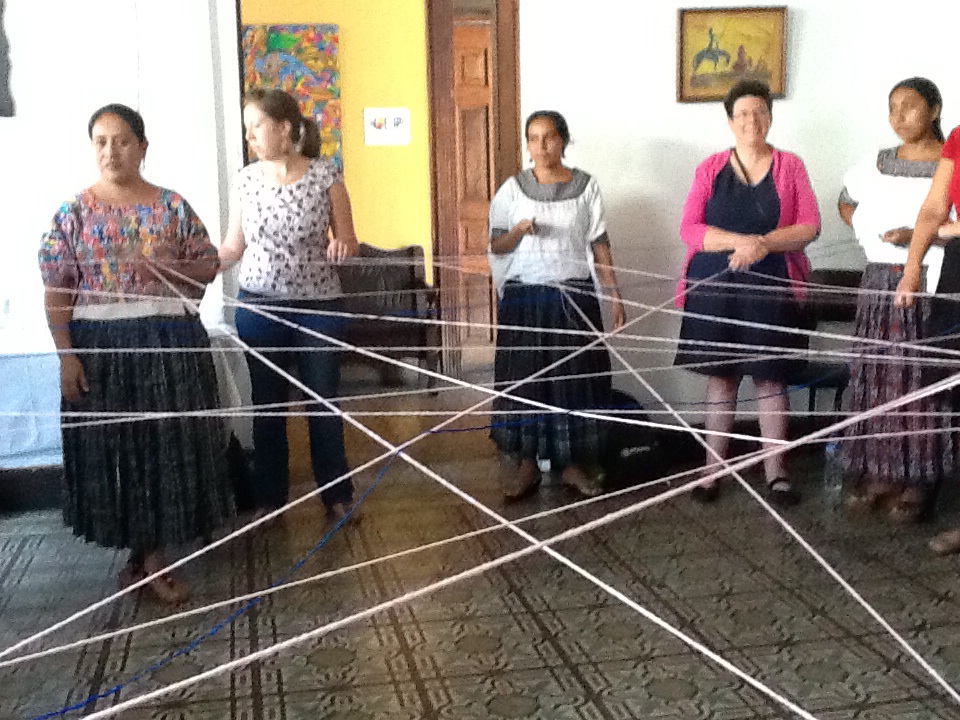
Spider Web exercise with Nuevo Horizonte to represent the connections between us

Spider Web exercise with Nuevo Horizonte to represent the connections between us. We threw the ball of yarn across to someone who introduced themselves before throwing the yarn to someone else

Our small group: Paulina, R. Elliot Baskin, Elinda, Lilach Shafir (AJWS staff), Lucia, Rabbi Nancy Kasten, me

Our small group: Paulina, R. Elliot Baskin, Elinda, Lilach Shafir (AJWS staff), Lucia, Rabbi Nancy Kasten, me

Our first (and only) meeting with a grantee today was with Mayan women from an organization called Asociacion de Mujeres Campesinas Q’eqchies Nuevo Horizonte (ANH – New Horizon). Since traveling to them was not feasible for the length of time we are in Guatemala, they travelled to Guatemala City (several for the first time), probably a 4-6 hour trip. Some of them even live hours from each other, as the areas in which they reside are mountainous. Unlike the Mayan women we met yesterday who primarily live in the city and had education, these were rural woman, most with little education, with cell phones but no running water. One of the women was 24 with a 12 year-old daughter. The organization promotes the rights and health of Q’eqchi women, a population that suffers high rates of sexual and gender-based violence. While some of their work is to educate each other about women’s rights and their sexual and reproductive health, some of it is to educate men about their own masculinity/machismo. They said that the men used to come to control the women, but more of them come now to participate for themselves.

In the marketplace

In the marketplace

Another important  piece of ANH’s work now, however, has to do with defense of territory and pollution of the land due to the planting of African palms (used for Palm oil).  When I flew in, I had a lovely conversation with the Guatemalan man sitting next to me. I told him a bit about my trip and because he seemed both genuinely grateful  (and on the same team vis-vis the need for women’s rights, human rights, and land rights), I mentioned the documentary “Gold Fever” that I had watched as part of my prep for this trip. He knew the film and told me that mining wasn’t the only contributor to land and water pollution, but that plantations were, too. He mentioned  a river in which all of the fish had died, the water polluted, devastating the indigenous communities for miles and miles. I didn’t quite understand what he was talking about until today. These trees, used for biofuel, are not only polluting, but it has meant that the indigenous peoples no longer have crop diversity. ANH has been advocating for crop diversification and food sovereignty in 16 different communities, as the pollution is affecting the health of them and their children.

To-scale topigraphical map of Guatemala

To-scale topographical map of Guatemala

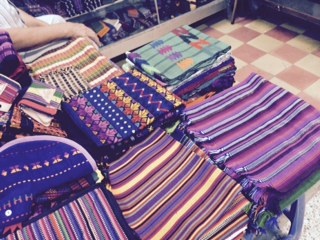
After our meeting and lunch, the 12 women from AHN accompanied us on the city tour in which we saw an amazing topographical map of Guatemala created in 1904-5 that is not only to-scale, but has withstood a number of earthquakes. It seemed to occupy what would be at least one, if not two New York City blocks. After the topographical map, we saw the old palace, the large public square, and had a very short time for retail therapy at the city marketplace.

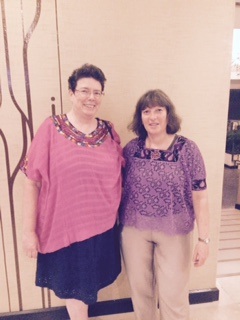
Me and Margaret in our new Guatemalan "huipils"

Me and Margaret in our new Guatemalan “huipils”

Tomorrow we leave Guatemala City for Quetzaltenango.

For more reading about current issues in Guatemala, read this article, http://www.bbc.co.uk/newsbeat/article/33179768/we-need-to-talk-about-Guatemala whose tag line is “Guatemala has been described as the worst place in the world to be a child”

(By the way, I apologize for the empty post that was accidentally sent out this morning due to technical difficulties. I am working from my IPad and not from a laptop on this journey, and there are things I can’t seem to do or figure out, like putting the above news story into a clickable link.)

Guatemala Day 2

Every component of this AJWS  trip is thoughtfully planned, bringing not only educational and political awareness to our venture, but time and space for spiritual work and reflection, as well. Every morning officially begins with Sacred Space, a period in which 1 or 2 of us will set and create a kavannah (intention) for the day. This period of time is not intended as traditional prayer time, as the expectation is that we will each use our early morning time for our own personal spiritual practice before coming together for Sacred Space at 9 AM — I  went for a walk, as our hotel is next to a wide boulevard with a walk/bike path down the middle.  (I have, for better or worse, started multi-tasking by doing my morning prayer practice while exercising rather than setting aside dedicated time for it.)

This morning I was responsible for creating our sacred space along with Laurence Rosenthal, a Conservative rabbi from Atlanta. We set our intentions for gratitude (a Modah Ani chant), for full presence/listening/humility and tzimtzum — a condensing of self to make room for the other (using a Shema kirtan chant), and, thirdly,  an intention for carrying the legacy of those who came before and set us on this path of social justice (a riff on the Avot prayer).

Rabbi David Englander, Flore from Incide Joven, Rabbi Marla Feldman, and moi

Rabbi David Englander, Flore from Incide Joven, Rabbi Marla Feldman, and moi


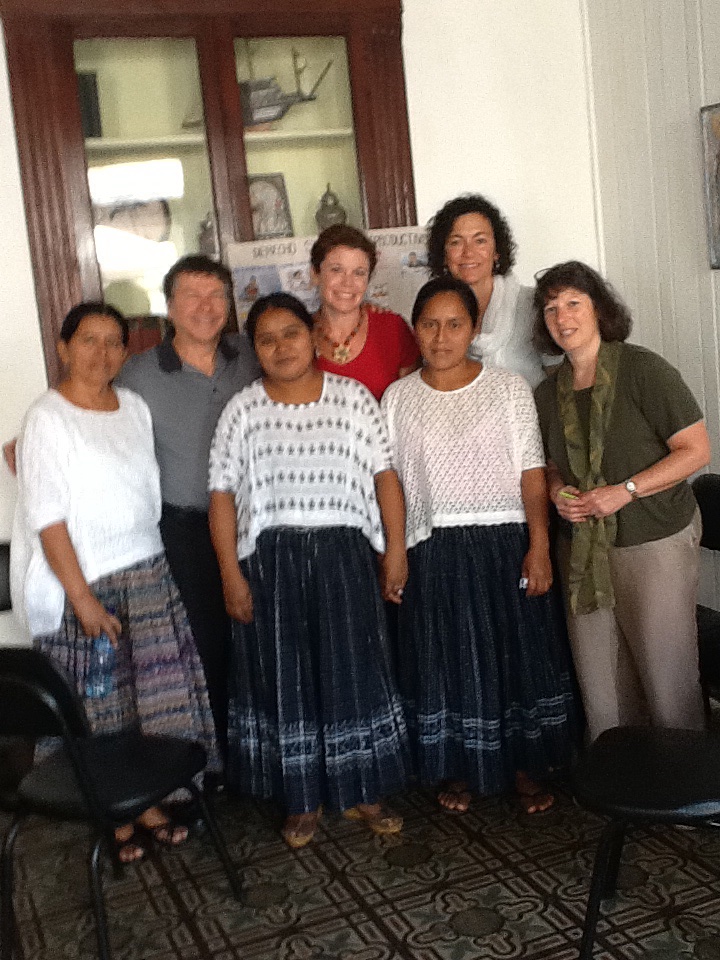
Our group with the women from La Enredadera de Mujeres

Our group with the women from La Enredadera de Mujeres

Additionally, each one of us will be responsible at some point to help write notes for our daily journal, which is read every morning following Sacred Space time as a remembrance of the previous day. After that, we had our reflection session. Because AJWS is incredibly thoughtful about the kind of tourism it does, there is also a daily reflection session to engage us more deeply with the AJWS mission, vision, and values. Today’s reflection/study session was on how to engage ethically with the NGO’s we visit. There are not only cross-cultural issues to consider, but issues of privilege that complicate the relationship-building, as does the fact that we are coming as representatives of one of their funding sources, creating an obvious power differential as part of the dynamic from the start.

We had prepared ahead of time with a number of fascinating readings to help us parse out issues of what has been called “slum dog tourism” by Kennedy Odede of Kenya, a highly critical view that was challenged by another article we read by John Lancaster called “Next Stop Squalor,” (in which he talks about some of the dignifying aspects of the “poverty tour” operating in Dharavi, India), as well as by Elie Wiesel’s quote “For the dead and the living, we must bear witness.”

How to be culturally sensitive and not exoticize the suffering of others is something that I learned many years ago from a nun, a former spiritual director of mine, when she gave me a life-changing poem called “A Brief for the Defense” by Jack Gilbert (you can easily Google it). She gave it to me because of my guilt of conscience about my privilege in the face of such pain, poverty, and wretchedness in the world, but I’ve been re-reading the poem on this trip because it is also about the “exoticization” of the other. A great quote from the book “I, Rigoberta Menchu: An Indian Woman in Guatemala” which we also read for this trip (Rigoberta Menchu received the Nobel Peace Prize in 1992) is: “What hurts Indians most is that our costumes are considered beautiful, but it’s as if the person wearing it doesn’t exist.”

Yehuda Amichai also bemoans this aspect of tourism in his poem “Tourists:”

Once I sat on the steps by a gate at David’s Tower, I placed my two heavy baskets at my side. A group of tourists was standing around their guide and I became their target marker. “You see that man with the baskets? Just right of his head there’s an arch from the Roman period…” I said to myself: redemption will come only if there guide tells them, “You see that arch from the Roman period? It’s not important: but next to it, left and down a bit, there sits a man who’s bought fruit and vegetables for his family.”

How to be culturally sensitive includes asking if taking a photograph is okay before taking it, and, in my case, letting folks know that I am blogging and to ascertain if they are comfortable knowing that I might share their story, etc.

Today we met with two grantees, Incide Joven (Youth Advocacy) and with La Enredadera de Mujeres (A Tangle of Women), two feminist organizations led by the under 30 generation addressing issues of sexual health and reproductive rights. Since my first real adult job post-college was in the field of women’s health leading to a passion concerning reproductive rights (see my blog post from Jan. 2013 “Abortion in Israel” for more), I was particularly invested in hearing about the work of these two groups. There are so many factors at play here in Guatemala around these issues: The maternal mortality rate in Guatemala is the second highest in all of Latin America and is especially high among indigenous women. Contraception is used by less than half of women of reproductive age. The high level of sexual violence leads to early forced marriages. And on and on.

Incide Joven is the first (only?) youth-led organization in Latin America to successfully lobby a national government for comprehensive sex education. To do so, they were (and continue to be) up against the Catholic Church, the evangelical right, and a conservative government. They also helped fight the removal of the morning-after emergency pill from pharmacy shelves. There is so much sexual violence in Guatemala that this corrective is necessary, as abortion is illegal except when mother or baby’s life is at risk. The irony of this is that all pregnancies in very young women are considered high risk, yet only C-sections (once the mother-to-be is already in labor) and not abortions are allowed for girls under aged 10.

Flore told us that she initially hadn’t wanted to work with the organization because the idea of politics scared her off. But 12 girls in her high school class were pregnant (due to incest or rape — in fact, 90% of teen pregnancies in Guatemala occur within the family), the nuns had kicked them out of school, so she became politicized. And she is a power-house! The young men who are involved with Incide Joven have generally been victims of sexual violence themselves. The group holds regular reading circles on issues of sexuality and also have also been progressive advocates for lesbian women who want to explore options of having children without being partnered with a man.

La Enredadera Mujeres, with whom we also met, is a group of under-30 indigenous (Mayan) women who are addressing similar issues around sexuality and reproductive health but also about sexual harassment.

It’s been a long and powerful day, in which we also spent a spacious and thoughtful hour sharing our different needs, desires, and dreams for our upcoming Shabbat together. Get 11 rabbis in the room, try to get them to agree about Shabbat norms, practices, and hopes for an interdenominational Shabbat together, and what do you get? In this case, we got magic.


Arriving in Guatemala

Anti-trafficking ad, Guatemala airport

Anti-trafficking ad, Guatemala airport

Zury is running. Really?

Zury is running. Really?

I arrived in Guatemala early this afternoon. This sign publicizing the crime of the sexual exploitation of children was the first thing I saw upon entering the airport in Guatemala City. American Jewish World Service (AJWS), which is sponsoring this rabbinic global justice fellowship I’m participating in, supports three critical areas in its grant-making  work in the developing world: (1) sexual and reproductive health, (2) civil and political rights and, (3) natural resource rights. Interestingly, while AJWS does a lot of work around sexual exploitation in other countries, its country strategy docket in Guatemala only includes the portfolios of civil/political rights and natural resource/land rights. I will be curious to learn more about why that is and how the organization decides upon its priority areas for grant making in each country.

Since I’d left all my jewelry home (including wedding ring) for safety reasons, and locked all other valuables in the room safe, I took a walk in the neighborhood, before coming back to greet the rest of the gathered group, have lunch, and start our official programming. As the next presidential election is coming up on September 6, the streets are covered in political signage and photographs of the candidates. I will write more about this candidate Zury and her infamous father in another post.

Following a brief reflection session on what we want to leave behind and what we bring with us as we start this long-awaited trip abroad and then another short session on AJWS’s 5 organizational values as we interact with grantees (including the essential dignity of every human being, a sense of possibility, partnership and community, initiative and accountability, and humility), we had a fascinating overview of Guatemalan history presented by Megan Thomas, the AJWS in-country consultant. I will not turn this into a history lesson, but suffice it to say that the AJWS reading list I’ve been working through over the last few months has offered depth and complexity to my understanding and Megan helped bring some of the ripples of that history into what is happening with the upcoming election.i will surely write more about that soon (after I’ve had more sleep).

The program is full and it is holy, the learning is deep, the leaders are stellar. I am so grateful for this amazing opportunity to test my curiosity about the world and grow my political awareness in this way.

If you would like to read my previous posts about the AJWS policy summit I attended in May, read the previous posts “The Week of Bonding –Yesod,” “Days 38-39 –Meeting Randy Barry, Eliot Engel and MLK Anew,” and “Lobbying on Capital Hill.”

3 Joys: Margaret Joy, Faith Joy, and Pamela Joy

3 Joys: Margaret Joy, Faith Joy, and Pamela Joy

Before closing for the night, I’d like to acknowledge the death this afternoon of Gene Wein, z”l, the father of my friends Roberta, Paulette, Sherry, and Larry. May his memory be for a blessing.

The Week of Malchut: Sovereignty and Nobility

This, the last week of the Omer, is the week of Malchut (translated as sovereignty or nobility).

Tonight after sundown will be the last (49th) night of my counting the Omer. Tomorrow night we will have arrived at Shavuot, the 50th day. This is the holiday toward which we have been counting since Passover. I love the holiday of Shavuot, surely the most unappreciated and un-observed of the major Jewish holidays.

What do I love? I love the imagery of it being the wedding between God and us. Immersed as I am in Torah and Torah study, I love the idea that Torah is understood to be the marriage document (the ketubah) that God gave us — studying Torah is considered a form of prayer, a way to communicate with God, a way to hold God close as a partner.

The tradition of staying up the night of Shavuot to study is a highlight of my Jewish year. I have been commemorating this tikkun leil Shavuot for the past several years in the Berkshires, where a small group of folks from Congregation Beth Israel in North Adams, Congregation Beth El in Bennington, VT, and from the Williams College community join together for a night of song and study. I will be teaching on the theme of particularism and universalism and our expanding universe of obligation (inspired by my AJWS fellowship studies). Chaim will be teaching on economic justice issues.

Last year I was feeling bereft at Shavuot for the end of my daily Omer count, a practice that had been my one and only daily spiritual practice for the past several years. This year I am pleased to have not only intensified that practice by keeping this (albeit occasional) Omer blog, but also to have started a daily prayer, chant and meditation practice (compelled by my high blood pressure) that will fill me all the year through.

For many years, the two missing pieces in my life were longings for such a daily spiritual practice, as well as for a true call to social justice, not a mere dabbling. Both have been answered in this Omer period. The commitment to a morning prayer practice is a dream fulfilled, and my week in DC with AJWS finally gave me the confidence and skills I needed to do the advocacy work I have longed to do in the social justice realm.

As R. Simon Jacobson says of this week of Malchut,

        “Malchut manifests and actualizes the character and majesty of     the human spirit. It is the very fiber of what makes us human. Malchut is a sense of belonging. Knowing that you matter and that you make a difference. That you have the ability to be a proficient leader in your own right. It gives you independence and confidence. A feeling of certainty and authority.”

For me, this is truly a statement of where I am. As this Omer period comes to a close, I feel a great deal of gratitude for these gifts, and I say AMEN!

Chag Sameiach!