
On Monday, I put in over 13,000 steps walking around Jerusalem. First, I walked to Bili and Mats’ friend Lisa’s with whom I’d stayed many years ago. Lisa, an American olah, is herself a poet as well as a translator of poetry from Hebrew to English. We met many years ago long before I considered myself a poet. We spoke poetry, yes, but, of course, we also spoke about “ha-matzav,” the situation here in Israel. She told me that her neighbor called to ask if they should put a shelter in the backyard of the house to protect them. At first, she thought it was a good idea, but then she realized she would probably be just as safe–or no more safe–than were she to hide in her closet. She is not worried about rockets. I’ve heard from several people that the reason Jerusalem is relatively safe without the sirens that blare all the time in the north or the south–or even in Tel Aviv– warning of close rockets, is because no Arab nation (or Hamas, which is not a nation) would dare risk harming Al Aqsa Mosque in the Old City.
From Lisa’s I walked to the campus of Hebrew Union College, where I attended my first year of rabbinical school. It’s a stunning campus of Jerusalem stone, with an exquisite view of the Old City. The offices of IRAC (the Israel Religious Action Center) whose amazing work I mentioned the other day, also has its offices on the campus. What I didn’t say about our conversation with IRAC (definitely an organization worthy of your tzedakah/charity dollars) the other day, is that because Israel doesn’t have a constitution that protects rights, rights can only be protected through the court system. When the Netanyahu government threatened judicial overhaul, it was threatening the only checks-and-balances that Israel has for religion-and-state issues. And the government might have succeeded had they done the work piecemeal. It was the utter hubris of striking everything down in one fell swoop that brought people out onto the streets, week after week, month after month.
Many of the issues that IRAC addresses are about freedom of religion. Some of you will know that Orthodox institutions and rabbis get state money, but Reform congregations have had to fight hard for recognition, for funding, and even for land to build congregations. The congregation in Shoham that we visited last week was one of the only Reform congregations in the country that got its land without a legal struggle.
I wish I’d contacted Hebrew Union College before I left the States about possibly presenting something to the first year rabbinical students as I had done on a previous trip, but I only thought about it when I was already on campus walking around. Apparently about 19 of the 24 American students have remained in Israel (or went back to the US after October 7, but have since returned to Israel). Those who did not return are getting their training via Zoom.
In the evening, Bili, Mats and I attended a play, “The Labor of Life” at the Jerusalem Theater by playwright Hanoch Levin. It was Bili’s birthday present to both me and Mats (his birthday was a few days before mine). We were in the second row, so both Mats and I had to scooch down low in our seats to see the English subtitles that were above the stage. (No, my Hebrew is far from fluent, and I’ve forgotten so much of what I once knew.) Before the play began, an announcement was made acknowledging that Israel is at war, that we are praying for the hostages. But, the sentiment was, after some time of the theater having closed, that “the show must go on.”
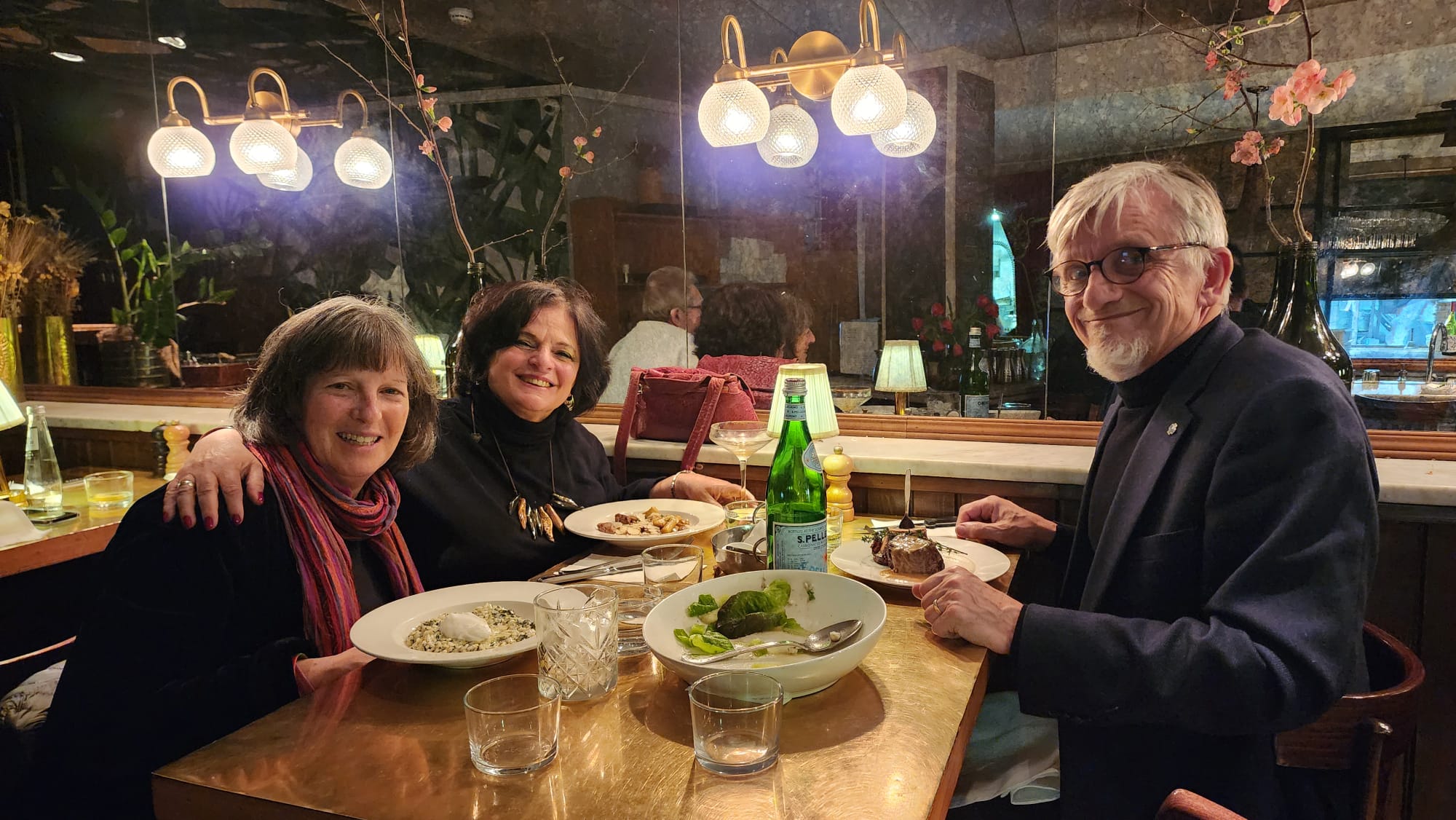
with Bili and Mats at dinner after the play
Now that my official tour has ended and I am not seeing evacuees in the hallways and lobby of my hotel, I could, in fact, go about my business here without knowing that a war is going on and that thousands upon thousands of Israelis have been evacuated from their homes. Until you ask the question–and then you hear that everyone knows someone who is serving in the army, who died, who is or was a hostage, who is injured, who had to leave their home. The connections are close.
In anticipation of a war with Lebanon and news that she heard about the infrastructure being disabled, Bili has started to think about stockpiling dry foods, bottles of water, propane heaters, transistors, batteries, etc. “And my elderly neighbors; I have to think about them, too,” she said. Yes, Israelis are tough –and kind and generous. The civil society, we were told again and again, is what ran this country since October 7 when the government was AWOL.
I saw it in action yesterday when I travelled to Tel Aviv to volunteer at the civilian operations center based at the Expo Center. (Here is an article about this amazing mobilization: https://www.timesofisrael.com/in-stunning-response-15000-volunteers-fill-leadership-vacuum-to-help-victims-of-hamas/). While they are about to close up the operation now, I still had lots of work to do there. And yesterday, I walked over 22,000 steps! In another small-world story of there being less than 6 degrees of separation in the Jewish world, Luisa, the woman who I was hooked up to for this volunteer opportunity, knows my town of North Adams, MA quite well–she used to be married to the son of one of my former congregants! (And I know her rabbi.) She is a Peruvian Jew-by-choice who lives in Rockland County, New York, but this is her third visit to Israel since October 7 to volunteer, and she and her husband plan to make aliyah now. She feels that Israel is her home and that she is safer in Israel as a Jew than she would be in the U.S.
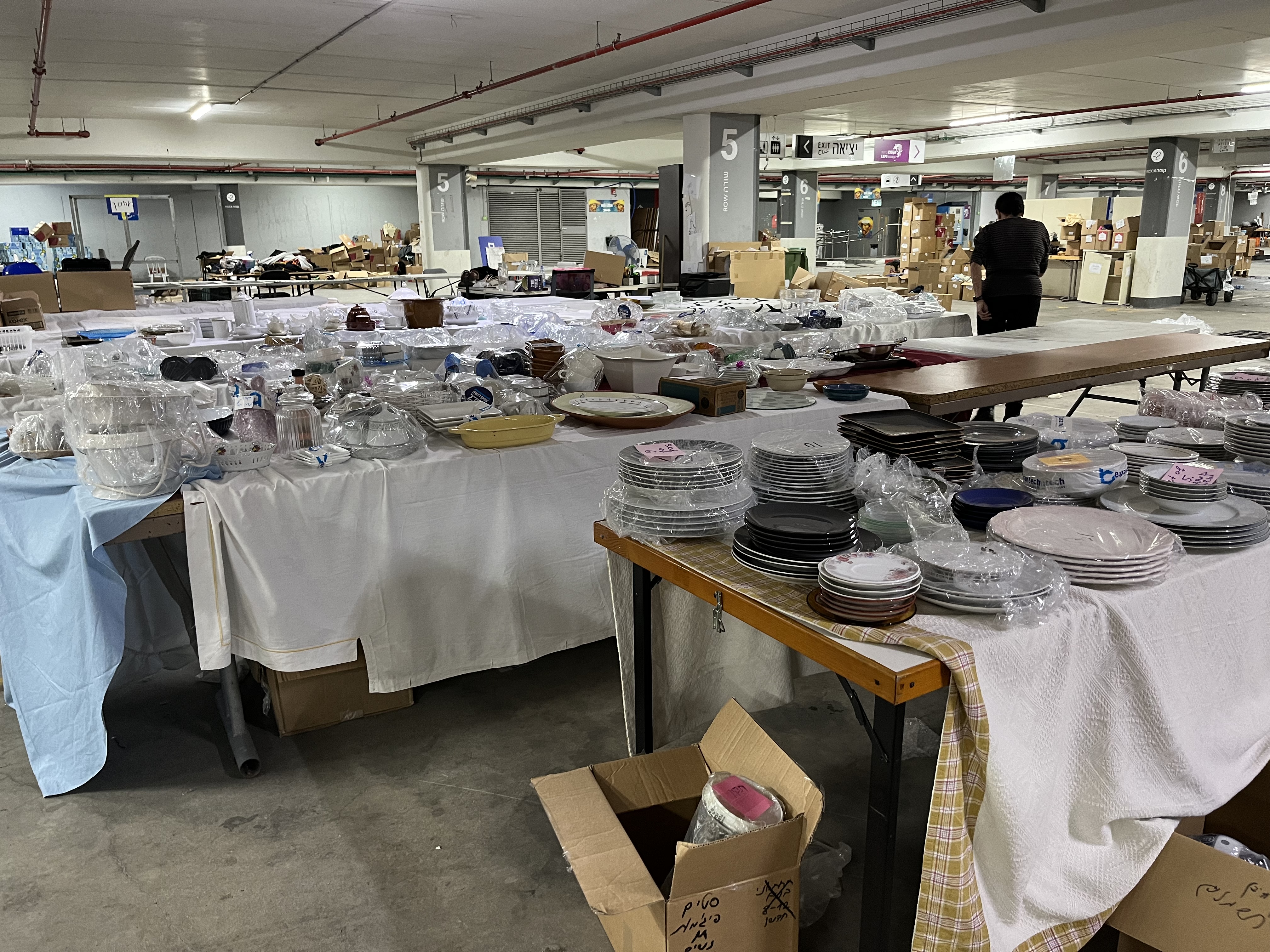
Just a small section of housewares at the Expo Center. Requests come in from displaced families or from soldiers, and then boxes were put together of housewares or clothing, etc.

My job was to sort and clean plastic chairs–many different colors and styles had been donated.

me and Luisa

One of the Brothers-in-Arms describing the operation
Tel Aviv was totally bustling and overwhelming for me. And yet, everywhere are pictures of the hostages, posters calling for their release. Walking down Dizengoff Street later in the day, every bench had a big teddy bear with blood.

this teddy bear has a sign with a picture of a hostage, now released
After arriving back to Jerusalem, I met with fellow Obie (Oberlin graduate), Josh Shuman who lives in the neighborhood. He had wanted to buy a copy of my first book when it was first published but the postage would have been exorbitant. I gave him both books and told him to make a tzedakah donation to a good cause.
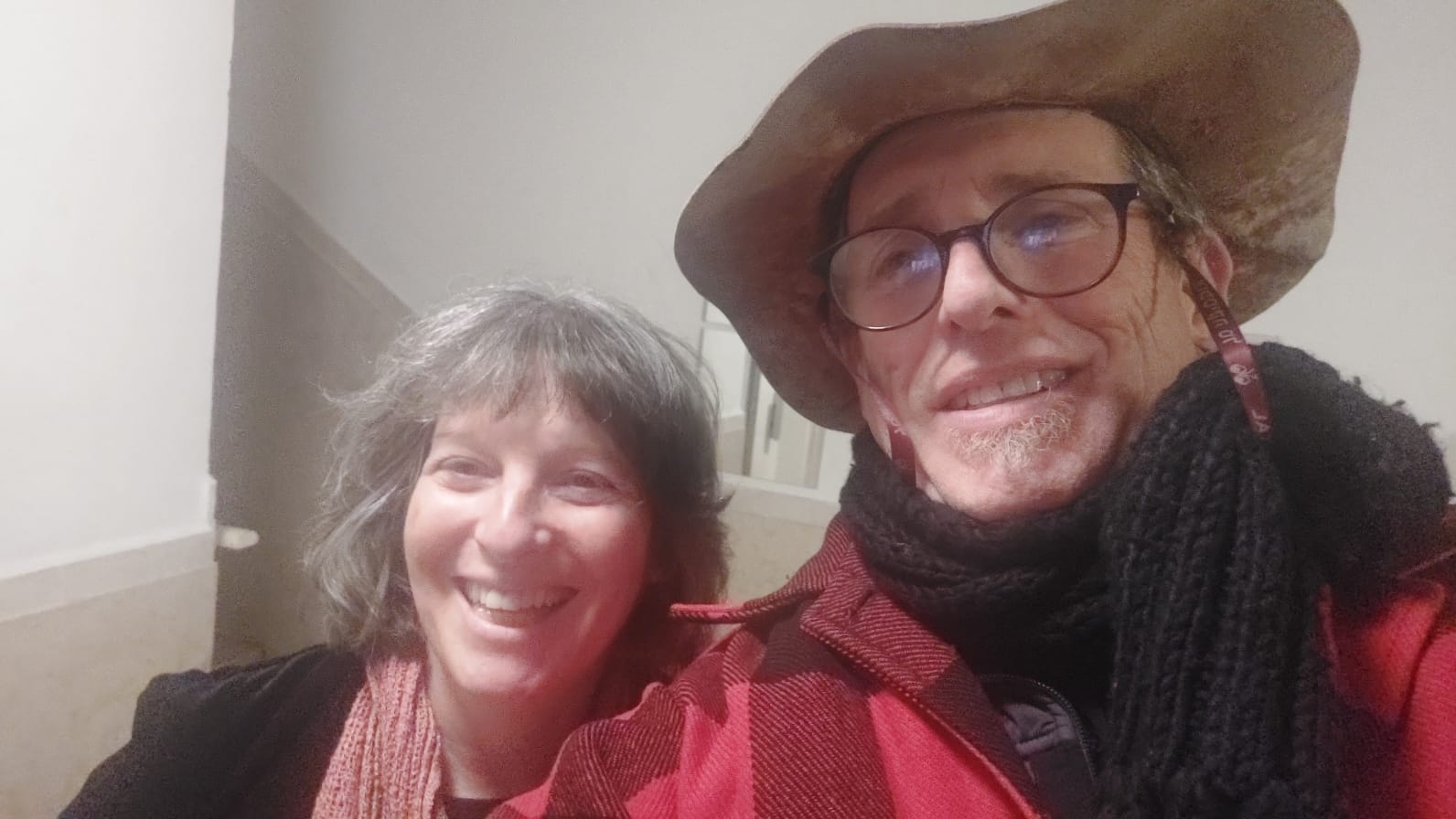
with Josh Shuman
 paminjerusalem